

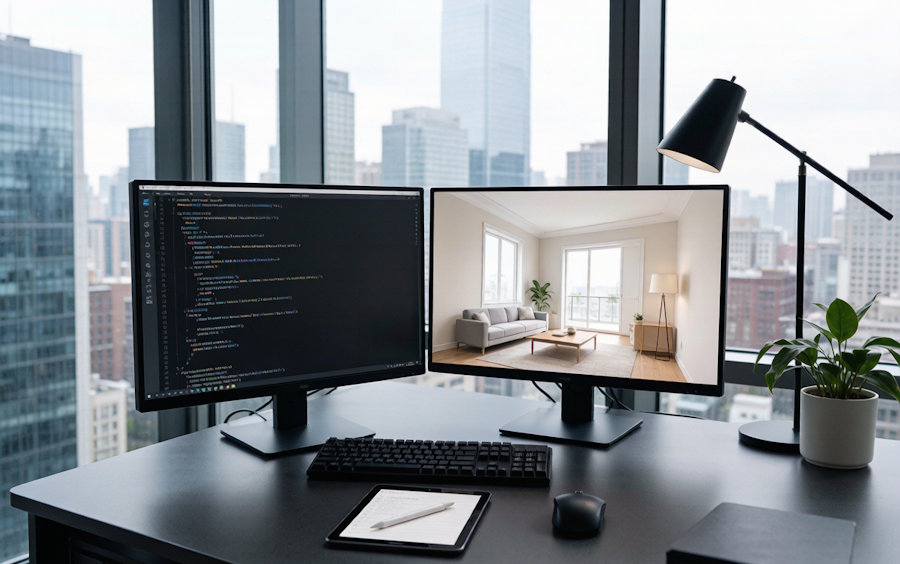
If you have been following the evolution of generative AI, you have watched diffusion models progress from producing surreal, five-fingered hands to generating images that are difficult to distinguish from professional photography. What is less widely discussed is how quickly this technology has been specialized for practical, domain-specific applications. One of the clearest examples is interior design, where AI models trained specifically on architecture and room layouts now power consumer-facing ai room design tools that rival what a professional designer would deliver — and they do it in seconds, directly in the browser.
For developers, this is an interesting case study in how general-purpose generative models get fine-tuned for vertical applications. The underlying architecture is familiar — diffusion models conditioned on text prompts — but the training data, the conditioning signals, and the evaluation criteria are all tailored to the specific domain of interior spaces. A general-purpose model asked to "redesign this room" will produce something visually plausible but spatially incoherent. A model fine-tuned on interior design datasets understands wall boundaries, window placement, furniture scale, and the relationship between a room's structural elements and its aesthetic styling. In practical terms, these tools let you upload a photo of an actual room, choose a style, and receive multiple photorealistic redesigns in seconds — under the hood, a combination of semantic segmentation and style-conditioned inpainting that respects the room's spatial constraints.
Why This Matters Beyond the Pretty Pictures
The significance of this technology extends well beyond novelty. Interior design has historically been a gatekept service: the tools were expensive, the learning curve was steep, and the professional expertise required to produce a usable design was a genuine barrier. By collapsing the cost of design visualization to essentially zero, AI is doing for home design what the early web did for publishing — removing the intermediary that controlled access to the output.
There is a legitimate debate to be had about whether this is unambiguously good. Professional designers bring judgment, taste, and project management skills that a diffusion model cannot replicate. But it is hard to argue with the efficiency gains. A designer who can generate a dozen concept directions in an hour — rather than laboring over hand-built mood boards — can serve more clients at higher quality. A homeowner who can visualize a dozen furniture arrangements before spending a dollar avoids the costly mistakes that come from committing to a layout sight unseen.
Technical Considerations for Developers
If you are evaluating these tools from an engineering perspective, there are a few architectural patterns worth understanding. The most important is the shift from generic text-to-image generation to structure-preserving image translation. In a generic pipeline, a text prompt drives the entire generation process, and the model has broad latitude over the output. In a room-redesign pipeline, the input image is treated as a strong structural prior — the model is constrained to preserve the room's geometry while restyling its contents. This is typically achieved through a combination of depth estimation, semantic segmentation masks, and ControlNet-style conditioning that locks down edges and layout while allowing the diffusion process freedom over materials, colors, and furniture.
Another notable pattern is the use of domain-specific fine-tuning datasets. The difference between a mediocre room redesign and a convincing one comes down to the quality and specificity of the training data — real interior photography, professionally annotated with room types, styles, and furniture layouts. This is the same lesson the LLM community learned with instruction-tuning: a well-curated, domain-focused dataset can produce dramatic quality gains even with a smaller model.
Latency and cost are also worth considering. These tools typically run on GPU infrastructure with optimized inference pipelines, delivering results in five to ten seconds. For a consumer application, that is the difference between a delightful experience and an abandoned one. If you are building something similar, budget accordingly — real-time diffusion is not free, and the economics of serving it at scale are still evolving. The good news is that inference costs continue to fall, which is part of why this category of application has become viable in the first place.
Practical Applications Worth Watching
Beyond the obvious consumer use case, the same underlying capability is being applied across a growing number of commercial workflows. Real estate platforms are using room-design models for virtual staging — taking a photo of an empty property and rendering it fully furnished, which helps prospective buyers form an emotional connection without the cost of physically staging a home. Property managers are using the same tools to refresh listings across entire portfolios, generating fresh, style-specific images for each unit rather than shooting them one by one. And interior designers are increasingly treating these tools as a rapid ideation layer, generating a dozen concept directions in the time it used to take to assemble a single mood board.
What is notable about all of these applications is that they share the same technical foundation. The differentiation now lives at the application layer — in the room-type taxonomy, the style conditioning, the multi-variant generation, and the user experience that wraps around the diffusion backbone. That is the pattern to internalize if you are watching this space as a developer: the hard problems are increasingly not "can a model generate a room" but "how do you build a product around a model that generates rooms." The teams that answer that question well will capture the value, while the underlying models themselves continue their steady march toward commoditization.
Building Blocks and Room-Specific Tools
The room design capability is just one piece of a broader ecosystem. A full AI home design platform typically bundles several specialized tools: room-by-room redesign for interiors, exterior facade generation, garden and landscape planning, and 2D-to-3D floor plan creation. Each of these is powered by its own specialized model or conditioning pipeline, which is why a platform can produce a coherent garden design and a coherent kitchen design from the same interface — the models are trained separately but orchestrated within a unified system.
From a product standpoint, the platform exposes a surprisingly rich surface area. Interiors are split across eight room types — living room, bedroom, kitchen, bathroom, dining room, office, basement, and attic — and the styling system supports more than twenty aesthetic directions, from the familiar (Scandinavian, Modern, Minimalist) to the more specialized (Japandi, Hollywood Regency, Cottage Core, Quiet Luxury). The generation flow accepts either an uploaded image or a free-text description as input, then lets users choose a style, a room type, and the number of output variations — up to four at once — before returning photorealistic renders. For a developer, this is a useful reminder that a production-ready AI product is as much about the orchestration layer as it is about the model itself: the style taxonomy, the room-type conditioning, and the multi-variant generation are all product decisions that sit on top of the diffusion backbone.
For developers thinking about building on top of these capabilities, the interesting question is where the APIs and integration points are. As the underlying models commoditize — which is happening quickly, following the same trajectory we saw with LLMs — the value will migrate to the application layer: the UX, the domain-specific workflows, and the integrations with adjacent systems like e-commerce, property listings, and contractor management. Anyone who has watched the LLM application layer consolidate knows the playbook. The same dynamics are now unfolding in vertical design AI.
Whether you are a developer evaluating these tools as a user, or someone considering building in the space, the takeaway is consistent: specialized generative models have crossed the threshold from impressive demo to practical utility. The interior design use case is one of the clearest examples of that transition, and it is worth watching as a template for how other creative industries — fashion, architecture, product design — will be transformed next.

