

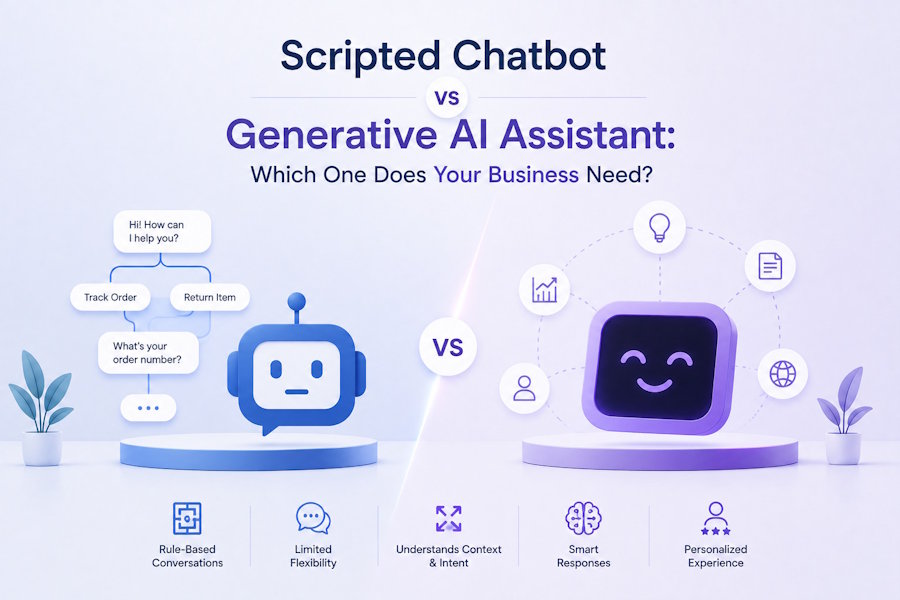
Conversational AI has advanced significantly in recent years, giving businesses more options to automate customer interactions and internal workflows.
While scripted chatbots have long been used to answer frequently asked questions and handle repetitive tasks, generative AI assistants can understand context, generate human-like responses, and complete more complex requests.
Choosing between the two is not simply about adopting the latest technology. It requires evaluating your business objectives, customer expectations, operational complexity, and long-term growth plans.
The right solution can improve efficiency and customer satisfaction, while the wrong choice may increase costs without delivering meaningful value.
In this blog, we'll compare scripted chatbots and generative AI assistants to help you determine which solution best fits your business.
Scripted Chatbot vs Generative AI Assistant: Understanding the Core Differences
Although both scripted chatbots and generative AI assistants automate conversations, they differ significantly in how they process information, respond to users, and handle business workflows. Understanding these differences is the first step toward selecting the right solution for your organization.
How Scripted Chatbots Work?
- Operate using predefined conversation flows, decision trees, and rule-based logic.
- Respond to specific keywords, commands, or user selections.
- Guide users through fixed conversation paths with predictable responses.
- Deliver consistent interactions for repetitive and structured queries.
- Commonly used for customer support, lead generation, appointment scheduling, and order tracking.
- Businesses often rely on AI chatbot development services to build customized scripted chatbots tailored to their operational requirements.
How Do Generative AI Assistants Work?
- Use large language models (LLMs) to understand natural language and user intent.
- Generate context-aware responses instead of relying on predefined scripts.
- Adapt conversations dynamically based on the user's questions and previous interactions.
- Handle complex queries, summarize information, and assist with multi-step tasks.
- Leverage enterprise knowledge bases and external data sources to deliver more relevant and intelligent responses.
- Support a wide range of business functions, including customer service, employee assistance, and workflow automation.
Key Differences That Impact Business Performance
| Comparison Factor | Scripted Chatbot | Generative AI Assistant |
|---|---|---|
| Conversation Style | Follows predefined rules and decision trees. | Understands natural language and generates context-aware responses. |
| Flexibility | Limited to programmed scenarios and fixed workflows. | Adapts to diverse user queries and changing conversation contexts. |
| Personalization | Provides standardized responses with minimal personalization. | Delivers personalized interactions based on user intent and conversation history. |
| Complex Query Handling | Best suited for repetitive and predictable questions. | Handles complex, multi-step queries and provides detailed explanations. |
| Learning Capability | Requires manual updates to add new responses or workflows. | Continuously improves through model updates, knowledge integration, and prompt optimization. |
| Implementation | Faster and simpler to deploy with lower technical complexity. | Requires AI models, enterprise integrations, governance, and ongoing optimization. |
| Best Use Cases | FAQs, appointment booking, order tracking, lead qualification, and basic customer support. | Customer service, employee assistance, knowledge management, business automation, and intelligent decision support. |
Comparing Both Solutions Across Business Needs
The best conversational AI solution depends on how your business interacts with customers and employees. Comparing both technologies across key operational areas provides a clearer understanding of where each delivers the greatest value.
A] Customer Support and User Experience
Scripted chatbots efficiently resolve repetitive customer queries such as business hours, appointment bookings, order status, and FAQs.
Generative AI assistants offer a more conversational experience by understanding intent, asking follow-up questions, and delivering personalized responses that closely resemble interactions with human support representatives.
B] Personalization and Context Awareness
Rule-based chatbots treat most conversations as isolated interactions and provide responses based on predefined rules.
Generative AI assistants retain conversational context, recognize user preferences, and deliver recommendations tailored to previous interactions, creating a more engaging and personalized customer experience.
C] Scalability and Business Flexibility
As businesses expand, scripted chatbots require continuous updates to accommodate new products, services, and conversation flows.
Generative AI assistants can adapt more easily by leveraging existing knowledge bases and enterprise data, allowing organizations to scale customer interactions without redesigning every conversation pathway.
D] Implementation Complexity, Maintenance, and Cost
Scripted chatbots are generally faster to deploy and easier to maintain because they rely on predefined workflows. Generative AI assistants require additional planning, model selection, prompt engineering, knowledge integration, and governance.
Businesses should also evaluate the overall AI chatbot development cost, as implementation expenses vary based on the solution's complexity, integrations, customization requirements, and long-term maintenance needs.
E] Data Security and Compliance
Both solutions must protect sensitive business and customer information. Scripted chatbots typically expose fewer security concerns due to their limited capabilities.
Generative AI assistants require stronger governance, access controls, encryption, and compliance measures because they process larger volumes of enterprise data and support more sophisticated business operations.
Factors to Consider Before Choosing the Right Solution
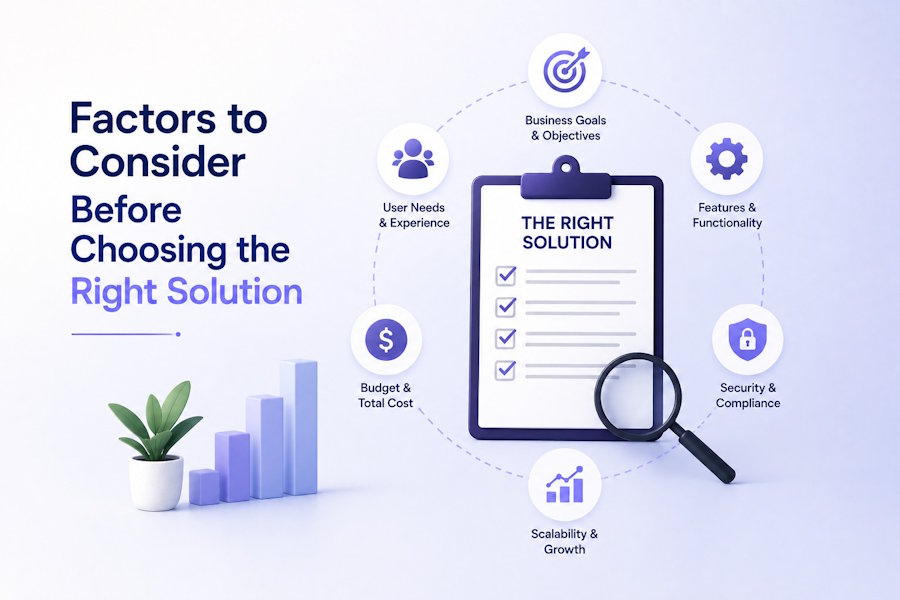
Choosing between a scripted chatbot and a generative AI assistant requires evaluating your business goals, budget, existing technology, and future growth plans. Considering these factors early helps you invest in a solution that delivers long-term value and aligns with your operational needs.
1. Define Your Business Objectives
Start by identifying what you want your conversational AI solution to achieve. If your goal is to automate repetitive tasks such as answering FAQs or scheduling appointments, a scripted chatbot may be sufficient.
For businesses looking to provide intelligent assistance, automate complex workflows, or support internal teams, a generative AI assistant offers greater flexibility.
2. Evaluate Your Budget and Long-Term Investment
Budget plays an important role in selecting the right solution. Scripted chatbots generally require a lower initial investment and faster deployment, while generative AI assistants involve additional expenses for AI models, integrations, infrastructure, and continuous optimization.
Comparing both the initial investment and long-term operational value helps businesses choose a solution that aligns with their goals and expected return on investment.
3. Assess Integration and Data Readiness
The effectiveness of any conversational AI solution depends on its ability to connect with existing business systems. Evaluate whether your CRM, ERP, knowledge base, or customer support platform can integrate seamlessly with the solution.
Businesses considering generative AI should also ensure their internal data is accurate, organized, and regularly updated to deliver reliable responses.
4. Prioritize Security and Future Scalability
Security, compliance, and scalability should remain central to your decision. Protecting customer information through encryption, access controls, and governance policies is essential, especially in regulated industries.
Additionally, choose a solution that can evolve alongside your business by supporting increased conversation volumes, expanding use cases, and future technology enhancements without requiring a complete system redesign.
Conclusion
There is no one-size-fits-all solution when it comes to conversational AI. Scripted chatbots are ideal for handling repetitive, rule-based interactions with speed and consistency, making them a practical choice for businesses with straightforward customer support needs.
Generative AI assistants, on the other hand, deliver greater flexibility by understanding context, managing complex conversations, and supporting intelligent business automation.
The right choice depends on your business objectives, customer expectations, operational complexity, and long-term growth strategy.
By carefully evaluating these factors, businesses can invest in a conversational AI solution that not only addresses current requirements but also scales alongside future demands, delivering lasting value and a better user experience.

