

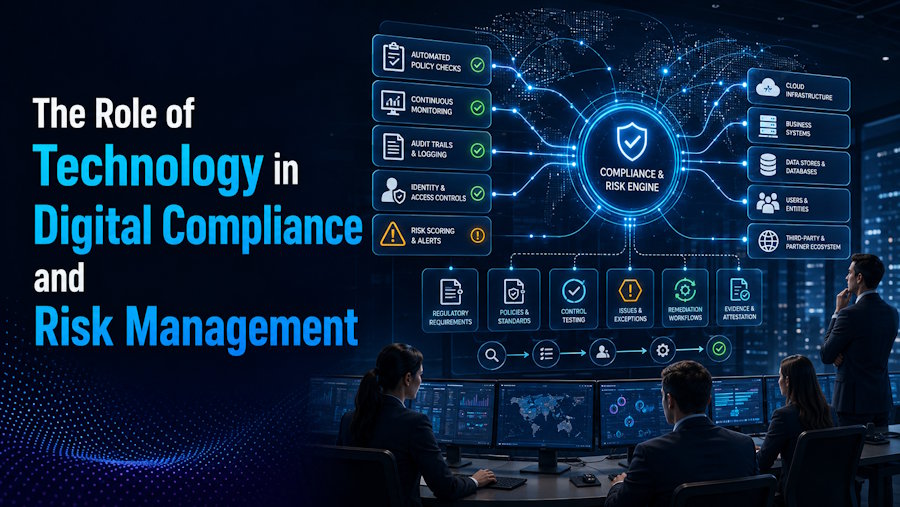
As software becomes increasingly important to everyday business operations, organizations are facing a growing responsibility to protect data, maintain secure systems, and comply with industry regulations. From cloud applications and APIs to customer databases and automated workflows, modern businesses depend on technology for almost every critical process.
This growing reliance on software also introduces new risks. Security vulnerabilities, unauthorized access, data leaks, and poorly managed systems can result in financial losses and reputational damage. For this reason, digital compliance and risk management have become important considerations for both developers and technology teams.
Rather than treating compliance as a separate administrative task, organizations can integrate compliance and risk management directly into their software development and infrastructure processes.
What Is Digital Compliance?
Digital compliance refers to the process of ensuring that software, systems, and digital operations follow applicable laws, regulations, industry standards, and internal policies.
The exact requirements depend on the type of organization and the information it handles. A company processing customer information, for example, may need strong controls around data collection, storage, access, and deletion.
For software developers, compliance can influence many technical decisions. These can include how authentication is implemented, how sensitive information is stored, how system activity is logged, and which users are allowed to access particular resources.
A compliant system should not simply meet requirements when it is launched. Compliance needs to be considered throughout the software lifecycle.
Why Risk Management Matters in Software Development
Risk management helps organizations identify potential problems before they become serious incidents.
In a software environment, risks can come from many different sources. Outdated dependencies may contain security vulnerabilities, incorrectly configured cloud resources can expose sensitive information, and weak authentication systems may allow unauthorized users to access accounts.
Developers can reduce these risks by introducing security and compliance checks throughout the development process.
For example, automated tools can scan dependencies for known vulnerabilities before an application is deployed. Code review processes can identify potentially dangerous implementation patterns, while automated testing can verify that important security controls continue to work after changes are made.
This approach is often more effective than waiting for a security problem to appear in production.
Building Compliance Into the Development Lifecycle
One of the most practical ways to improve digital compliance is to integrate it into the software development lifecycle.
During the planning stage, development teams can identify regulatory requirements and security considerations that may affect the project. This allows developers to design appropriate controls before writing significant amounts of code.
During development, teams can use secure coding practices, dependency scanning, secrets management, and automated testing. Code repositories should also be protected with appropriate access controls so that only authorized team members can make changes.
Testing provides another opportunity to identify weaknesses. Security testing can examine authentication, authorization, input validation, API endpoints, and other parts of an application that could introduce risk.
Finally, deployment should include appropriate monitoring and logging. These mechanisms help organizations identify unusual activity and investigate incidents when they occur.
The Importance of Access Control
Access control is one of the most important elements of a secure software environment.
Not every employee or application should have access to every resource. A well-designed system should provide users with only the permissions they need to perform their responsibilities.
This principle is commonly known as least privilege.
For example, a content editor may need permission to create and modify articles but should not necessarily have access to database administration tools. Similarly, an application service may require access to a specific database table without requiring unrestricted access to the entire infrastructure.
Role-based access control can help developers implement these restrictions in a structured way. Organizations can define roles and associate each role with specific permissions, making access easier to manage as the system grows.
Protecting Sensitive Information
Data protection is another major component of digital risk management.
Sensitive information should be protected both while it is being transmitted and while it is stored. Encryption can help prevent unauthorized parties from reading information if communication channels or storage systems are compromised.
Developers should also avoid storing sensitive credentials directly inside source code. API keys, passwords, and other secrets should be managed using appropriate secrets-management solutions and environment-specific configuration.
This is especially critical in tightly regulated sectors such as online gaming, where platform providers like Soft2Bet must align their technical infrastructure with iGaming regulatory standards while safeguarding player data and financial transactions.
Data minimization can provide another layer of protection. If an application does not actually need a particular piece of information, collecting it may create unnecessary risk.
Reducing the amount of sensitive data an organization stores can simplify compliance efforts and limit the potential impact of a security incident.
Monitoring and Logging
A secure application needs visibility into what is happening inside the system.
Logging can provide valuable information about authentication attempts, administrative actions, system errors, API requests, and other important events. When properly implemented, logs can help development and security teams investigate suspicious activity.
However, logging itself must be designed carefully. Applications should avoid placing passwords, authentication tokens, payment information, or other sensitive data into ordinary logs.
Monitoring systems can also generate alerts when unusual patterns are detected. For example, repeated failed login attempts or unexpected administrative activity may indicate that an account or application component requires investigation.
Automation Can Improve Compliance
Manual compliance processes can become difficult to maintain as organizations and applications grow.
Automation allows teams to perform repetitive security and compliance checks consistently. Continuous integration and continuous deployment pipelines can automatically test code, scan dependencies, validate configurations, and check for certain security issues before software reaches production.
Infrastructure-as-code can provide similar benefits for infrastructure management. Instead of configuring every server manually, teams can define infrastructure through version-controlled configuration files.
This makes changes easier to review and reproduce while reducing the likelihood of configuration differences between environments.
Preparing for Changing Requirements
Technology and regulatory requirements continue to evolve. A system that meets today's requirements may need additional controls in the future.
Organizations should therefore avoid designing compliance processes around a single audit or one-time project. Instead, teams should regularly review their applications, infrastructure, access permissions, dependencies, and security policies.
Developers can support this process by creating flexible systems that make security controls easier to update. Clear documentation is also valuable because it allows future team members to understand why particular technical decisions were made.
Conclusion
Digital compliance and risk management are increasingly connected to software development. Security, privacy, access control, monitoring, and data protection are no longer concerns that can be addressed only after an application has been completed.
By integrating compliance requirements into the development lifecycle, organizations can identify risks earlier and build more reliable systems. Automated testing, secure development practices, least-privilege access, encryption, monitoring, and careful data management can all contribute to a stronger technology environment.
Ultimately, effective compliance is not simply about satisfying regulatory requirements. It is about creating software and infrastructure that can protect information, reduce operational risk, and remain trustworthy as technology and business requirements continue to change.

