

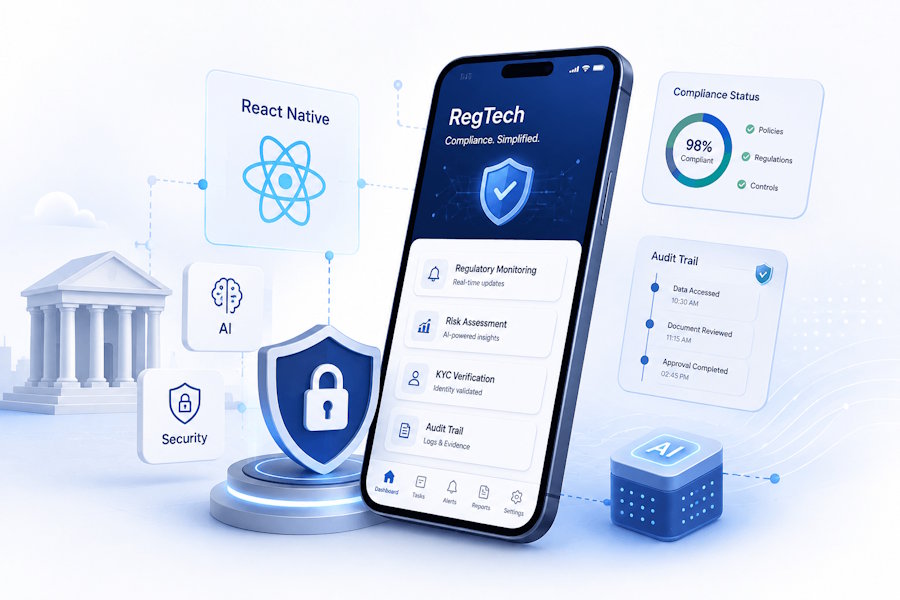
Regulatory requirements are becoming more complex, making compliance harder to manage across growing volumes of data and changing rules. RegTech software development helps businesses automate compliance workflows, monitor risks, and process regulatory information more efficiently.
React Native offers a practical foundation for cross-platform RegTech applications, while AI can support regulatory analysis, risk detection, and intelligent compliance workflows. Together, they can help build secure, accessible applications without adding unnecessary development complexity.
Why React Native Fits RegTech Applications
RegTech applications need to work reliably across mobile platforms while connecting with secure APIs, regulatory systems, and backend services. A React Native mobile app development company can build iOS and Android applications from a shared codebase while retaining access to native capabilities. This makes React Native a practical foundation for compliance-focused mobile products.
- Cross-Platform Development: Build core application functionality for iOS and Android from a shared codebase, reducing duplicated development effort.
- Secure API Integration: Connect applications with compliance platforms, financial systems, regulatory databases, and backend services through secure APIs.
- Real-Time Notifications: Deliver compliance alerts, risk notifications, regulatory updates, and workflow reminders directly to users' mobile devices.
- Native Device Capabilities: Access biometrics, secure storage, cameras, and other native capabilities when compliance workflows require them.
- Consistent User Experience: Maintain consistent application behavior across iOS and Android while supporting platform-specific requirements.
- Simplified Maintenance: A shared codebase can make updates, bug fixes, and feature improvements easier to manage as regulatory requirements evolve.
These capabilities allow RegTech products to reduce development complexity while maintaining the flexibility required for enterprise integrations. React Native can also incorporate native modules when specialized security, performance, or device-level functionality is needed.
Where AI Adds Value to RegTech
AI can make RegTech applications more proactive by turning large volumes of regulatory and compliance data into actionable information. With artificial intelligence integration services, organizations can incorporate intelligent capabilities into existing compliance workflows rather than relying entirely on manual analysis.
1) Regulatory Document Analysis
Regulatory teams often work with lengthy policies, guidelines, and regulatory documents. AI can analyze this information, extract relevant requirements, summarize key changes, and help teams locate information faster.
2) Risk and Anomaly Detection
AI models can analyze patterns across transactions, user activity, and compliance records to identify unusual behavior. These signals can help compliance teams prioritize potential risks for further investigation.
3) Regulatory Change Monitoring
Regulations change frequently across jurisdictions and industries. AI can help compare new regulatory information with existing requirements and highlight changes that may require updates to policies, workflows, or application logic.
4) Intelligent Compliance Alerts
Instead of generating notifications for every event, AI can help add context to compliance alerts by considering the underlying data and identifying potentially significant events. This can reduce unnecessary alerts and help teams focus on higher-priority issues.
5) Natural-Language Regulatory Search
AI-powered search allows users to interact with regulatory information using natural-language questions. Instead of manually navigating large collections of documents, compliance professionals can quickly retrieve relevant information and supporting context.
6) Automated Reporting Support
AI can assist with organizing compliance data, generating summaries, and preparing preliminary reports for review. Human validation remains important, particularly when reports influence regulatory decisions or require formal submission.
The strongest RegTech implementations treat AI as an intelligence layer within a broader compliance architecture. Its effectiveness depends not only on the model but also on data quality, secure integration, auditability, and appropriate human oversight.
Key Engineering Challenges of AI-Powered RegTech Apps
Combining React Native with AI introduces engineering considerations that go beyond standard mobile application development. RegTech applications often process sensitive financial and regulatory information, making security, reliability, auditability, and performance essential from the architecture stage.
Protecting Sensitive Regulatory Data
RegTech applications may handle financial records, customer information, transaction data, and confidential regulatory documents. Sensitive information should be protected through encryption in transit and at rest, secure authentication, role-based access controls, and carefully designed API permissions.
Developers should also minimize unnecessary data exposure when information moves between the React Native application, backend services, databases, and AI processing layer.
Integrating AI Without Compromising Security
AI integration creates another security boundary within the application architecture. Sensitive compliance data should not be sent to AI services without appropriate controls around data handling, access, retention, and processing.
A dedicated backend or AI integration layer can help control what information reaches the model while keeping credentials, business logic, and security policies away from the mobile application.
Making AI Outputs Reliable and Auditable
AI-generated recommendations can support compliance teams, but they should not automatically be treated as authoritative decisions. RegTech applications need mechanisms for validation, source attribution, logging, and human review where appropriate.
Maintaining audit trails for prompts, relevant data, model outputs, and subsequent actions can also help organizations understand how an AI-assisted compliance result was produced.
Maintaining Cross-Platform Performance
AI-powered features can introduce additional network requests, data processing, and response latency. React Native applications therefore need efficient API communication, appropriate caching, background processing, and careful management of resource-intensive operations. Platform-specific optimization may also be required when applications depend on biometrics, secure device storage, notifications, or other native capabilities.
Addressing these challenges early helps prevent security and performance limitations from becoming architectural constraints later. For AI-powered RegTech products, the mobile interface, backend, AI layer, and compliance data infrastructure should be designed as interconnected components rather than isolated features.
Architecture for a React Native RegTech Application
A practical architecture separates the mobile experience from compliance logic, sensitive data, and AI processing. This reduces unnecessary exposure of sensitive information and makes individual components easier to secure, monitor, and scale.
React Native App
↓
API Gateway & Authentication
↓
RegTech Backend & Business Logic
↓
Regulatory Data + Compliance Systems
↓
AI Processing & Intelligence Layer
↓
Database, Audit Logs & Monitoring
The React Native app handles the user experience, including compliance dashboards, alerts, document access, and workflow actions. The API layer manages authentication and secure communication with backend services, while the RegTech backend applies business rules and connects with internal or third-party compliance systems.
The AI layer can process approved regulatory and business data for tasks such as document analysis, risk detection, classification, and regulatory search. Audit logging and monitoring should operate across the architecture to record important activities, track AI-assisted actions, and support investigation when required.
This separation allows teams to replace or upgrade individual components without redesigning the entire application. It also creates a stronger foundation for scaling AI capabilities and adapting the RegTech platform as regulatory requirements evolve.
When to Hire Dedicated React Native Developers for RegTech
Building a RegTech application becomes more complex when it combines mobile development, sensitive compliance workflows, third-party integrations, and AI capabilities.
When these requirements demand specialized expertise and ongoing development, businesses can hire a dedicated React Native developer to build and maintain the mobile application.
Consider dedicated React Native expertise when:
- Complex integrations are required: The application needs connections with regulatory APIs, financial systems, identity providers, analytics platforms, or AI services.
- Security is a core requirement: Compliance applications often require secure authentication, encrypted communication, role-based access, and careful handling of sensitive information.
- Native functionality is needed: Features such as biometrics, secure device storage, push notifications, or platform-specific security controls may require React Native and native development expertise.
- AI features are part of the roadmap: Developers need to connect mobile interfaces with backend AI services while managing latency, permissions, and error handling.
- The product requires continuous development: Changing regulations, new compliance workflows, security updates, and mobile platform releases can require ongoing engineering support.
Dedicated React Native expertise becomes particularly valuable when the mobile application is one component of a broader RegTech ecosystem. Developers need to work closely with backend, AI, security, and compliance teams to ensure mobile functionality remains aligned with the overall architecture.
Building RegTech for Long-Term Compliance
Regulatory requirements will continue to evolve, making flexibility an important consideration for modern compliance applications. Effective RegTech software development should account for changing regulations, security requirements, new data sources, and emerging technologies without requiring major architectural changes.
This is where RegTech solutions need to move beyond solving today's compliance requirements. They should provide enough flexibility to incorporate new regulations, expand into additional compliance workflows, and adopt emerging technologies without creating unnecessary technical debt. React Native and AI can support this flexibility when they are implemented within a well-structured, secure, and maintainable architecture.

