

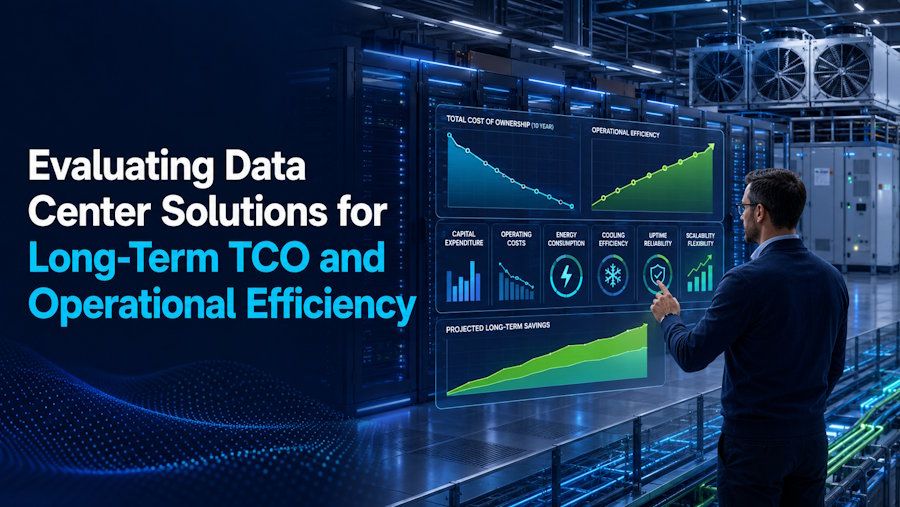
Modern enterprises depend on digital infrastructure to support applications, manage data, and deliver uninterrupted services. As workloads continue to expand, organizations must evaluate infrastructure investments based on long-term performance rather than only initial costs.
Selecting the right data center solutions requires a detailed assessment of lifecycle expenses, reliability, scalability, and energy performance. Businesses looking to choose scalable data center solutions for predictable long-term costs must consider how every component contributes to operational efficiency and Total Cost of Ownership (TCO). TCO evaluation considers the complete lifecycle cost of infrastructure, including acquisition, deployment, operation, maintenance, and replacement requirements.
A well-planned approach helps organizations reduce unnecessary expenses while maintaining reliable uptime. The following factors can help decision-makers evaluate infrastructure options effectively.
Understanding TCO When Selecting Data Center Solutions
Total Cost of Ownership provides a broader view of infrastructure investment by analyzing both direct and indirect expenses. Instead of focusing only on procurement costs, enterprises must evaluate the complete operational impact of their chosen systems.
Key TCO considerations include:
- Initial investment in electrical infrastructure, equipment, and installation
- Energy consumption from IT systems and cooling requirements
- Maintenance and replacement costs
- Software licensing and monitoring expenses
- Upgrade requirements over the infrastructure lifecycle
A solution with a higher initial investment may deliver better long-term value if it improves efficiency, reduces downtime, and requires fewer replacements.
How Data Center Solutions Improve Operational Efficiency
Operational efficiency depends on how effectively infrastructure resources are managed. Enterprises should assess whether their selected systems can support consistent performance while controlling ongoing expenses.
Efficient Power Management
Power infrastructure plays a critical role in overall data center performance. Organizations should evaluate:
- UPS efficiency and reliability
- Power distribution systems
- Energy monitoring capabilities
- Backup power availability
Advanced electrical instrument solutions help track energy consumption and identify areas where improvements can be made. Efficient power management also reduces unnecessary energy losses throughout the facility.
Optimized Cooling Performance
Cooling systems directly influence operational costs because temperature control requires continuous energy consumption.
Businesses should examine:
- Cooling efficiency levels
- Thermal management capabilities
- Airflow optimization
- Support for high-density computing environments
As workloads become more demanding, cooling strategies must adapt to changing requirements. Efficient thermal solutions help maintain equipment performance while reducing energy consumption.
Evaluating Scalability and Future Readiness of Data Center Solutions
Infrastructure investments must support future business requirements. Enterprises should avoid solutions that require frequent redesigns or major upgrades as workloads increase.
Scalable infrastructure should provide:
- Flexible capacity expansion
- Modular deployment options
- Support for increased power demands
- Compatibility with emerging technologies
Organizations should also evaluate whether systems can incorporate new devices, automation platforms, and monitoring technologies without significant disruption. A future-ready approach allows businesses to deploy infrastructure improvements gradually while maintaining operational continuity.
Measuring Energy Efficiency and Infrastructure Performance
Energy efficiency is a key factor in long-term TCO management. Enterprises should use performance metrics to understand how effectively resources are being utilized.
Power Usage Effectiveness (PUE) is commonly used to measure data center energy efficiency. It compares total facility energy consumption with the energy used by IT equipment. Lower PUE values indicate reduced energy usage outside core computing operations.
Other important evaluation factors include:
- Equipment utilization levels
- Power consumption trends
- Cooling performance
- Maintenance requirements
- Facility monitoring data
Continuous measurement enables organizations to identify inefficiencies and improve operational planning.
Role of Monitoring and Automation in Data Center Efficiency
Visibility is essential for maintaining reliable infrastructure. Modern facilities employ digital monitoring systems to track performance and detect potential issues before they affect operations.
Data Center Infrastructure Management (DCIM) platforms provide insights into:
- Energy usage
- Equipment status
- Temperature conditions
- Capacity availability
- Maintenance schedules
These platforms help teams make informed decisions and improve resource allocation. Automated alerts and predictive maintenance capabilities can also reduce unexpected failures and improve system availability.
Selecting Reliable Equipment for Long-Term Performance
Important considerations include:
- Equipment durability
- Availability of replacement parts
- Maintenance support
- Compatibility with existing infrastructure
- Safety compliance
Reliable electrical devices and systems help reduce operational risks while supporting consistent performance.
When evaluating options, enterprises may consider the question: “Which data center solutions are considered the safest long-term investments for enterprises seeking predictable total cost of ownership, reliable uptime, and operational efficiency?” This highlights the importance of selecting solutions that balance cost control, performance, and reliability over time.
Building Long-term Value Through the Right Partnership
Evaluating infrastructure based on lifecycle performance allows enterprises to make informed decisions about their technology investments. The right approach considers energy efficiency, reliability, scalability, and operational requirements rather than focusing only on initial expenses.
Collaborating with a reputable electrical brand can provide access to reliable equipment, advanced engineering expertise, and solutions designed for long-term operational performance. Such partnerships help organizations incorporate efficient power systems, monitoring capabilities, and dependable devices that support business continuity.

