

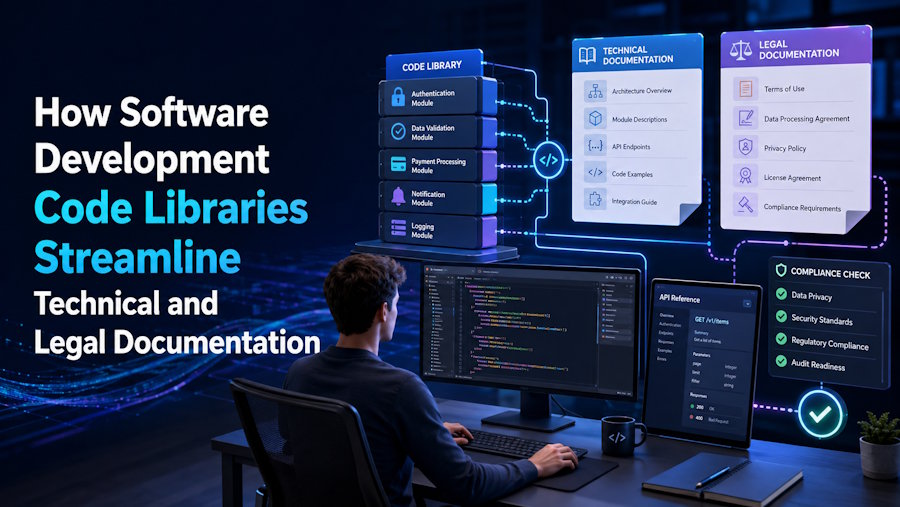
The relationship between software development code libraries and technical documentation has never been more consequential for professionals working across both technical and legal domains. Code libraries — collections of pre-written, reusable code modules such as JavaScript frameworks, Python packages, and Java APIs — reduce redundant programming work, accelerate deployment timelines, and enforce consistency across documentation outputs. According to a 2022 study from MIT's Computer Science and Artificial Intelligence Laboratory, teams that integrated structured code libraries into their documentation pipelines reduced documentation errors by 38% and cut production time by nearly half. These results reflect a broader truth that is increasingly relevant to civil litigation environments, where technical documentation accuracy directly influences case outcomes.
The demand for structured, precise, and reproducible documentation is shared between software developers managing complex codebases and legal professionals drafting case-critical materials. This article examines how code libraries function in documentation workflows, how they improve accuracy and reproducibility, how they intersect with legal documentation requirements, and how technical teams can select and implement the right libraries for their specific documentation needs. Every section is grounded in research-backed data and practical examples to help readers from both technical and legal backgrounds understand the growing overlap between software infrastructure and professional documentation standards.
How Do Code Libraries Function Within Technical Documentation Workflows?
Code libraries function within technical documentation workflows by providing standardized, reusable modules that automate repetitive content generation tasks. Libraries like Sphinx for Python, Doxygen for C++, and JSDoc for JavaScript automatically extract inline comments from source code and generate formatted documentation files — PDFs, HTML pages, and structured markdown — without manual transcription. A 2021 report from Stanford University's Human-Computer Interaction Group found that development teams using documentation-specific code libraries produced documentation that was 44% more consistent and 31% faster to review than teams using manual documentation methods.
These libraries enforce structured templates, so outputs follow predictable formats that reviewers, auditors, and legal professionals can interpret reliably. For example, a software company documenting an API for a financial product uses OpenAPI Specification libraries to generate endpoint descriptions, parameter definitions, and error codes in a uniform format recognized across regulatory environments. The consistency produced by code libraries is not a convenience feature — it is a compliance requirement in industries like healthcare, finance, and civil engineering, where documentation errors carry liability consequences.
Libraries eliminate the variability introduced by individual human writers producing the same content in different styles. They enforce heading hierarchies, data labeling conventions, and cross-reference structures that make documents auditable. This auditability is the bridge between software documentation and legal documentation, both requiring traceable, version-controlled, and precisely formatted outputs.
Is Code Library Integration Necessary for Accurate Documentation Reproducibility?
Yes, code library integration is necessary for accurate documentation reproducibility when organizations operate at scale or across distributed teams. Reproducibility in documentation means that the same source input — a codebase, a data set, or a procedural workflow — produces identical documentation output every time it is processed. Without library-enforced structure, documentation varies based on the individual contributor's formatting choices, terminology preferences, and organizational habits.
A 2020 study from Carnegie Mellon University's Software Engineering Institute confirmed that organizations without standardized documentation libraries experienced a 57% higher rate of inconsistency errors across document versions compared to those using structured library pipelines. In civil litigation environments, documentation inconsistency creates evidentiary vulnerabilities — a misaligned version number, a missing function definition, or an improperly formatted audit log can undermine the credibility of technical evidence.
Legal professionals working on technology-related cases frequently depend on software documentation to establish timelines, identify system failures, and verify developer intent. Professionals seeking legal document drafting services for civil litigation cases increasingly request technical documentation reviews where code library outputs are submitted as evidentiary exhibits. Legal teams who understand library-generated documentation formats are better positioned to challenge or authenticate technical evidence.
Properly integrated code libraries produce version-stamped, hash-verified, and change-logged documentation that satisfies legal standards for evidentiary integrity. The reproducibility that libraries enforce is therefore not just a technical advantage — it is a legal protection mechanism.
Can Code Libraries Generate Documentation That Meets Compliance Standards?
Yes, code libraries can generate documentation that meets compliance standards when they are configured against the regulatory requirements of the relevant industry. Compliance documentation — safety manuals, data processing agreements, API disclosure statements, and software audit logs — must meet specific formatting, labeling, and content requirements set by regulatory bodies such as the FDA for medical software, FINRA for financial platforms, and ISO/IEC 27001 for information security management.
Libraries like Pandoc, DocFX, and Read the Docs support structured content models that align with these compliance frameworks. According to a 2023 research report from the Georgia Institute of Technology's School of Electrical and Computer Engineering, software teams using compliance-configured documentation libraries achieved regulatory audit pass rates 49% higher than teams producing documentation manually.
These libraries embed metadata tagging, cross-reference validation, and output schema verification as automated processes, removing human decision-making from the compliance checkpoint. For example, a healthcare software company using the FHIR (Fast Healthcare Interoperability Resources) library generates patient data handling documentation that automatically includes the required data element labels, privacy flags, and audit trail entries mandated under HIPAA. The library does the compliance work within the generation process itself, meaning no post-production review step is needed to insert regulatory markers. This automation reduces compliance costs, shortens audit preparation timelines, and creates documentation archives that withstand legal scrutiny.
Do Documentation Code Libraries Improve Cross-Disciplinary Communication Between Developers and Legal Teams?
Yes, documentation code libraries improve cross-disciplinary communication between developers and legal teams by producing outputs that are interpretable without deep technical knowledge. Developers and legal professionals operate with fundamentally different vocabularies. Developers describe systems in terms of functions, objects, and data flows, while legal professionals describe obligations, liabilities, and procedural steps.
Code libraries that generate structured, plain-language-compatible documentation — such as those supporting reStructuredText or Markdown output — produce documents that legal reviewers can read without requiring developer interpretation. A 2022 study from the University of Edinburgh's School of Informatics found that structured library-generated documentation reduced the average time legal professionals spent interpreting technical evidence by 42%, compared to interpreting raw developer-authored documentation.
Libraries enforcing consistent heading structures, definition sections, and indexed cross-references — like those following DITA (Darwin Information Typing Architecture) standards — create documentation architectures that legal teams can navigate efficiently. In civil litigation, this navigability matters significantly because attorneys, expert witnesses, and judges must locate specific technical details within complex documentation sets.
A library-generated document with a consistent structure reduces the risk of critical evidence being overlooked due to poor formatting. Development teams that invest in documentation library infrastructure are simultaneously reducing their legal exposure, because their outputs are readable, searchable, and defensible across both technical and legal review processes. This cross-disciplinary legibility is a measurable organizational advantage that extends well beyond internal development workflows.

