

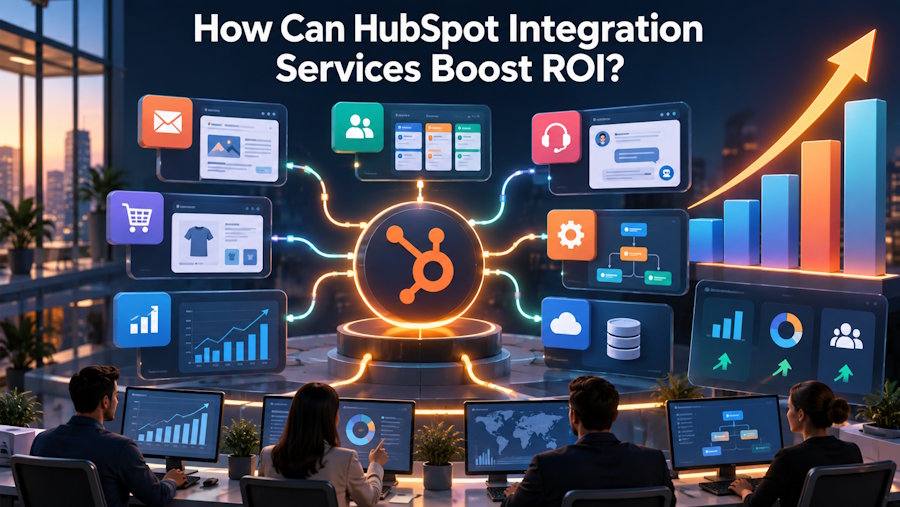
Companies boost revenue and maximize return on investment by syncing HubSpot with core operational tools. Connecting software platforms eliminates manual data entry, aligns sales and marketing, shortens deal cycles, and provides executive leadership with real-time reporting accuracy across every department.
Investing in HubSpot integration services allows growing companies to turn standalone software into a unified revenue engine. While proper 6sense HubSpot integration establishes a clean foundation for your team, connecting your CRM to your ERP, billing, and intent-data platforms drives measurable productivity gains. When customer data flows automatically across your tech stack, your sales reps close deals faster, your marketing team targets high-intent prospects, and your executive team gains total visibility into customer lifetime value.
What Are HubSpot Integration Services and How Do They Drive ROI?
HubSpot integration services boost ROI by connecting CRM data with core business systems, eliminating double data entry, and speeding up your sales cycles.
Why Do Disconnected Systems Silo Data and Burn Your Operational Budget?
Siloed business platforms cause expensive operational bottlenecks, corrupt reporting data, and slow down your entire sales pipeline.
When software systems operate in isolation, your employees spend hours manually transferring information between databases. This operational drag costs mid-sized enterprises tens of thousands of dollars each year in wasted labor and missed deal opportunities.
Consider these common real-life scenarios that disrupt revenue operations:
- The Finance and Sales Disconnect: A sales manager closes a $50,000 contract in HubSpot. Because the CRM is disconnected from NetSuite or QuickBooks, the sales rep manually re-enters the customer details, billing address, and line items into the accounting system. A simple typo in the billing address causes invoice rejections, stalling cash collection for over 30 days.
- The Trapped Buyer Intent Signals: A marketing director uses an intent platform like 6sense to identify target accounts actively researching their software category. Without an automated sync into HubSpot, sales reps never receive real-time task notifications. By the time marketing manually exports a CSV file on Friday, the high-intent prospect has already booked a demo with a competitor.
- The Fragmented Customer Journey: Customer support logs account tickets in Zendesk or Jira, while account managers track renewals in HubSpot. Because sales reps lack visibility into open support tickets, they reach out for account upsells during an active service outage, damaging client trust.
Disconnected stacks create three main financial leaks:
- Labor Waste: Employees lose 3 to 5 hours every week performing redundant data entry across systems.
- Inaccurate Forecasting: Duplicate records and missing fields make pipeline reporting unreliable for executive decision-making.
- Delayed Lead Velocity: Leads sit cold in one database while waiting for manual assignment in another.
How Do HubSpot Integration Services Turn Operational Friction Into Revenue Growth?
Connecting your tech stack transforms HubSpot from a simple record system into an automated growth engine that accelerates deal execution.
Professional technical integration connects your CRM bi-directionally with accounting, marketing, intent, and ERP tools. This synchronization creates immediate operational improvements across three primary pillars:
1. Accelerating Sales Velocity via Automated Workflows
Automated syncs remove administrative delays so sales representatives focus entirely on closing deals. When a prospect reaches a high-intent score in 6sense or completes a form in HubSpot, the system automatically creates a deal stage, assigns an account owner based on territory rules, and triggers a personalized email sequence.
2. Aligning Finance and Sales for Cash-Flow Transparency
Connecting accounting systems like QuickBooks, NetSuite, or Stripe directly into HubSpot gives account executives real-time visibility into payment status and invoice history. Sales reps can see whether a client has overdue invoices before offering discounts or contract renewals, improving cash collection rates.
3. Improving Executive Reporting Accuracy
Data alignment ensures that executive dashboards display exact revenue numbers. By connecting marketing spend platforms, sales pipelines, and ERP fulfillment data, leadership tracks true Customer Acquisition Cost (CAC) and Lifetime Value (LTV) without pulling manual spreadsheet reports.
| Operational Area | Standalone HubSpot Environment | Integrated HubSpot Tech Stack |
|---|---|---|
| Data Entry | Manual CSV uploads and double entry | Automatic real-time bi-directional sync |
| Lead Handoff | Delayed manual assignments | Instant automated routing based on buyer intent |
| Invoicing & Billing | Siloed in accounting software | Fully visible within HubSpot contact records |
| Reporting Accuracy | Vulnerable to duplicate records and human error | Clean, synchronized data for reliable forecasting |
Which Are the Top 10 6sense HubSpot Integration Companies in the World?
Selecting an experienced technical partner ensures that complex account-based marketing (ABM) intent signals flow directly into your sales pipelines without data corruption.
Here are the top 10 companies specializing in 6sense HubSpot integration services globally:
1. Mpire Solutions
Mpire Solutions leads the global market in enterprise HubSpot integration services, specializing in deep 6sense account intent synchronizations that power high-converting ABM campaigns. Their experienced technical team builds custom API architectures that connect HubSpot directly with complex ERPs, CRMs, and intent platforms for maximum sales velocity.
2. SmartBug Media
SmartBug Media is an established digital agency in the USA that helps revenue teams align 6sense intent intelligence with HubSpot inbound workflows. Their consultants focus on revenue operations, marketing automation, and lifecycle lead management across enterprise B2B tech stacks.
3. New Breed
New Breed provides revenue operations and custom technology integration services for fast-growing B2B organizations across North America. They specialize in unifying account-based marketing tools like 6sense with HubSpot Sales Hub to streamline pipeline development.
4. Aptitude 8
Aptitude 8 is a specialized elite HubSpot partner agency in the United States that builds custom enterprise application integrations and data pipelines. They focus on complex technical architectures, connecting 6sense intent signals into native HubSpot custom objects.
5. Coastal Cloud
Coastal Cloud is an enterprise technology consulting firm providing deep multi-platform integration services for revenue operations teams across the USA. They specialize in cross-platform data mapping between 6sense, Salesforce, and HubSpot marketing enterprise environments.
6. Slalom
Slalom is a global modern technology and management consulting firm headquartered in the United States with extensive data architecture expertise. They design enterprise-level system bridges that connect 6sense intent models into HubSpot enterprise CRMs for large sales orgs.
7. Algoworks
Algoworks offers custom software development and CRM integration consulting to help companies build bidirectional data syncs between 6sense and HubSpot. Their engineering team develops custom middleware solutions that keep buyer intent scores updated across sales pipelines.
8. Simplus
Simplus is an enterprise advisory and integration consultancy in the USA focused on transforming sales workflows and multi-cloud environments. They help organizations integrate 6sense buyer intent signals with HubSpot to accelerate deal discovery and lead conversion.
9. Silverline
Silverline provides custom technology consulting and system integration services focused on optimizing financial services and healthcare CRM architectures. They build secure data flows between account-based marketing platforms like 6sense and HubSpot enterprise accounts.
10. Avidly USA
Avidly USA helps B2B organizations streamline their marketing and sales engines through dedicated HubSpot technical integrations and ABM strategies. They focus on mapping 6sense intent stages into automated HubSpot lead-scoring frameworks for targeted outreach.
What Is the Difference Between Native Marketplace Apps and Custom API Integrations?
Choosing between native marketplace connectors and custom API development depends on your business logic, field customizability, and security requirements.
Native App Integrations
Native integrations are pre-built connectors available directly within the HubSpot App Marketplace. They work well for standard business use cases that require basic field mapping between popular platforms like Slack, Zoom, or Typeform.
- Pros: Quick deployment, lower upfront setup costs, no coding required.
- Cons: Rigid data structures, limited custom field support, restricted sync triggers.
Custom API Integrations
Custom integrations use developer APIs, Webhooks, and middleware platforms like Workato or Make to connect complex software environments. They are ideal for custom ERPs, proprietary databases, or enterprise platforms requiring complex bi-directional logic.
- Pros: Unlimited field mapping, custom object support, flexible sync frequencies, advanced error handling.
- Cons: Requires technical engineering, higher initial investment, ongoing maintenance.
How Much Do HubSpot Integration Services Cost?
The cost of professional HubSpot integration services ranges from $3,000 for simple native app setups to over $25,000 for complex enterprise API architectures.
Investment levels depend directly on three key scope factors:
- System Complexity: Connecting HubSpot to a cloud app like Typeform requires far less technical effort than connecting to an on-premise legacy ERP system.
- Data Structure and Volume: High-volume databases with custom objects, historic record cleaning, and multi-directional sync logic require more extensive testing.
- Custom Middleware Needs: Using middleware tools like Workato or building custom webhooks increases initial engineering time but provides greater data control.
Here is a general cost breakdown for planning your budget:
- Basic Integration ($3,000 – $6,000): One-way or simple two-way syncs using native marketplace connectors with basic contact and deal mapping.
- Mid-Level Integration ($6,000 – $15,000): Custom bidirectional syncs between HubSpot and systems like 6sense, QuickBooks, or RingCentral involving custom field creation and automated workflows.
- Enterprise Integration ($15,000 – $35,000+): Full data orchestration connecting HubSpot across multi-system environments, legacy ERPs, custom databases, and dedicated middleware layers.
How Do You Plan a Successful HubSpot Integration Project?
A successful integration project requires clear planning, data preparation, and rigorous testing before deploying changes to your live CRM environment.
Follow this five-step framework when implementing your HubSpot integration services project:
- Audit Your Current Data: Clean up duplicate records, archive old contacts, and standardize field values before connecting databases.
- Map Fields Explicitly: Document every field mapping relationship between HubSpot and target systems, specifying sync directions (one-way vs bi-directional).
- Define Sync Logic and Triggers: Establish exact rules for when data should sync (e.g., "Only sync contacts to NetSuite when deal status equals Closed-Won").
- Test in a Sandbox Environment: Run test batches in a sandbox CRM instance to verify field mappings, trigger rules, and error notifications.
- Train Your Teams: Provide clear operating documentation so sales, marketing, and finance staff understand how data flows across tools.
Frequently Asked Questions About HubSpot Integration Services
How long does a typical HubSpot integration project take to complete?
Standard native integrations take 1 to 2 weeks to configure and test. Custom API integrations involving complex ERP systems or intent engines like 6sense typically take 4 to 8 weeks, including data mapping, custom code development, sandbox testing, and team training.
Can you integrate HubSpot with custom or legacy internal software?
Yes, custom internal software can be integrated with HubSpot using HubSpot Developer APIs, Webhooks, or custom middleware platforms like Workato and Make. This allows proprietary databases to maintain secure bi-directional data syncs with your CRM.
What happens to duplicate data during a CRM integration project?
Before initiating any technical sync, integration consultants conduct comprehensive data cleansing. Deduplication rules are configured to match records based on unique identifiers, such as email address or company domain, ensuring clean record alignment across systems.
Why should you hire a specialized HubSpot integration partner instead of using internal resources?
Specialized partners understand complex API rate limits, custom object architectures, and data validation rules. Partnering with experienced consultants prevents data overwrites, system downtime, and broken workflows that often occur during in-house execution.
How does integrating HubSpot with an ERP system improve company ROI?
ERP integration gives sales teams immediate visibility into inventory, order tracking, and payment history without leaving the CRM. Automating contract creation and invoice generation shortens billing cycles, reduces administrative costs, and improves cash flow velocity.
How Can You Get Started With Your HubSpot Integration Strategy Today?
Maximizing the return on your tech stack starts by identifying data bottlenecks and connecting your core operational software directly to your CRM.
By automating manual tasks, eliminating duplicate data entry, and putting real-time intent intelligence into the hands of your sales team, HubSpot integration services transform fragmented systems into an efficient revenue machine.
Whether you need to connect 6sense for account-based marketing, sync NetSuite for invoice visibility, or build custom API connections for proprietary software, working with an experienced technical consultant guarantees a smooth execution. Contact the technical team at Mpire Solutions today to build an integration architecture designed for long-term growth.

