

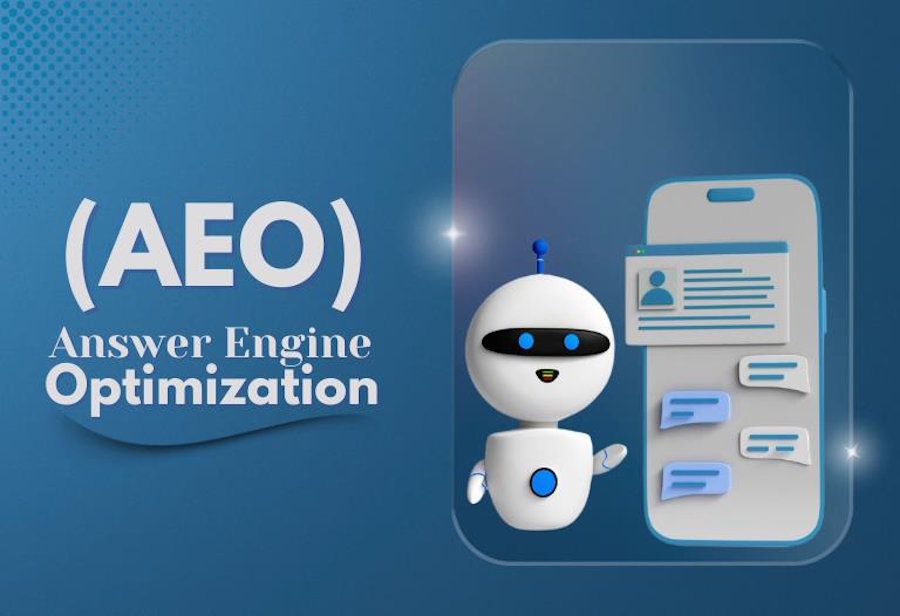
Online discovery is a landscape that is going through a shift. For more than twenty years search engine optimization completely focused on positioning the web pages at the top of traditional search engine result pages using specific keywords, backlink profiles, and meta tags. Users used short search strings, browsed ten blue links, and also manually found information through different tabs.
The times have now changed and conversational AI models, large language models, and AI-driven search engines are completely changing how users get information. Rather than serving a list of links, modern answer engines provide direct and synthesized answers that are directly pulled from the underlying web sources. To stay visible in the AI-first environment engineering and content strategies must adapt by integrating specialized Answer Engine Optimization services into their core website architecture.
What is Answer Engine Optimization (AEO)?
Answer Engine Optimization is the practice of structuring, organizing, and optimizing the digital content so that artificial intelligence systems can extract, comprehend, and cite it as an authoritative source in the generative responses.
Traditional SEO completely focuses on driving raw traffic through broad query rankings. AEO on the other hand goes for citation inclusion which ensures that when an AI answer engine answers any user prompt it depends completely on the data of your site and brand knowledge based on the documentation as the foundational truth.
The Technical Pillars of AEO for Web Developers
For software engineers, front-end developers, and technical marketers, AEO needs to go beyond the simple content creation. AI crawlers completely evaluate the structure of the page, data clarity, authority signals, and technical access to decide whether the content is trustworthy enough to feature in the direct answers.
1. Rich JSON-LD Schema & Structured Data
AI systems process structured data with higher confidence than unstructured prose. Implementing comprehensive JSON-LD (JavaScript Object Notation for Linked Data) schema markup offers search algorithms with clear semantic context regarding relationships, entities, products, technical documentation as well as FAQs.
2. Direct Answer Architecture & Clear Content Hierarchy
Answer engines prioritize the content that is formatted to answer specific questions concisely and clearly. Implementing a clear and logical heading hierarchy, which is combined with the right summary paragraphs immediately following the headers, makes it extremely easy for LLMs to get direct answers.
Key architectural best practices include:
- You should write the direct answer or the main key takeaway in the starting sentences right below the section heading which is also followed by supporting data.
- Use native markup and tags to help the language models parse lists, data comparisons, and also step-by-step procedures.
- You must also clearly define the technical terminology, brand names, and industry concepts with direct language rather than going for a difficult vocabulary.
3. Site Speed, Crawlability, and AI Bot Access
AI crawlers need fast unblocked access to parse the content efficiently. This ensures that your robots.txt file gives access to official AI web crawlers. It is essential for brand inclusion in AI search summaries. Besides that, the fast page load speeds and clean, server-side rendered or statically generated HTML ensure that the crawlers can also easily digest the data without any execution delays.
Difference Between Traditional SEO and Answer Engine Optimization
There are a few major differences between SEO and AEO that you need to understand for clarity.
Traditional search engine optimization focuses on achieving high SERP rankings and driving direct page clicks through the long form keyword targeted articles.
Answer Engine optimization, on the other hand, opts for direct citation with AI-synthesized responses by providing concise, structured factual answers and data.
Traditional SEO depends heavily on crawlability and mobile-friendly design with backlink profiles to satisfy the short keyword search queries. AEO on the other hand prioritises JSON-LD schema markup, semantic HTML tags, and clear entity mapping to optimize the content.
SEO heavily depends on keyword search queries but AEO depends on natural language prompts and multi-turn questions.
Preparing Your Web Architecture for the Future of Search
Building web platforms that accommodate AI crawlers is no longer a choice as search discovery is going toward the conversational interface and direct AI synthesis. Developers and businesses that opt for structured data standards and fast-loading web architecture will completely capture the high visibility in the AI search environments.
To completely future-proof your digital platforms and also ensure that the web assets are optimized fully for conversational AI search engines, you should partner with technical experts who provide answer engine optimization services like Broworks. We will ensure your site always stays visible, cited, and also competitive in the modern search ecosystems.

