

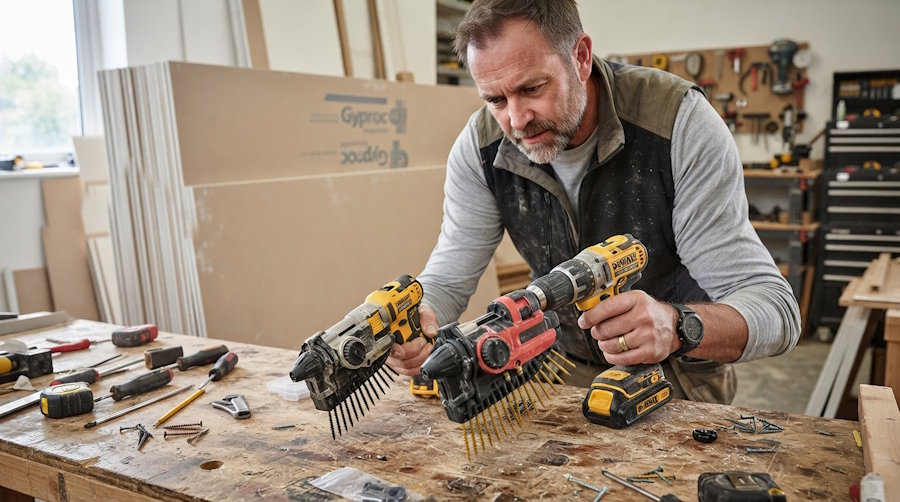
Most buying guides for this exact purchase read like near-identical best 10 screw guns lists, with the actual decision criteria buried in a rushed intro paragraph before the product rankings start. That's backwards. Here's a genuine, product-agnostic checklist for evaluating any auto-feed drywall screw gun before you buy, regardless of which brand you end up choosing.
First, Confirm You Actually Need Auto-Feed
Before comparing any features, confirm the purchase actually makes sense for your volume of work. A widely cited threshold across the trade puts the payoff point somewhere around 30-plus sheets or roughly 200-plus screws per project. Below that, the cost of a dedicated auto-feed system or attachment, plus the higher per-screw cost of collated strips compared to loose screws, often doesn't clearly pay for itself yet. A dimpler bit paired with a standard driver remains a perfectly sensible choice for smaller, occasional jobs.
Above that threshold, the math tends to shift quickly in favor of auto-feed, since the time saved per screw compounds fast across hundreds of repetitions. If you're not sure which side of that line your typical job falls on, it's worth tracking your actual sheet or screw count on your next project before committing to a purchase either way.
Dedicated Tool or Attachment for What You Already Own?
Once you've confirmed the volume justifies auto-feed, the next decision is whether to buy a purpose-built auto-feed screw gun or a collated attachment that converts a drill or screw gun you already own. A dedicated tool tends to offer better balance and ergonomics, since it's engineered around the auto-feed mechanism from the ground up rather than adding weight and bulk to an existing tool. An attachment, on the other hand, is generally cheaper if you already own a compatible base tool, and it keeps your existing tool available for other tasks without needing a second dedicated purchase.
Neither option is universally better. A contractor running auto-feed constantly across most jobs generally gets more value from a dedicated tool built for the task. Someone using it occasionally alongside other work often finds an attachment the more practical, lower-cost entry point.
Compatibility: Check This Before You Buy, Not After
This is the detail that causes the most returns and buyer frustration, and it deserves its own dedicated check rather than a buried FAQ note. If you're buying an attachment rather than a dedicated tool, verify it's actually compatible with your specific base tool's model number, not just the general brand, since compatibility often varies between models within the same manufacturer's lineup. Confirm the supported screw length and diameter range matches what you actually need for your typical jobs, since some attachments have a narrower supported range than the marketing copy suggests at a glance.
Doing this check before purchase, ideally by confirming compatibility directly with the manufacturer or a knowledgeable retailer rather than assuming from a product listing, avoids the common scenario of receiving an attachment that technically fits your tool's chuck but doesn't actually support the screw range your jobs require.
Depth Control and Consistency
Tool-free depth adjustment matters considerably more on drywall than on most other materials, since overdriving a screw even slightly can blow out the paper face and ruin the fastening hold, creating rework that outweighs any speed gained from auto-feed in the first place. Look for clear, easy-to-read depth markings and an adjustment mechanism that doesn't require tools or excessive fiddling to change between jobs or materials. A screw gun that holds its depth setting reliably across hundreds of screws, without drifting or needing constant readjustment, is worth prioritizing over one with a marginally higher RPM but looser depth consistency.
Feed Reliability and Jam Risk
Jamming is the single biggest frustration reported with auto-feed systems, and it's worth understanding what actually causes it before buying rather than discovering it on a job site. According to fastener-industry sources, the large majority of jams trace back to a small set of causes: cheap or incompatible screw strips, incorrect depth settings, or lifting the tool before the motor has fully disengaged from the previous screw. None of these are inherent flaws in auto-feed technology itself. They're usage and compatibility issues that better screw-strip quality and correct technique largely prevent.
When evaluating a specific model, look for reviews that mention real-world jam frequency under actual job conditions, not just spec-sheet claims about feed reliability. A tool paired with well-matched, brand-compatible screw strips consistently performs better on this front than a mismatched combination of a screw gun from one manufacturer and generic strips from another.
Motor Power and Torque Under Load
Maximum RPM gets prominent billing on most spec sheets, but it's a somewhat misleading number on its own. What matters more for consistent performance is torque under repeated load, especially when driving into denser material like metal-stud framing rather than standard wood framing. A tool that maintains consistent torque across a full strip of screws, rather than bogging down as the motor heats up during extended use, will perform more reliably across a full day's work than one optimized purely for a high peak RPM figure that doesn't hold up under sustained use.
Ergonomics and Runtime, If Cordless
Weight and balance matter enormously for overhead and ceiling work specifically, where you're holding the tool at an awkward angle for extended stretches. The screw guns available in this category span a wide range of weights and balance points, and a tool that feels fine held at waist height can feel considerably heavier after twenty minutes of overhead work. If you're already invested in a specific battery ecosystem, checking whether a cordless model shares that platform avoids the cost and hassle of maintaining a separate battery and charger system. Realistic runtime expectations matter too, since a battery that claims all-day runtime under light use may perform quite differently under the sustained, continuous-motor demands of auto-feed drywall work specifically.
Choosing an Automatic Feed Drywall Screw Gun That Actually Fits Your Work
Pulling all of this together, the right automatic feed drywall screw gun for your situation depends on matching volume, compatibility, depth consistency, and feed reliability to your actual jobs, not on chasing the highest RPM figure or the most heavily marketed model on a retailer's shelf. A tool that checks every box above for your specific base tool and job type will consistently outperform a more impressive-looking spec sheet that doesn't actually match your real working conditions.
A Quick Pre-Purchase Checklist
Before buying, confirm: your typical job volume clears the roughly 200-screw or 30-sheet threshold where auto-feed pays off; a dedicated tool or attachment fits your actual usage pattern and budget; compatibility is verified against your specific base tool model, not just the general brand; depth control is tool-free and holds its setting reliably; feed reliability has real-world reviews supporting it, not just spec-sheet claims; torque holds up under sustained load, not just at peak RPM; and weight, balance, and battery ecosystem fit your specific working conditions, especially for overhead work.
Final Thoughts
Buying the right auto-feed drywall screw gun comes down to matching these specific criteria to your actual jobs, not picking whichever model tops a generic "best of" list. If you've confirmed your volume justifies the investment and want to explore compatible systems, you can browse MURO's auto-feed and collated fastening systems directly through muro.

