

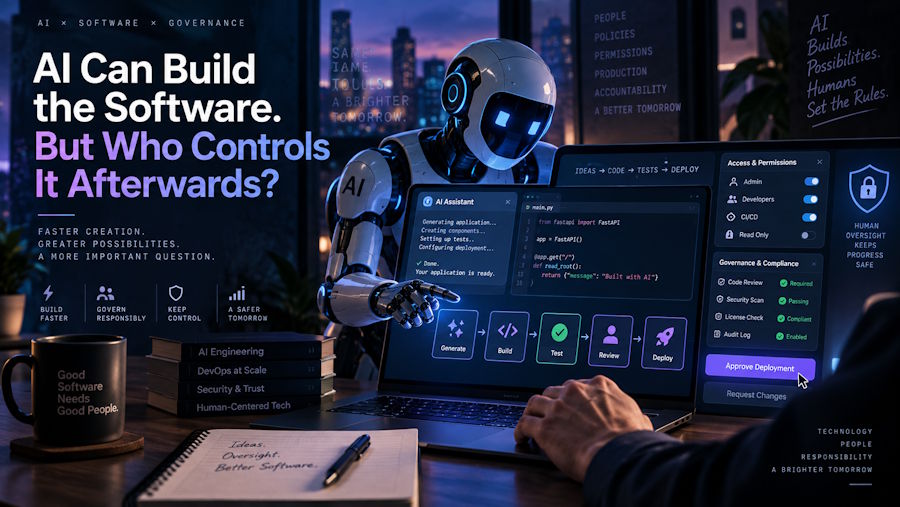
AI is making software dramatically faster to create. Developers can generate working components in minutes, while founders and product teams can increasingly describe an application in natural language and let AI handle much of the implementation underneath.
But speed introduces a less visible technical question: What happens when you want to take the software somewhere else?
An application that can only be maintained, deployed or extended inside the environment that generated it may be fast to create, but difficult to own in any meaningful sense.
As AI becomes a larger part of the development stack, portability and technical control are becoming just as important as generation speed.
Owning code is not the same as controlling a system
“Own your code” has become a common promise across AI development platforms, but ownership can mean different things in practice.
A useful test is not only whether the source code can be downloaded, but what happens next.
Can another engineering team take over the project? Can the frontend and backend be modified independently? Can the application be deployed in another environment? Are there proprietary services or dependencies that remain essential for it to function?
These questions matter because an application is rarely just source code. It is a connected system of frontend components, backend logic, databases, APIs, dependencies and infrastructure.
A prototype may only need to prove an idea. A production application may eventually support customers, revenue, internal workflows or valuable intellectual property. At that point, portability becomes a technical and commercial requirement rather than a nice-to-have.
AI should remove development friction, not create dependency
One of the biggest advantages of AI-native development is its ability to shorten the path from intent to implementation.
A user can increasingly build an app with AI by describing the intended product in natural language, while the platform handles more of the frontend, backend, database and infrastructure underneath.
That is valuable, but only if convenience during development does not become dependency afterwards. The value of that speed depends on what the user retains at the end.
Myndlab approaches this by combining full-stack generation with portability. Built in Dubai by Permus Software House, Myndlab is an AI app builder that generates containerized, production-grade applications with full code ownership and export.
The important part is not simply that files can be downloaded. The broader principle is that the resulting application should remain something a user can continue developing and operating beyond the platform where it originated.
Portability is part of technical sovereignty
As AI takes on more of the development process, technical sovereignty becomes increasingly relevant.
In practice, sovereignty means maintaining meaningful control over the application’s codebase, architecture and future development path.
A portable application gives teams options. They can move development to an internal engineering team, change hosting environments, introduce different tooling or continue building outside the original platform.
Containerized output can also support that flexibility by packaging an application with the dependencies it needs to run consistently across environments.
This matters because platform convenience can easily become platform lock-in. The easier an environment makes development, the more important it becomes to understand what happens if a team eventually wants to leave it.
Full-stack ownership matters more than interface ownership
An application is not only its frontend.
The visible interface depends on backend logic, databases, APIs and infrastructure working together. For that reason, meaningful ownership should extend beyond the screens users see.
This is also where AI powered app development platforms are beginning to diverge. The more of the application stack AI generates, the more important it becomes for users to understand which parts they can actually access, export and control.
Myndlab’s approach reflects this broader definition of ownership: the application is intended to remain an asset that the user can continue developing rather than something permanently tied to the environment where it was created.
The next AI development benchmark is technical independence
AI has already made software creation faster. The next question is whether it can do so without weakening the builder’s control over the result.
The strongest development platforms will not force users to choose between convenience and independence.
They will make it easier to move from idea to deployable software while preserving portability, ownership and the ability to change direction later.
As AI becomes a larger part of the development stack, that may become one of the most important measures of a platform: not only what it enables users to build, but how much freedom they retain once the build is complete.

