

On July 14, 2026, Injective shipped an SDK that lets AI agents place trades and query on-chain data using natural language instead of hand-written transaction logic. The same week, Robinhood launched Robinhood Chain, an Arbitrum-based network built specifically for AI agents to hold and transact with tokenized assets around the clock.
Within its first week, the chain processed $77 million in agent-driven volume across roughly 2,100 deployed agents. That's DeFAI development in practice: decentralized finance platforms where AI agents analyze markets and execute trading, lending, or yield strategies directly on-chain, not chatbots that suggest a trade for a human to approve.
This guide covers the architecture a production-grade DeFAI platform actually needs, the technologies behind it, the real security risks, and what it costs to build one.
At Debut Infotech, we build DeFi and AI systems as two separate practices that increasingly need to work as one. This guide reflects what that intersection actually requires: an architecture that survives an agent making a wrong call, not just one that works in a demo.
What Is DeFAI Development?
DeFAI development is the engineering of decentralized finance platforms where AI agents autonomously analyze markets and execute strategies, trading and lending among them, directly on-chain rather than through a human intermediary.
The difference between DeFi and DeFAI comes down to who pulls the trigger. Traditional DeFi protocols execute exactly what a human says.
AI-powered DeFi solutions add a reasoning layer that decides what to sign in the first place, within limits a human sets in advance, monitoring positions across several protocols and rebalancing automatically when risk crosses a threshold, without a new signature each time.
DeFAI Platform Architecture: The Four Layers
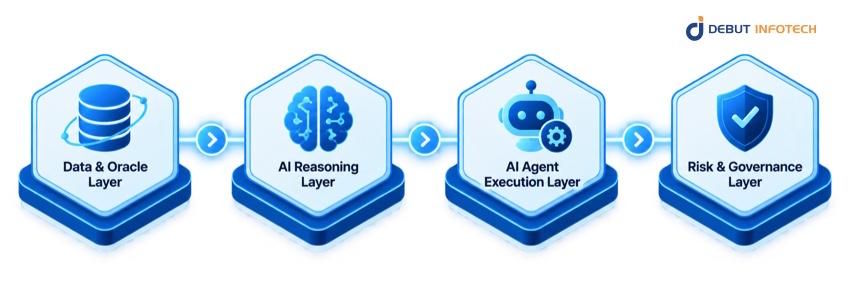
A serious AI-powered DeFi architecture is built from four distinct layers, and skipping any one of them is how "autonomous" platforms turn into liability generators.
Data and oracle layer. An AI agent is only as reliable as what it's reading. A single bad price feed reaching an autonomous agent doesn't produce a wrong answer on a screen, it produces an irreversible on-chain transaction. Production platforms cross-check multiple oracle sources and filter outliers before that data ever reaches the reasoning layer.
AI reasoning layer. This is where large language models, good at parsing news and governance proposals, work alongside quantitative models built for yield optimization and portfolio rebalancing. Every decision this layer makes should be logged immutably, so a trade can be reconstructed and explained after the fact.
AI agent execution layer. This is where the agent actually acts, and it's the layer that changed the most in 2026. ERC-8004, live on Ethereum mainnet since January 29, 2026, gives agents a persistent on-chain identity and portable reputation, so a protocol can check an agent's track record before trusting it.
ERC-7715, MetaMask's policy-bound permissions standard, lets a user grant an agent narrow, revocable spending rights instead of a private key, enforced on-chain rather than by good behavior. Together they answer two separate questions: can I trust this agent, and what is it actually allowed to do.
Risk and governance layer. Hard-coded circuit breakers and anomaly detection that override the AI reasoning layer whenever it tries to do something outside pre-set boundaries. This is the layer that turns experimental agent logic into something an enterprise can actually deploy.
Technologies Used to Build AI-Powered DeFi Solutions
The technology stack behind autonomous DeFi development spans several pieces. Smart contracts remain the settlement layer, executing exactly what they're told once a transaction is submitted.
On-chain AI development adds the identity and permission layer on top: ERC-8004 for agent identity and reputation, ERC-7715 for policy-bound wallets, and the Model Context Protocol (MCP) for standardizing how an agent connects to a protocol instead of a custom integration per protocol. Injective and Coinbase both now ship their own MCP servers for this reason.
Underneath the agent layer sit the same DeFi protocols and DeFi infrastructure any platform needs: lending markets and DEX liquidity. What's different is that this infrastructure now needs to assume some of its callers are autonomous, which is really what agentic AI for DeFi means at the infrastructure level.
A contract built only for human callers needs a different threat model once an agent can call it thousands of times a day. That's exactly the kind of change that should go through dedicated smart contract audit services before it touches real funds.
What Are the Biggest Security Risks, and What Controls Does a Production Platform Need?
Compounded risk. AI hallucination and smart contract immutability create a failure mode that doesn't exist in either field alone: a wrong inference becomes an unrecoverable transaction. The control is pre-execution simulation, so a proposed trade gets tested against current state before it's ever signed.
Cascade events. In an incident several outlets have called the "February Wick," roughly 15,000 AI agents reportedly moved in sync on the same signal, contributing to a three-second crash and an estimated $400 million in liquidations.
Agents trained on the same data sources can reach the same conclusion at the same moment, and unlike human traders, they don't hesitate. The control here is randomized execution windows and per-pool exposure caps, so no single signal can move every agent at once.
Opaque decision-making. The SEC's fiscal year 2026 examination priorities, published in November 2025, name AI and emerging financial technology as a top focus area, specifically flagging "black box" algorithms where a firm can't explain why a trade happened.
For AI-powered risk management in DeFi, "the model decided" is not a defense a regulator will accept. The control is the same immutable decision logging described in the reasoning layer above, applied from day one, not retrofitted after an examination.
No jurisdiction has AI-agent-specific rules yet, so existing securities and market-conduct law applies in full, and liability sits with whoever deployed the agent, not the agent itself.
Cost and Process to Build an AI-Powered DeFi Platform
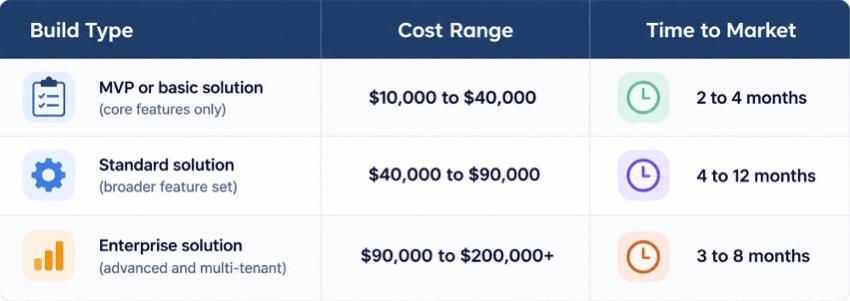
The AI-powered DeFi development cost varies enormously by how autonomous the platform actually is, which is also the biggest lever on timeline.
The AI-powered DeFi development process follows the four-layer architecture above in order: data and oracle integration first, since every later layer depends on trustworthy inputs, then reasoning, then agent execution and identity, then risk and governance, tested against adversarial scenarios before real capital touches it.
How to build an AI-powered yield farming platform is a good middle-tier example: rebalancing logic across pools is well understood, but multi-protocol integration and withdrawal-limit guardrails still take real engineering time, and the cost to build an AI-powered DeFi platform this way sits closer to the middle row above than the bottom.
For a fuller breakdown of what drives DeFi costs independent of the AI layer, see our guide to DeFi development cost.
What Do You Need to Build an AI-Powered DeFi Application?
At minimum: verified, cross-checked data feeds; a reasoning layer that logs every decision it makes; an execution layer built on policy-bound wallets rather than unrestricted key access; circuit breakers that can override the AI outright; and a compliance posture that assumes regulators will eventually ask why a specific trade happened.
Teams that skip the last two aren't building a leaner version of DeFAI, they're building the liability case study the next article in this space will reference.
Why Build DeFAI With Debut Infotech
Enterprise DeFAI development sits at the intersection of two disciplines that don't usually live in the same team: DeFi protocol engineering and applied AI.
We work across both, as a DeFi development company building lending and staking infrastructure, plus yield systems, and through dedicated AI development solutions covering the reasoning and agent layers this guide describes.
As a DeFAI development partner, we scope the architecture against your actual risk tolerance and regulatory exposure before a line of code gets written, not after.

