

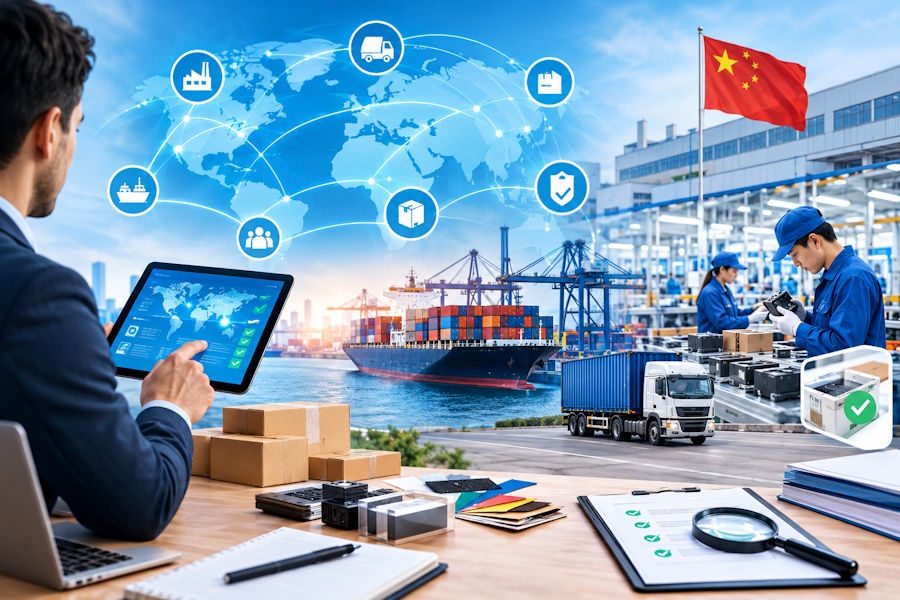
Managing overseas suppliers used to require extensive travel, phone calls, spreadsheets, and manual documentation. Today, businesses can coordinate much of the procurement process through digital platforms. From supplier research and communication to quality inspections and shipment tracking, technology is changing how companies interact with manufacturers across international markets.
For companies purchasing from China, a professional sourcing agent in China can help connect the advantages of digital tools with practical knowledge of the manufacturing environment. The combination is particularly useful for businesses that need to coordinate multiple suppliers, product specifications, samples, inspections, and shipments without maintaining a permanent team in China.
The Role of Technology in Product Sourcing
The modern sourcing process generates a considerable amount of information. Supplier profiles, quotations, product specifications, sample photographs, inspection reports, invoices, shipping documents, and communication records all need to be organized.
Businesses involved in product sourcing in China can use cloud-based systems to centralize much of this information. Instead of keeping important documents across separate computers and email accounts, teams can create shared digital records that can be accessed by authorized employees from different locations.
This creates a more organized workflow and makes it easier to determine the current status of an order.
Digital Supplier Discovery
Finding potential manufacturers is one of the first challenges in international procurement.
Online supplier directories, business websites, marketplaces, trade databases, and industry platforms allow buyers to discover manufacturers without immediately traveling overseas. Search tools can narrow potential suppliers by product category, location, manufacturing capability, and other criteria.
However, digital discovery should not be confused with supplier verification.
A supplier's online presence may provide useful information, but businesses should still investigate whether the company has the appropriate production capabilities and experience. Verification can involve reviewing business documentation, factory information, certifications, production facilities, references, and product samples.
Technology makes the initial research faster, while professional due diligence helps determine whether a supplier is actually suitable.
Using Data to Compare Suppliers
Supplier selection can become difficult when a business receives multiple quotations.
A simple spreadsheet can compare unit prices, minimum order quantities, lead times, tooling expenses, packaging costs, payment terms, and shipping estimates. More advanced procurement systems can automate calculations and provide dashboards showing supplier performance.
This approach helps businesses move away from choosing manufacturers based purely on price.
For example, Supplier A might offer the lowest unit price but have a long production lead time and a high defect rate. Supplier B might cost slightly more while consistently meeting deadlines and maintaining better quality.
When data is organized in one place, these differences become easier to identify.
Artificial Intelligence in Procurement
Artificial intelligence is creating new possibilities for procurement teams.
AI systems can process large volumes of information quickly and help users summarize supplier communications, compare quotations, organize specifications, and identify unusual changes in data.
For example, a company could use an AI tool to compare several supplier quotations and highlight differences in quantities, materials, packaging, or production schedules.
AI can also help summarize long email conversations, making it easier for a procurement manager to understand what has already been agreed upon.
However, AI-generated analysis should be treated as decision support rather than an unquestionable answer. Supplier selection involves commercial judgment, manufacturing knowledge, and risk assessment that still require human involvement.
Better Communication Across Borders
Communication problems can create expensive sourcing mistakes.
A product specification may contain technical terminology, measurements, tolerances, packaging requirements, or branding instructions. If any of these details are misunderstood, the final product may not match the buyer's expectations.
Digital communication tools make it easier to share photographs, diagrams, videos, CAD files, spreadsheets, and other technical materials.
Video meetings can also provide a more direct way to discuss complicated requirements. A buyer can show a manufacturer an example product, explain a design issue, or review a prototype without waiting for an international visit.
Translation technology can provide additional support when teams communicate across different languages, although important contractual and technical information should still be reviewed carefully.
Cloud-Based Product Documentation
Product development often involves numerous revisions.
The dimensions of a product may change after testing. Packaging may be redesigned. A logo may be modified. Materials may be replaced. If different members of a sourcing team use outdated documents, the factory could manufacture according to incorrect specifications.
Cloud-based documentation helps reduce this risk by creating a centralized source of information.
Teams can maintain current product specifications, drawings, photographs, approved samples, packaging requirements, and quality standards in one location.
Version control is particularly valuable when several people are involved in product development.
Technology and Quality Inspections
Quality control is another area where digital tools can improve visibility.
Inspectors can use mobile devices to record measurements, photographs, videos, quantities, and defects during factory inspections. Reports can then be shared digitally with buyers.
This gives businesses evidence about product quality before goods are shipped.
Digital inspection records can also be compared across multiple orders. If a manufacturer repeatedly produces the same defect, historical data can reveal the pattern.
Businesses can then work with the supplier to identify the cause and establish corrective measures.
The value of this information increases over time because every inspection contributes to a broader supplier performance history.
Automating Order Management
Manual order management becomes increasingly difficult as a company grows.
A business purchasing products from several manufacturers may need to monitor purchase orders, production dates, sample approvals, inspections, shipping arrangements, and delivery schedules simultaneously.
Automation can reduce repetitive administrative tasks.
Software can generate reminders when an approval is required, update order statuses, organize supplier documents, and notify team members about approaching deadlines.
Automation does not necessarily require sophisticated enterprise software. Even well-designed spreadsheets, cloud databases, and workflow platforms can eliminate many repetitive processes.
The important principle is to create a system that reduces the chance of information being lost.
Tracking the Supply Chain
Once goods leave the factory, logistics information becomes increasingly important.
Digital tracking tools can provide updates as shipments move through warehouses, ports, transportation networks, and delivery systems.
For businesses managing inventory, this information can support better planning. If a shipment is delayed, the company may be able to adjust inventory allocation, customer communications, or future production schedules.
Supply-chain visibility is particularly important for businesses that operate with limited inventory. A delay of several days can have a much larger impact when there is little backup stock.
Building a Digital Supplier Scorecard
One practical way to combine technology and sourcing expertise is through supplier scorecards.
A scorecard can track metrics such as:
- Product quality
- Defect rates
- Production lead time
- Communication speed
- Order accuracy
- Pricing stability
- Shipping performance
- Responsiveness to problems
Suppliers can then be evaluated using historical performance rather than impressions from a single order.
This is useful when a company works with several manufacturers and needs to determine where future orders should be allocated.
Technology Does Not Replace Relationships
Despite the benefits of digital systems, international sourcing remains a relationship-driven activity.
Manufacturers are business partners, not simply entries in a database. Negotiations, problem-solving, quality discussions, product development, and production planning often depend on trust and communication.
Technology provides the infrastructure for better collaboration, but people remain responsible for making important decisions.
The strongest approach combines digital organization with experienced sourcing professionals who understand manufacturing realities.
The Future of International Supplier Management
Technology is making global sourcing more transparent, measurable, and manageable.
Businesses can discover suppliers online, compare quotations digitally, communicate through video, organize product documentation in the cloud, use AI to process information, record quality inspections electronically, and track shipments through connected systems.
These tools can reduce administrative work and give businesses better visibility into their supply chains.
However, technology should be viewed as an enabler rather than a complete sourcing strategy. Successful procurement still depends on selecting capable suppliers, communicating precise requirements, monitoring quality, and maintaining strong commercial relationships.
For companies sourcing from China, combining modern digital tools with practical supplier knowledge can create a more efficient and scalable procurement process. As technology continues to develop, businesses that build organized, data-driven sourcing systems will be better positioned to manage increasingly complex international supply chains.

