

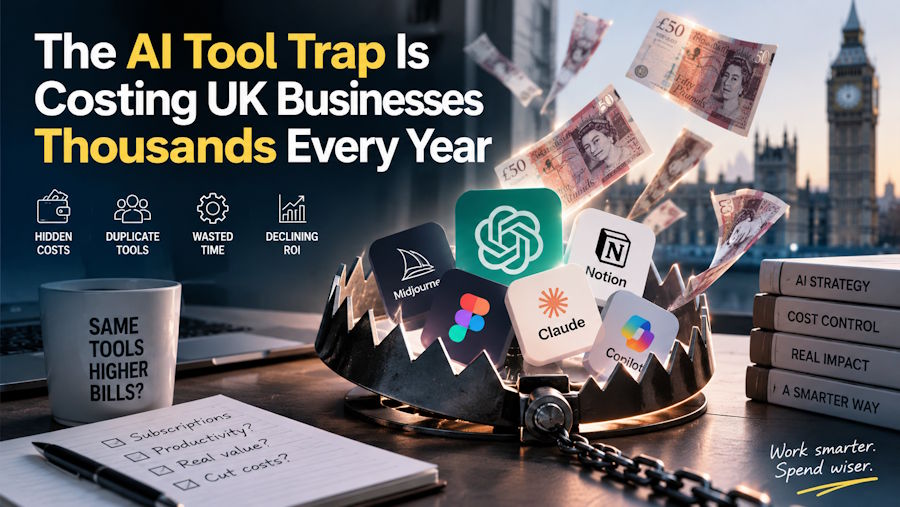
In early 2023, a solar panel installation company in the East Midlands decided to "go digital." The owner, a pragmatic man who had built his business from a single van and a spreadsheet, signed up for three separate SaaS platforms after a persuasive sales call. One handled customer inquiries. One tracked leads. One managed scheduling. Total monthly cost: just under £900. Eighteen months later, none of the three tools talked to each other. His sales team was manually copy-pasting data between systems twice a day. His follow-up rate had actually dropped. The promise of AI had delivered the opposite of what was advertised. He is not alone. Businesses looking to scale their operations often turn to The AI Automation Agency precisely because they have already burned money on tools that looked smart but worked stupidly.
This is the story the SaaS industry does not want you to read. It is a story about vendor lock-in, hidden integration costs, and the quiet operational chaos that generic AI tools leave behind. And it is happening across the UK right now, at scale.
The Hidden Cost of Off-the-Shelf AI Tools
Here is the number that should alarm every SME owner. According to research published by the McKinsey Global Institute, only about 16% of companies that deploy AI tools report capturing meaningful value from them at scale. That means roughly five out of six businesses spending money on AI automation are, at best, treading water.
Why does this keep happening? The answer is structural. Off-the-shelf AI platforms are built for the average business. Not your business. They come pre-configured with assumptions about your workflow, your data structure, and your customer journey. When reality does not match those assumptions, the platform wins. Your team adapts to the tool rather than the tool adapting to your operations.
The financial fallout is real and measurable. A 2024 report from the Federation of Small Businesses found that UK SMEs waste an average of 11 hours per week on manual tasks they believed their software would handle automatically. At a conservative £25 per hour, that is £14,300 per employee per year in lost productive capacity. Multiply that across a ten-person team and you are looking at a six-figure productivity drain that never appears on any invoice.
There is also the vendor lock-in problem. SaaS contracts are designed to be sticky. Annual billing, data export friction, and proprietary integrations all serve the same function: making it expensive and disruptive to leave. Many businesses discover this only after they have embedded a platform too deeply to remove it without a full operational reset. The tool that was supposed to free them has become a structural dependency.
When "AI-Enabled" Is Not the Same as AI-Integrated
There is a distinction that almost nobody in the software industry wants to discuss. Being "AI-enabled" means a platform has bolted a chatbot widget onto its interface or added a predictive text field to a form. Being AI-integrated means your entire operational workflow has been mapped, automated, and connected so that repetitive human tasks are genuinely eliminated.
Most businesses buying off-the-shelf tools get the former while paying for the latter.
Consider what genuine business process automation actually looks like in practice. A new lead comes in from a website form. The AI agent qualifies that lead against pre-set criteria, enriches the contact record with company data, assigns it to the right sales rep based on territory and capacity, schedules a follow-up, and logs everything in the CRM. No human touches the process until the rep picks up the phone for a warm, prepared conversation.
That is AI integration. A chatbot that says "Thanks for your message, we will be in touch soon" is not.
The gap between these two realities is where most UK SMEs are currently stuck. They have purchased the idea of automation without acquiring the infrastructure for it. And the reason is straightforward: building genuine AI integration requires deep technical expertise, workflow knowledge, and vendor-neutral access to the right tools. Most business owners have none of those things in-house. And frankly, they should not have to.
The Technical Expertise Gap Is Not Your Fault
This point deserves emphasis. The technology industry has spent years selling the idea that AI tools are "plug and play." They are not. Configuring a CRM automation workflow that handles exceptions, edge cases, and multi-step logic is a skilled technical task. Building a custom AI agent that understands your specific product range, your escalation protocols, and your tone of voice requires expertise that takes years to develop.
When a generic platform fails, the vendor's answer is always the same: more configuration, more add-ons, more consulting hours billed at rates that rival law firms. The implementation burden falls entirely on the business, and the business was never equipped to carry it.
This is the system failure hiding in plain sight. The industry profits from complexity while marketing simplicity.
What a Done-for-You AI Agency Actually Delivers
The done-for-you model is a direct response to this failure. Instead of handing a business a toolkit and a manual, it takes full ownership of the entire implementation. Planning, building, deploying, and handing over a fully functioning system that integrates with what already exists.
The mechanics matter here. A genuine AI automation agency starts with a workflow audit. Not a sales demo. An actual deep-dive into how the business currently operates, where the bottlenecks are, and which processes are consuming the most human time for the least strategic value. From that audit comes a custom architecture: specific agents, specific integrations, specific trigger logic designed for that business and no other.
Phase one is discovery. Phase two is build. Phase three is deployment, quality testing, team onboarding, and performance baselining. The client organization is involved at key decision points but is not responsible for the technical execution. That distinction is everything.
Whole-of-Market Access Changes the Calculus Entirely
One of the most quietly damaging forces in the AI services market is vendor affiliation. Many agencies calling themselves "AI consultants" are, in practice, certified resellers for a specific platform. Their entire recommendation framework is shaped by the ecosystem they are paid to promote. HubSpot partners recommend HubSpot. Salesforce partners recommend Salesforce. The client's needs come second to the partner margin.
Whole-of-market access means no affiliation to any single vendor. Recommendations are made purely on the basis of what delivers the best ROI for the specific business. That might mean combining three different platforms with a custom-built layer on top. It might mean using a lightweight tool that costs a fraction of the enterprise alternative. The evaluation criteria are total cost of ownership, integration depth, scalability, and long-term flexibility. Not commission structures.
According to analysis from Gartner's 2024 AI software report, businesses that implement AI systems through vendor-neutral advisors see up to 40% lower total cost of ownership over a three-year period compared to those who implement through affiliated resellers. The reason is simple: the right tool for the job costs less to run and less to maintain than the wrong tool with familiar branding.
The 90-Day Window: Why Speed Matters More Than You Think
Enterprise AI projects have a reputation for taking 12 to 18 months to deliver anything measurable. That timeline is a budget killer for most SMEs. By the time the system goes live, priorities have shifted, the team has changed, and the initial business case looks shaky.
The 90-day model is built around a different philosophy. Fast enough to generate ROI before the next budget cycle. Structured enough to build systems that actually work rather than prototypes that need six months of post-launch patching.
The breakdown looks roughly like this. Weeks one and two cover the workflow audit and automation opportunity mapping. Weeks three through six handle system architecture design and custom agent development. Weeks seven through ten focus on integration with existing CRM, sales, and operational tools. Weeks eleven and twelve handle deployment, testing, team onboarding, and performance baseline setting.
The money-back guarantee attached to this timeline is not a marketing flourish. It is a structural signal. It shifts financial risk away from the client and onto the agency. That only makes sense if the agency has genuine confidence in its delivery process. Most software vendors offer free trials. An agency offering a money-back guarantee on a full AI implementation is making a categorically different kind of commitment.
What Needs to Be in Place Before You Start
A 90-day engagement is not a magic trick. It requires some minimum viable infrastructure on the client side. A functioning CRM, even a basic one. Defined workflows, even if they are currently manual. Access to key stakeholders for decision-making during the build phase. And a clear priority: what is the single most painful, most time-consuming manual process that automation should solve first.
The good news is that most SMEs with more than five employees already have these things in some form. The gap is rarely about resources. It is almost always about knowing what to build and how to connect the pieces.
Custom AI Agents Built for Real Business Functions
Generic AI tools fail partly because they are built for categories of businesses rather than specific ones. Custom AI agents work because they are built for exactly what a specific business does, nothing more and nothing less.
Sales automation agents handle the repetitive outreach that kills sales team productivity. Prospecting sequences, follow-up timing, CRM data enrichment, lead qualification scoring. A well-built sales agent means a rep's first human touchpoint is a warm, informed conversation with a qualified prospect rather than a cold call to an unscored contact who may have already bought elsewhere.
Customer service agents handle inbound query triage, resolution for common issues, and intelligent escalation logic for complex ones. They operate around the clock without overtime costs. They handle volume spikes without hiring. And when built correctly, they escalate to a human being at exactly the right moment with full context already documented.
Field management automation is less discussed but arguably more impactful for trade and service businesses. Scheduling, job dispatch, status updates, customer notifications, and post-job reporting can all be automated in ways that reduce admin overhead dramatically. A field operative finishes a job. The system automatically closes the ticket, sends a customer satisfaction prompt, updates the CRM, and flags the next job assignment. No paperwork. No delay. No dropped balls.
CRM automation ties all of this together. Automated lead scoring, stage progression triggers, activity logging, and cross-team notifications keep pipelines moving and teams accountable without requiring a dedicated CRM manager to police data quality.
The £45 Million Proof Point
Numbers like "improved efficiency" and "reduced overhead" are easy to say and impossible to verify. Revenue numbers are harder to fake. Clients working with specialist AI automation agencies have generated over £45 million in combined revenue over the past two years, directly attributed to the automation strategies and systems implemented on their behalf. That figure spans businesses across sectors including legal services, solar installation, online retail, and enterprise SaaS.
The common thread is not industry. It is structural. Each of those businesses replaced a manual process with an automated one in a revenue-critical part of their operation. Sales follow-ups that previously fell through the cracks now happen consistently. Customer service interactions that previously required a headcount now run autonomously. Data that previously sat in disconnected spreadsheets now flows in real time to the people who need it.
That is not a technology story. That is an operational story. The technology is just the mechanism.
Calculating the ROI Case Before You Commit
Every business has a version of the same three or four processes that eat disproportionate amounts of staff time. Identifying them takes about an hour with a whiteboard and a timer.
Start here. What are the three highest-volume manual tasks your team performs every week? Estimate the total hours spent on each. Multiply by your average hourly staff cost. That is your baseline cost figure. Now estimate what percentage of that task could be handled by a well-configured automation. Even a conservative 60% coverage rate produces a striking number when multiplied across a full year.
This is not a theoretical exercise. A discovery process with a qualified AI automation advisor turns this rough calculation into a documented business case with real data, specific tool recommendations, and projected timelines for ROI realization. That business case should exist before any money changes hands. Any agency worth working with will help you build it before asking you to commit.
Flexible Models for Businesses at Every Stage
Not every business is ready for a full 90-day AI implementation. That is fine. The engagement model should match where the business actually is, not where a vendor wants it to be.
The fast-track model suits businesses with defined workflows, an existing CRM, and a clear priority to automate. It delivers a complete, functioning AI system in 90 days with full handover documentation and team onboarding.
The ongoing retainer model suits businesses that want to scale automation over time. New agents, continuous optimization, and system monitoring as the business grows and its needs evolve. Automation that stays aligned with the business rather than becoming outdated infrastructure.
The weekly expert access model suits businesses building internal AI capability. Expert support on demand, fast response times, and guided implementation for teams that want to own the process internally. It is a lower-commitment entry point that can scale into full managed service as complexity increases.
All three models share one characteristic. The expertise stays with the service provider. The business owner gets outcomes, not homework.
The Accountability Gap the Industry Ignores
Here is the uncomfortable truth that the SaaS industry has successfully avoided discussing at any meaningful scale. When a £900-a-month AI tool fails to deliver what it promised, who is accountable? The vendor points to configuration. The reseller points to onboarding. The business owner absorbs the loss and starts the search again.
There is no structural accountability in the off-the-shelf model. Tools are sold on demos. Demos show best-case scenarios with clean data and pre-configured workflows. Real businesses have messy data, legacy systems, and processes that evolved through years of pragmatic problem-solving rather than optimal design. The demo never addresses any of that.
The done-for-you model changes the accountability structure. When an agency builds and deploys a system on your behalf and backs it with a money-back guarantee, the incentive alignment shifts completely. They succeed only when you succeed. That is not a philosophical preference. It is a commercial reality that produces different behavior throughout the engagement.
UK SMEs have spent too long being sold the idea of AI while receiving the reality of complexity. The businesses that are pulling ahead right now are the ones that stopped shopping for tools and started finding the right implementation partners. The difference between an AI-enabled business and an AI-integrated one is not the software. It is who builds it, how it is built, and whether anyone is accountable when it works.
The future of UK business operations will not be built on off-the-shelf subscriptions and hope. It will be built on bespoke systems, vendor-neutral expertise, and a 90-day window to prove the numbers before renewing the bet.

