

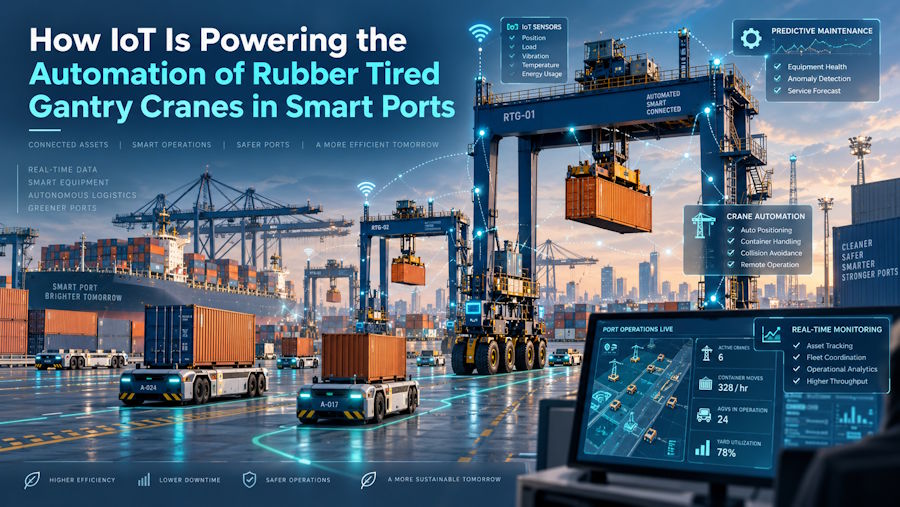
Container terminals are among the most data-intensive industrial environments on the planet. A busy port handles thousands of container moves per day, coordinating cranes, trucks, vessels, and yard systems in real time. At the center of this complexity sits one of the most widely deployed pieces of heavy equipment in the world: the rubber tired gantry crane (RTG crane).
What makes the RTG crane particularly interesting from a technology standpoint is not the machine itself — it is the IoT stack increasingly being built around it. Sensor networks, edge computing, 5G connectivity, computer vision, and cloud-based terminal operating systems are transforming what was once a manually operated diesel machine into a node in a fully connected industrial IoT ecosystem.
This article breaks down how that transformation works — the protocols, the architecture, the data flows, and the engineering challenges involved in connecting a 300-ton gantry crane to the internet of things.
What Is a Rubber Tired Gantry Crane?
Before diving into the IoT layer, a quick primer on the hardware. A rubber tired gantry crane is a large mobile crane that straddles multiple rows of stacked shipping containers in a terminal yard. It lifts containers using a spreader bar suspended from an overhead trolley, and moves on rubber tires — giving it the flexibility to reposition anywhere in the yard without fixed rail infrastructure.
A typical RTG spans six container rows plus one truck lane, stacks containers up to six units high, and has a lifting capacity of 35 to 65 tons. At a large terminal, dozens of RTGs may be operating simultaneously across a yard covering several square kilometers.
Coordinating that fleet — knowing where every crane is, what it is carrying, where each container needs to go, and how to sequence moves to minimize delay — is fundamentally a software and data problem. IoT is how it gets solved.
The IoT Architecture of a Modern RTG Crane
A connected RTG crane is not a single device. It is a distributed system of sensors, controllers, communication hardware, and software interfaces. The architecture can be broken into four layers:
1. Sensor and Actuator Layer (The Edge Device)
At the physical level, a modern RTG crane is instrumented with a dense array of sensors:
- Load cells and weighing systems: Measure container weight in real time during lifting, feeding data to the TOS (Terminal Operating System) and helping prevent overloading
- Laser range finders and LiDAR units: Mounted on the trolley and gantry legs, these provide millimeter-precision position data for the spreader and container stacks — essential for automated landing
- Encoders on drive motors: Track the exact position of the trolley, hoist, and travel mechanisms, enabling precise closed-loop control
- Inertial Measurement Units (IMUs): Detect crane tilt, vibration, and sway — feeding data into anti-sway algorithms
- RFID readers: Identify terminal trucks and chassis as they enter the crane's service lane
- HD cameras with OCR: Read container ISO codes automatically as containers pass through camera fields of view, eliminating manual data entry
All of this hardware feeds into the crane's PLC (Programmable Logic Controller) — the real-time embedded controller that executes motion commands and enforces safety interlocks. PLCs in RTG cranes typically run deterministic real-time operating systems with scan cycles in the 10–100 millisecond range, and communicate internally via industrial protocols like PROFIBUS, PROFINET, or EtherCAT.
2. Edge Computing Layer
Raw sensor data from a working RTG cannot all be sent to the cloud — the volume is too high, and the latency requirements for motion control are too tight. Edge computing handles local processing before anything leaves the crane.
Key functions handled at the edge:
- Anti-sway computation: The spreader on an RTG behaves like a pendulum. Anti-sway algorithms — running on dedicated edge controllers — process IMU and encoder data in real time and issue corrective motor commands to dampen oscillation. Round-trip latency to a remote server would make this impossible; the computation must happen onboard.
- Collision avoidance: Proximity sensors and camera feeds are processed locally to detect obstacles — other cranes, trucks, or personnel — and trigger safety stops before a remote system could even receive the data.
- Local data buffering: If wireless connectivity drops (a common occurrence in metal-dense port environments), the edge system buffers operational data and synchronizes with the TOS when the connection is restored.
3. Connectivity Layer
Connecting a moving, 300-ton steel crane to a network is not trivial. RTG cranes operate across large yards, move continuously, and are surrounded by metal structures that interfere with radio signals. The connectivity challenge has historically been one of the biggest barriers to RTG automation.
The current generation of solutions:
- Wi-Fi (802.11ac/ax): Dense access point deployments across the container yard, with fast roaming protocols to maintain session continuity as the crane moves between coverage cells. Used for moderate-bandwidth applications like video streaming and TOS data exchange.
- 5G private networks: Increasingly the preferred solution for new terminal deployments. 5G's combination of low latency (sub-10ms achievable), high bandwidth, and high device density makes it well-suited to port automation. ZPMC and Huawei deployed 5G private networks at Shanghai Yangshan Port and Ningbo Port specifically to validate RTG remote control over 5G — transmitting HD video from the crane cab to a remote operator station while sending PLC control signals in the opposite direction.
- Fiber via cable reel: For electric RTGs using cable reel power delivery, a fiber optic strand is often bundled into the same cable, providing a wired high-bandwidth backbone that is unaffected by RF interference.
4. Cloud and TOS Integration Layer
At the top of the stack, crane data flows into the Terminal Operating System — the central software brain of the port. The TOS integrates data from all cranes, trucks, yard tractors, gate systems, and vessel management to optimize container flows across the entire terminal.
Modern TOS platforms (such as Navis N4, Tideworks, or SPARCS) expose APIs that RTG automation systems connect to. When the TOS assigns a work order to a crane — "pick container ABCD1234567 from slot A-12-3 and land it on truck lane 4" — that instruction travels down through the stack to the crane's PLC, which executes the physical sequence.
The Port of Tanjung Pelepas implemented Navis RTG Optimization across its fleet of 172 rubber tire gantry cranes, processing dynamic business rules and operational constraints in real time to automate crane assignment decisions and reduce handling cost per TEU — a direct example of TOS-level IoT intelligence improving fleet efficiency at scale.
Remote Operation: IoT Enabling Human-Machine Collaboration
Full autonomy is not always the goal or the immediate step. Many terminals are deploying remote supervised operation as an intermediate model — where IoT infrastructure handles the data pipeline but a human operator remains in the loop.
In this setup, the crane's cameras stream live HD video to a Remote Operating Station (ROS) in a control room. The operator sees multiple camera feeds — typically a forward view from the trolley, a container landing view, and a truck lane view — on a multi-monitor workstation. Control inputs (joystick, pedals) send commands back to the crane's PLC over the network.
This architecture makes the latency and reliability of the connectivity layer absolutely critical. A 200ms network jitter during a precise container landing is not acceptable. Terminals use QoS (Quality of Service) configurations on their private networks to prioritize crane control traffic over less time-sensitive data, and design their wireless infrastructure with redundant coverage so no single access point failure disrupts operations.
The Konecranes project at the Port of Cartagena in Colombia — where 37 existing RTGs are being retrofitted for remote supervised operation alongside an order for 25 new RTGs signed in Q3 2025 — illustrates how this model is being deployed at scale on existing fleets, not just new builds.
Computer Vision and AI in the Container Yard
Beyond connectivity and remote operation, machine learning is beginning to play a role in RTG operations, primarily through computer vision:
OCR for container identification: Cameras mounted on the crane and at terminal gates use optical character recognition to read container ISO codes, eliminating manual scanning and feeding real-time container location data to the TOS. Modern OCR systems achieve accuracy above 99% in operational conditions.
Truck and chassis recognition: RFID and vision systems identify incoming trucks, verify their appointment in the TOS, and guide them to the correct position under the crane — reducing truck turnaround time and enabling automated lane management.
Predictive maintenance: Vibration sensors, temperature monitors, and motor current data are fed into machine learning models to predict component failures before they occur. Condition monitoring for hoist brakes, wheel bearings, and drive inverters is now standard on premium RTG configurations — reducing unplanned downtime.
Stack management optimization: AI-driven yard planning algorithms analyze container dwell times, vessel schedules, and truck appointments to decide where containers should be placed in the yard to minimize future reshuffling moves — a problem with enormous combinatorial complexity that benefits from learned optimization.
Challenges in RTG IoT Deployment
For engineers and developers working in the industrial IoT space, RTG crane deployments surface challenges that are instructive beyond the port context:
RF propagation in metal-dense environments: Container stacks create complex multipath environments that make wireless signal planning difficult. Standard indoor coverage models do not apply. Terminals require site surveys and ray-tracing simulation before deploying wireless infrastructure.
IT/OT convergence: RTG automation requires integrating the operational technology (OT) world — PLCs, industrial protocols, deterministic real-time systems — with the IT world of cloud APIs, REST services, and TCP/IP networking. These systems have very different assumptions about update rates, failure modes, and security models.
Cybersecurity in critical infrastructure: A port is critical infrastructure. Connecting cranes to networks introduces attack surfaces that did not exist when cranes were isolated machines. Network segmentation, OT-specific security monitoring, and secure remote access protocols are increasingly required by port operators and regulators.
Data volume and storage: A single RTG crane instrumented for full automation generates continuous streams from dozens of sensors. Across a fleet of 50+ cranes, the data volume requires deliberate decisions about what to process at the edge, what to sample and transmit, and what to archive.
Where HT Crane Fits in the Global RTG Market
The global rubber tired gantry crane market is growing steadily, with demand driven by port capacity expansion and automation upgrades across Asia, the Middle East, and Africa. While European manufacturers lead the premium automation segment, Chinese manufacturers have become major suppliers for cost-sensitive markets.
HT Crane (Henan Haitai Heavy Industry Co., Ltd.) is one of the Chinese manufacturers supplying RTG cranes and port lifting equipment to international buyers, alongside products including marine travel lifts and ship-to-shore systems. As IoT-ready features become table stakes even in mid-market RTG procurement, suppliers across the spectrum are integrating PLC-based automation, remote monitoring capability, and TOS connectivity into their standard configurations.
Conclusion
The rubber tired gantry crane is one of the more instructive examples of how IoT is being applied to legacy industrial equipment at scale. The core engineering challenges — edge computing under real-time constraints, wireless connectivity in difficult RF environments, IT/OT integration, computer vision in variable lighting, and AI-driven optimization of combinatorially complex logistics problems — are the same challenges that appear across industrial IoT broadly.
For developers and engineers exploring IIoT (Industrial Internet of Things), smart manufacturing, or edge computing architectures, the port terminal is a uniquely rich environment: large scale, high stakes, measurable outcomes, and an industry that is actively investing in the technology stack to solve it.
The crane is just the hardware. The interesting problems are in the software, the network, and the data.

