

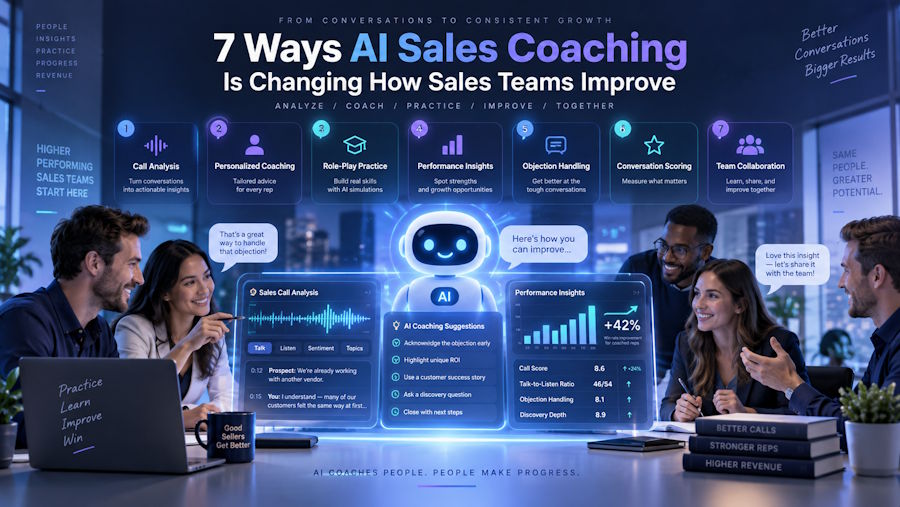
In general, coaching has always played a role in helping sales teams develop communication skills, qualification skills, objection handling skills, and conversational skills. Some vital insights might be lost for the simple reason that time does not allow for the analysis of all of them.
Such a situation has triggered interest in the practical application of AI sales coaching. Instead of looking at coaching as an occasional event, one can leverage artificial intelligence to analyze sales calls and provide insights into those areas in which representatives require assistance.
AI sales coaching is a tool which brings another level of insight without taking away the human element from management.
1. It Turns Sales Conversations Into Useful Coaching Data
Conversations include valuable coaching information in the form of questions asked by the sales rep, how much time they spend listening, how they deal with objections, and the clearness of their next step.
With AI, a manager will be able to find out the recurring patterns and situations that need coaching. One may discover that the sales rep starts explaining the product without understanding what is important for the buyer. Another may ask good discovery questions, but struggle with the issues of cost or implementation.
2. It Makes Feedback More Timely
Feedback is generally more effective if it takes place right after the event it concerns. The representative that gets some advice right after a sales call remembers the context, customer’s reaction and decisions made during the call.
This feedback loop can be shortened by using AI that will analyze recent events and provide information about them sooner. The representative will have the chance to review particular situations while they are still fresh.
It does not mean that feedback should be always timely – there can be too much feedback which distracts representatives from work.
3. It Helps Identify Individual Skill Gaps
Not all salespeople require coaching of the same kind. While one might require better skills at discovering something about the client, another might require becoming a more effective obstacle handler. Yet another individual can be an excellent communicator but can have problems making next steps.
By analyzing behavioral patterns of individual sales representatives through their conversations, AI can recognize these differences. This way, managers would not be obliged to give the same training to everyone but would be able to concentrate on coaching where it is really required.
This way, development could become more realistic. An individual sales representative would only need to polish one or two behaviors.
4. It Gives Managers a Broader View
The technology of AI helps plug this visibility gap to some degree since it is possible to analyze a larger number of conversations. In this regard, a manager does not have to rely only on selected conversations but rather search for certain trends among many more conversations.
For instance, it might be possible that several representatives face the same sort of objection during their conversations. In this regard, there might be a need to train all representatives as a team rather than each person individually. On the other hand, one representative might display certain behavior.
5. It Supports Consistent Coaching Standards
Sales managers usually have varying coaching approaches. This diversity can be beneficial; however, it could also cause inconsistency. The representatives on the same team would get varying opinions about similar actions.
A clearly outlined AI-driven structure would ensure that there are common standards to evaluate conversations. Teams could measure the discovery, listening, objections, value communication, and follow-ups of their colleagues.
However, standardization would not imply uniformity in coaching. Different managers could make various evaluations of the observations according to their experience and the specificities of the situation.
This would be especially helpful when sales teams are expanding. Newly appointed managers would have ready-made criteria for evaluating coaching.
6. It Encourages Continuous Skill Development
Sales training is usually done intermittently. A company will organize a training program or workshop for its representatives and then expects them to use the training in their day-to-day sales operations.
What makes this process challenging is ensuring that skills gained are not lost.
Artificial intelligence for sales will be able to enhance the continuous development process by linking coaching with conversation. Representatives will be able to review the conversation, reflect on what took place, and how they could have handled things differently.
This is also in line with a broader trend towards continuous skills development which is emphasized in the World Economic Forum’s reports on changing skills requirements. The Future of Jobs Report 2025 provides additional information about this.
Continuous coaching helps make development a part of the routine flow of sales.
Another benefit of this approach is that information from coaching will help teams have more structured dialogues. Representatives can plan based on their recurring issues, managers can pick up examples for individual training, and teams can decide which subjects need joint discussion. When done properly, this makes dialogue information useful for learning instead of analyzing each call separately. The difference may be helpful for connecting coaching with regular sales activity.
7. It Creates a Stronger Link Between Coaching and Performance
Training is useful only when it influences behavior. A representative may understand a sales principle during a workshop but struggle to apply it when facing a real prospect.
AI can connect coaching discussions with actual sales activity. Managers can examine whether a behavior appears repeatedly, whether it changes after coaching, and where additional practice may be useful.
Consider objection handling. A representative might understand the recommended framework but respond too quickly during live calls. Reviewing several conversations can reveal whether that behavior is occasional or consistent. The manager can then use specific examples during coaching and revisit the same behavior later.
This creates a feedback loop: observe, coach, practice, and observe again.
Effective selling still requires judgment, empathy, and adaptation. Technology makes parts of development easier to observe.
Traditional Coaching and AI-Assisted Coaching
|
Area |
Traditional Coaching |
AI-Assisted Coaching |
|
Conversation review |
Selected calls |
Larger volumes of conversations |
|
Feedback timing |
Often periodic |
Can surface observations sooner |
|
Personalization |
Manager-led |
Identifies individual patterns |
|
Consistency |
Varies by coaching style |
Shared evaluation criteria |
|
Human judgment |
Central |
Central for context |
|
Scalability |
Limited by manager time |
Supports broader analysis |
Human coaching provides context that automated analysis may miss, while AI offers scale and pattern recognition.
What Managers Should Keep in Mind
Teams should define what good selling behavior means in their environment. Without clear criteria, automated feedback may produce observations that are difficult to turn into useful action.
Most importantly, representatives should understand the purpose of the technology. If AI is presented only as a monitoring mechanism, adoption may suffer. When teams understand that the objective is skill development and more useful coaching, the process can become easier to integrate into daily work.
Managers should also establish clear rules for handling sales conversation data and determine who can access coaching information.
The Role of Human Coaching
AI is able to recognize patterns, yet coaching involves more than that. The manager must be aware of the reasoning behind the representative's actions, if it makes sense, and how the representative should adjust to that situation.
Such human intervention is important since sales dialogues are hardly predictable. A client may shift his or her focus during a call, bring up some unexpected problem, or act differently due to past experience.
AI should work as a proof, not as the one which cannot be questioned. The managers can use their insights to have better dialogue and develop useful skills.
Looking Ahead
With more and more data available through sales interactions, sales coaching will become more data-driven. AI-based sales coaching could be an enabler in terms of shifting from sporadic to ongoing development.
The value that AI could bring isn’t about automation itself but about making coaching more visible, relevant, and connected to real sales activity.
The challenge is how AI can assist teams in focusing more on those behaviors that positively impact the sales process.
Frequently Asked Questions
1. What is AI sales coaching?
AI Sales Coaching applies artificial intelligence technology to study sales encounters and find trends around questioning, listening, dealing with objections, and follow-up. The insights can be used for coaching.
2. Can AI sales coaching replace sales managers?
No. AI is capable of analyzing the conversation and identifying opportunities for coaching; however, it is the role of managers to contextualize, prioritize, mentor, and implement feedback.
3. How can AI improve sales training?
AI will allow training to be linked to the experience of selling. This means that sales people can use real experiences to learn from behavior and make improvements based on this experience.
4. Is AI coaching useful for smaller sales teams?
It may be beneficial where managers do not have enough time to go through calls manually. The effectiveness will depend on the sales process of the team, volume of conversations, goals of the coaching process, and readiness to adopt technology into the process.

