

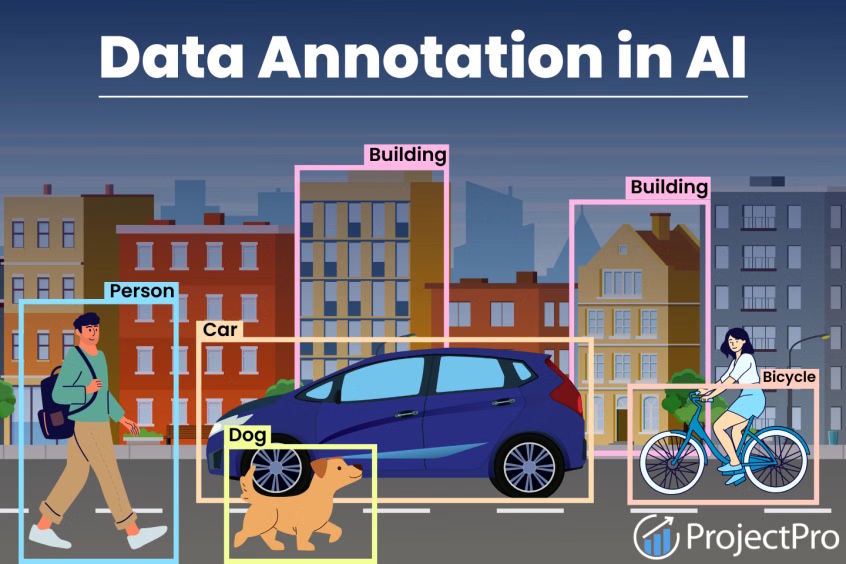
Building an AI prototype with a small dataset is one challenge. Preparing training data for a model that needs to perform reliably in production is another.
As datasets grow, data annotation becomes more than a labeling task. Teams need to maintain consistent definitions across thousands of examples, resolve ambiguous cases, monitor quality and update guidelines as models reveal new errors.
Adding annotators can increase throughput, but it can also introduce variation. Automation can accelerate straightforward tasks, but automated labels still need appropriate validation.
This is why data annotation at scale requires an operating model that can increase capacity without losing control over training data quality.
Why Data Annotation Gets Harder at Scale
In supervised machine learning, labels provide examples from which models learn. A small image classification project may begin with a few thousand images assigned to straightforward categories. A production computer vision system may eventually require much larger datasets covering different objects, environments and edge cases. To meet these scale and compliance requirements without collecting raw data from scratch, teams often turn to ethical AI datasets like DepositPhotos - sourcing millions of commercially licensed, pre-annotated images complete with rich metadata and model releases.
As volume increases, several challenges emerge:
- More annotators need to interpret the same guidelines
- More edge cases appear
- Quality review becomes more complex
- Annotation requirements change as models evolve
- Dataset versions become harder to manage
- Throughput must increase without reducing consistency
Scaling annotation therefore cannot mean simply adding more people. The workflow itself needs to scale.
What a Scalable Annotation Pipeline Looks Like
A production annotation workflow can generally be represented as:
Raw data → Guidelines → Annotation → Quality control → Accepted dataset → Model training → Error analysis → Refinement
The feedback loop is critical.
Annotation is not necessarily finished when every item receives a label. Model training can reveal weaknesses in the dataset.
A computer vision model may struggle under certain lighting conditions. A speech model may perform poorly with particular accents. An NLP system may repeatedly confuse similar entities.
Those findings should feed back into the data operation. Teams may need to collect new examples, clarify label definitions or re-annotate problematic data.
At scale, annotation becomes an iterative part of model development.
Where Annotation Quality Breaks Down
More data can expose problems that were less visible during prototyping.
Ambiguous Guidelines
Consider a sentiment dataset with three categories: positive, neutral and negative.
A review saying, “The product is good, but delivery was terrible” does not fit neatly into one category.
Without a defined rule, annotators may reach different conclusions.
Guidelines therefore need more than label names. They should include definitions, examples, edge cases and escalation rules.
Annotator Disagreement
Two trained annotators can interpret the same example differently, particularly with subjective tasks such as sentiment, intent classification or content moderation.
Disagreement can indicate a training issue, but it can also expose an unclear taxonomy. Adding more QA will not solve an ambiguous category definition.
Annotation Drift
Rules can gradually become inconsistent as new edge cases appear and requirements change.
Guidelines should therefore be maintained as a living document. When a rule changes, teams need to know what changed and whether previously annotated data needs to be reviewed.
Dataset Coverage
Correct labels do not automatically create a representative dataset.
A vehicle-detection dataset could contain highly accurate annotations but mostly daytime images. The model may still struggle at night or in poor weather.
Quality therefore involves both annotation accuracy and dataset coverage.
Define Quality Before Optimizing Throughput
“How many images can we annotate per day?” is an important operational question.
But first ask:
What constitutes an acceptable annotation?
Quality requirements vary by task. Simple image classification may require only the correct category, while autonomous-driving datasets may require object classes, precise boundaries and consistent tracking across frames.
Quality controls can include:
- Reviewer checks
- Sampling
- Multiple-annotator consensus
- Gold-standard tasks
- Automated validation
- Error categorization and rework
The appropriate method depends on task complexity and the consequences of incorrect labels.
The principle is straightforward: define quality first, then optimize throughput within that standard.
Human Annotation or Automation?
Automation can help annotation operations scale.
Existing models can generate preliminary labels, rules can validate structured outputs and annotation tools can automate repetitive actions.
However, human judgment remains important when:
- Context is ambiguous
- Labels require domain expertise
- Language or cultural nuance matters
- Edge cases carry significant risk
- Categories are still evolving
For many AI projects, the practical model is therefore human-in-the-loop annotation: automate predictable work while directing human attention to uncertain or complex examples.
When Internal Annotation Stops Scaling
During early development, engineers or domain specialists may annotate data themselves. This can help teams understand the dataset and refine the taxonomy quickly.
As volumes grow, however, annotation becomes an operational workload of its own.
Teams need to recruit and train annotators, conduct QA, resolve disagreements, maintain guidelines and manage changing demand.
At that stage, consider:
|
Factor |
Question |
|---|---|
|
Volume |
How much data needs annotation across future cycles? |
|
Complexity |
Does the task require specialist knowledge? |
|
Quality |
How much validation is required? |
|
Variability |
Does demand change between model iterations? |
|
Languages |
Are multilingual annotators required? |
|
Security |
What information will annotators access? |
|
Scalability |
How quickly must capacity change? |
Teams facing these constraints may consider scaling AI models with data annotation outsourcing to add operational capacity while allowing internal AI specialists to focus on model development, dataset strategy and complex exceptions.
Outsourcing does not remove the AI team's responsibility for training data. It changes how parts of the annotation operation are resourced.
What to Evaluate Before Outsourcing Data Annotation
Cost per label should not be the only selection criterion. A low-cost annotation provides little value if extensive correction is required afterward.
Evaluate the provider across several areas.
Annotation Capability
Can the team support the required data types and techniques, such as image classification, bounding boxes, segmentation, text classification, speech transcription or video tracking?
Quality Assurance
Ask how accuracy is calculated, which work is reviewed, how disagreements are resolved and how recurring errors are investigated.
An accuracy percentage without a clear measurement method provides limited information.
Scalability
Ask how additional capacity is added when volume increases and how new annotators are trained without reducing consistency.
Data Security
Annotation datasets may contain confidential, personal or commercially sensitive information.
Understand who can access the data, how access is controlled, where information is processed and what security procedures apply to the delivery environment.
This is also where recognized information security standards can help buyers assess a provider's governance framework. Innovature maintains ISO/IEC 27001:2022 certification, supporting a structured information security management approach across its service delivery.
Reporting
AI teams should retain visibility into the operation.
Useful reporting may include throughput, acceptance rate, error categories, rework, backlog and turnaround.
Innovature supports AI teams with data annotation and labeling services across image, video, text and audio datasets, with delivery models structured around project volume, annotation requirements and quality controls.
The important question is not how long a provider's capability list is. It is whether its operating model fits the dataset and the AI development cycle.
Test Before You Scale
Before transferring a large dataset, run a representative pilot.
Include normal inputs as well as difficult cases, ambiguous examples, rare classes and examples requiring escalation.
The pilot should test more than accuracy. It should reveal whether:
- Guidelines are clear
- Annotators identify ambiguous cases
- QA catches meaningful errors
- Escalations are handled consistently
- Reporting provides useful visibility
Use the results to refine the workflow before increasing volume.
Discovering an unclear taxonomy during a pilot is much easier to correct than finding the same problem after a large dataset has already been annotated.
Better AI Requires a Better Data Operation
Scaling an AI model requires more than increasing the size of its training dataset.
The annotation operation needs clear definitions, consistent execution, appropriate quality controls and a feedback loop connecting training data with model performance.
Automation can increase throughput. External teams can add capacity. Annotation platforms can improve workflow management.
But none replaces a well-designed data operation.
Before scaling, AI teams should be able to answer four questions:
What needs to be labeled?
What does a correct annotation look like?
How will quality be measured?
How will model feedback improve the next annotation cycle?
Once those questions have clear answers, scaling becomes much more manageable.
The goal is not simply more labeled data. It is better training data at the scale the model actually needs.

