

Machine Vision Consultants: What They Do and How to Find One Who Delivers
Machine vision and computer vision are terms that get used interchangeably in some contexts and quite differently in others.
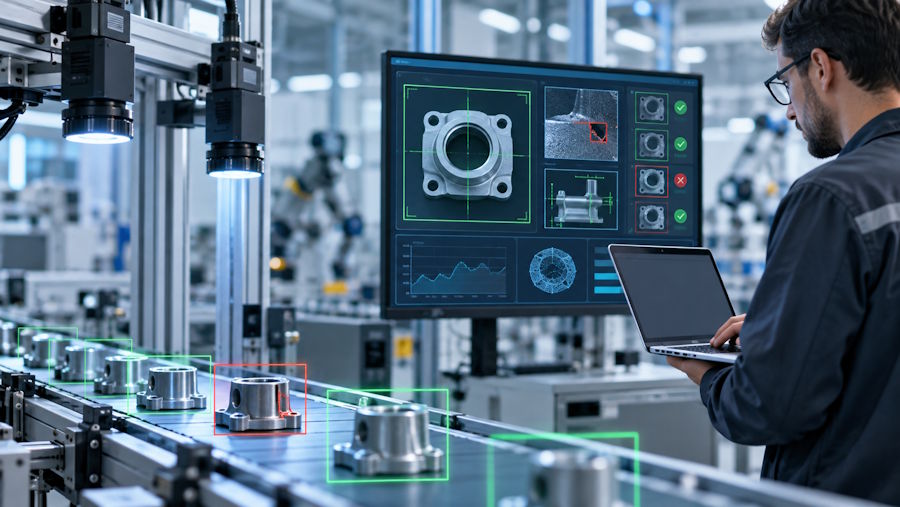
In industrial and manufacturing contexts, "machine vision" typically refers to camera-based inspection and measurement systems — quality control, dimensional measurement, defect detection, assembly verification. The term carries specific connotations about hardware (industrial cameras, structured lighting, precise mechanical integration) and about the real-time performance requirements of production line deployment.
Machine vision consultants work primarily in the industrial domain. The expertise they bring — understanding of industrial imaging hardware, real-time inference requirements, production line integration, and the specific defect types that appear in manufacturing — is domain-specific in ways that generalist computer vision expertise doesn't fully cover.
What Machine Vision Consultants Actually Do
System design and hardware selection. Machine vision deployments require specific hardware decisions: camera type (area scan vs. line scan), sensor resolution, lens selection, working distance, lighting design. Getting these wrong produces data that no algorithm can compensate for. Machine vision consultants with hardware experience make these decisions as part of the system design, not as afterthoughts.
Imaging setup and calibration. Consistent, controlled imaging conditions are the foundation of reliable machine vision. Machine vision consultants design the physical setup — camera mounting, lighting enclosures, conveyor integration, trigger timing — to produce images that are consistent enough for accurate model performance.
Algorithm and model development. The machine vision models themselves — defect classifiers, dimensional measurement algorithms, assembly verification systems. Consultants with deep machine vision experience know which approaches work for which defect types and what accuracy levels are achievable under realistic conditions.
Production line integration. Machine vision systems need to interface with production line control systems — PLCs, SCADA systems, MES platforms. This requires knowledge of industrial communication protocols (OPC-UA, Modbus, Profinet) and real-time performance requirements.
Validation and qualification. For regulated industries — pharmaceuticals, medical devices, automotive — machine vision systems require formal validation. Machine vision consultants with regulated industry experience design validation protocols as part of the system, not as a separate project after deployment.
The Domain Knowledge That Makes Machine Vision Consulting Different
Machine vision consulting is more domain-specific than general software consulting. The specific knowledge that experienced machine vision consultants bring is hard to substitute:
Defect type knowledge. A consultant who has worked extensively on surface defect inspection for injection-molded plastic parts knows which defect types are commonly confused, which lighting approaches reveal which defects, and what the realistic accuracy ceiling is for specific defect categories. This knowledge comes from having built and deployed these systems.
Material-specific imaging expertise. Metal, plastic, glass, textile, food — each material has different reflectance properties requiring different lighting and camera approaches. The consultant unfamiliar with specular surfaces may not know that diffuse illumination that works for matte surfaces produces unusable images on metal or glass.
Production speed constraints. Machine vision on a production line operates under real-time constraints. The inference needs to complete within the cycle time of the line. A consultant unfamiliar with production line speeds may design a system that's accurate but too slow.
False positive and false negative asymmetry. In manufacturing, a false negative (defective product accepted) and a false positive (good product rejected) have different costs. Machine vision consultants with manufacturing experience help clients understand this asymmetry and design system sensitivity accordingly.
The Questions That Surface Real Machine Vision Experience
"What lighting approach would you use for inspecting [describe your product surface]?"
This has a specific answer based on material properties. For matte surfaces, diffuse illumination. For specular surfaces, dark field or coaxial illumination. For dimensional measurement, telecentric illumination. A consultant who can give a specific answer has worked with real materials. One who says "it depends" without describing the decision factors hasn't.
"What accuracy level is realistically achievable for our defect types at our production speed?"
Realistic accuracy depends on defect type, defect size relative to image resolution, surface consistency, and imaging conditions. A consultant who asks about all of these factors before estimating has domain depth. One who quotes high accuracy without knowing these specifics is guessing.
"How do you handle new product variants that weren't in the training data?"
Production lines change. New product variants, new suppliers, new specifications. How a consultant plans for this — retraining processes, modular training data management, generalization testing — reveals whether they've thought about the full lifecycle.
"Walk me through the validation protocol you'd design for this system."
A consultant who can describe a specific validation protocol — IQ, OQ, PQ — has been through the process. One who treats validation as a separate question from system design hasn't.
What Machine Vision Consulting Portfolios Don't Show
Portfolio case studies show defect detection systems with 99%+ accuracy and seamless line integration. What they don't show is what happened after launch.
The questions that surface post-launch reality:
- "What happened to accuracy numbers six months after deployment, as product and production conditions evolved?"
- "How did you handle changeover when a new product variant was introduced?"
- "What was your most difficult integration with an existing production line control system?"
Specific, detailed answers — including what went wrong and how it was addressed — indicate consultants who have been present for the full lifecycle. Vague answers indicate experience that ends at delivery.
The Engagement Structure That Works for Machine Vision Projects
| Phase | Distinctive Consideration | Common Mistake |
|---|---|---|
| Hardware specification | Long lead times — specify early | Waiting until algorithm is developed |
| Imaging setup | Rarely finalized in one pass — plan for iteration | Treating setup as one-time activity |
| Training data collection | Best data comes from actual production environment | Using lab samples only |
| Acceptance testing | Lab conditions AND production run comparison | Lab-only testing |
| Post-deployment | Models drift as conditions change — plan monitoring | No monitoring designed |
Machine vision consultants who plan for these distinctive phases produce projects that proceed more smoothly and deployments that hold up longer than those who apply a generic software development project structure.
Machine vision consultants who deliver production value bring hardware expertise, domain-specific defect knowledge, production integration experience, and post-deployment lifecycle thinking that general computer vision expertise doesn't fully provide.
The questions above surface which consultants have this combination before you've committed the engagement to finding out through experience.

