

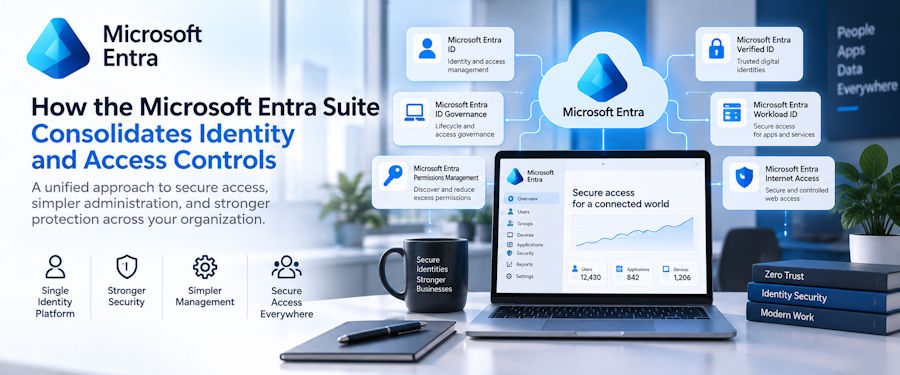
For years, identity, network access, and application permissions have lived in separate systems, each managed by different teams, governed by different policies, and rarely talking to one another in any meaningful way. That fragmentation made sense when these functions genuinely operated independently. It makes far less sense now, when a single compromised credential can move laterally across network segments and application permissions in minutes. Consolidating these controls under one coherent strategy has become less of an optional efficiency gain and more of a practical security necessity. Microsoft has approached this problem by bundling previously separate identity and access tools into a single suite, aiming to close the gaps that formed when these systems were managed in isolation.
The Cost of Fragmented Access Management
Fragmentation doesn't just create inefficiency; it creates blind spots. When identity governance sits in one platform, network access policies in another, and application permissions in a third, no single team has a complete picture of what any given user can actually access across the environment. A departing employee might be properly removed from the identity directory while retaining lingering VPN access or application-level permissions that nobody remembered to revoke, simply because the deprovisioning process spanned three disconnected systems instead of one.
These gaps tend to widen as organizations grow. What starts as a manageable set of separate tools becomes, after a few years of mergers, new hires, and shifting vendor relationships, a genuinely difficult environment to audit. Security teams conducting access reviews often find themselves reconciling data across multiple exports, each with different formats and update schedules, which slows down what should be a routine governance task into a time-consuming manual project.
What Consolidation Actually Solves
Bringing identity, network access, and permissions management into a single platform addresses this fragmentation directly, but it's worth being specific about what consolidation solves and what it doesn't. It doesn't eliminate the underlying complexity of managing access across a modern, distributed environment. What it does is give IT and security teams a single, consistent source of truth for access decisions, rather than requiring them to stitch together policy logic across disconnected systems.
By combining identity governance and network access capabilities, Microsoft Entra Suite gives organizations a way to coordinate access decisions across their environment, although teams still need to configure policies carefully and verify that changes reach the systems that depend on them. This means a change to a user's identity status, such as a role change or departure, can propagate consistently across network and application access rather than requiring separate manual updates in each system. For organizations that have struggled with the kind of deprovisioning gaps described earlier, this shared framework closes a significant portion of the risk that fragmentation created in the first place.
Practical Benefits Beyond Security
While the security case for consolidation is the most obvious driver, the operational benefits deserve equal attention, since they're often what determines whether a project gets sustained organizational support beyond the initial rollout. IT teams managing separate systems typically maintain separate documentation, separate training materials, and separate troubleshooting processes for each tool. Consolidating these functions reduces that overhead considerably, freeing staff time that would otherwise go toward maintaining parallel systems that accomplish related but disconnected goals.
A few specific operational gains tend to stand out once identity, network, and application access controls share a common platform:
- Faster onboarding and offboarding, since access changes apply consistently across systems rather than requiring separate manual steps
- Simplified audits, with a single reporting layer instead of reconciled exports from multiple tools
- Reduced help desk burden, as access issues become easier to diagnose when policies live in one place
- More consistent policy enforcement, since exceptions are less likely to accumulate unnoticed across disconnected systems
These gains compound over time. A single onboarding process that used to require coordination across three different teams and systems becomes a task one administrator can complete with far less back-and-forth, and that efficiency scales as the organization grows.
Building an Integrated Strategy Rather Than a Patchwork Rollout
Consolidation only delivers on its promise if the underlying strategy is genuinely integrated rather than simply layering a new tool on top of existing fragmented processes. Organizations sometimes adopt a unified platform without actually reworking the policies and workflows that made their previous environment fragmented in the first place, which limits the practical benefit considerably. The tool changes, but the underlying organizational habits, like separate teams managing separate approval processes, remain the same.
A genuinely integrated strategy involves rethinking these workflows alongside the technical rollout. That means identity, network, and security teams collaborating on shared policy definitions from the start, rather than each team configuring their portion of the suite independently and hoping the pieces align. It also means establishing clear ownership for cross-cutting decisions, such as who approves a new access policy that touches both network segmentation and application permissions, since ambiguous ownership tends to recreate the same silos the consolidation was meant to eliminate.
Final Analysis
Consolidating identity, network, and application access controls addresses a real and growing risk in how organizations manage security across increasingly interconnected systems. The technical capability to unify these functions matters, but it only produces meaningful results when paired with a genuine rethinking of the workflows and ownership structures that created fragmentation to begin with. Organizations that approach consolidation as both a technical and organizational shift tend to see the clearest gains, both in reduced risk and in the day-to-day efficiency of managing access across an environment that has only grown more complex over time.

