

Security leaders at small and mid-sized organizations face a familiar contradiction. Boards expect a mature security posture, regulators expect documented controls, and customers expect assurances about data protection. Yet the teams responsible for delivering on all of this are often four or five people managing everything from endpoint monitoring to vendor risk reviews. The strategy documents look sound on paper. The gap shows up the moment that strategy has to be executed against real, daily threats. That gap is why a growing number of lean security teams are pulling in outside operators who work alongside them rather than simply advising from a distance.
The Widening Gap Between Security Strategy and Execution
Most lean teams do not lack direction. They have a roadmap, a risk register, and a reasonably clear sense of what needs to happen over the next twelve months. What they lack is bandwidth to act on all of it at the pace threats actually move. A phishing campaign does not wait for the next quarterly planning cycle, and a misconfigured cloud bucket does not stay exposed only during business hours.
Research from groups such as ISC2 has repeatedly pointed to a persistent shortfall between the number of security professionals organizations need and the number they can hire, particularly outside large enterprises with dedicated recruiting budgets. For a five-person team, one open requisition sitting unfilled for six months is not a minor staffing issue. It is the difference between having someone actively hunting for indicators of compromise and having nobody watching that queue at all. Strategy built by a well-run tabletop exercise still requires hands to implement it, and those hands are frequently the scarcest resource in the room.
What Forward-Deployed Cybersecurity Support Actually Looks Like
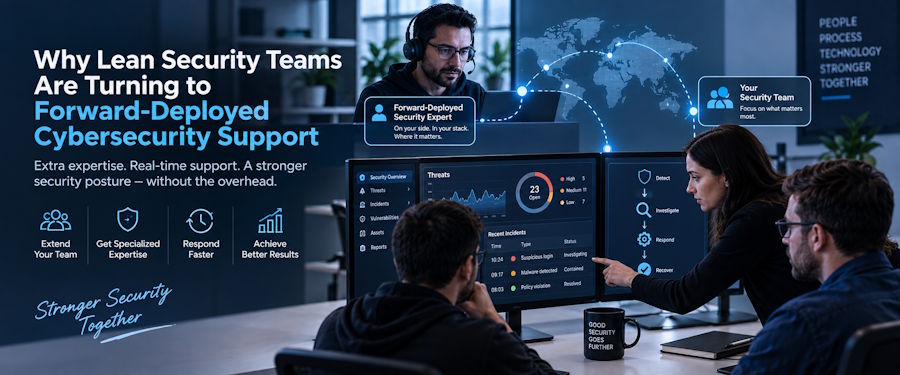
The term itself borrows from a military and product-engineering concept: specialists who embed close to the point of need rather than staying at headquarters. Applied to security operations, forward-deployed cybersecurity support means experienced practitioners working inside a team's actual environment, using its tools, and taking on real operational tasks rather than producing another advisory deck.
This is a meaningfully different relationship than a traditional consulting engagement. A consultant typically interviews stakeholders, reviews documentation, and delivers a report with recommendations that the internal team must then translate into action. Forward-deployed cybersecurity support skips that translation step. Specifically, it puts an experienced operator directly into incident triage, detection tuning, or control implementation, working the same tickets and dashboards the internal team already uses. Teams considering outside support can compare the agent-based approach described by Sidekick Security with hands-on engineering engagements, checking which operational tasks each model covers and where internal staff would still need to investigate findings or implement changes.
Turning Board-Level Priorities Into Daily Risk Reduction
Boards and executive committees think in terms of risk posture, compliance status, and material exposure. Practitioners think in terms of alerts, patches, and access reviews that need to happen before Friday. Translating between those two levels of abstraction is one of the hardest, least visible parts of a security leader's job, and it is often where strategy quietly stalls.
Forward-deployed cybersecurity support tends to close that translation gap because the people doing the work are close enough to both layers to move between them. An operator embedded in daily operations can take a board-approved priority, such as reducing third-party access risk, and turn it into a concrete sequence: inventory current vendor integrations, flag the ones with excessive permissions, and remediate the highest-risk connections first. Because this happens inside the existing environment rather than through a separate reporting relationship, progress against strategic goals becomes something the team can actually point to in weeks, not quarters.
Where Lean Teams Feel the Pressure Most
Not every part of a security program strains equally under thin staffing. A few areas tend to surface the pressure first, and they are worth naming directly:
- Alert fatigue and triage backlog, where the volume of detections outpaces the hours available to investigate them properly
- Incident response coverage gaps, particularly outside standard business hours or during multi-day incidents that exhaust a small team quickly
- Delayed patch and configuration remediation, where known vulnerabilities sit open longer than policy allows simply because no one has time to close them
- Compliance evidence collection, which consumes disproportionate hours relative to the actual risk reduction it produces
- Tooling that goes underused, where an organization has purchased capable detection or SIEM platforms but lacks the staff time to tune and operate them well
Each of these is solvable individually. The problem is that a lean team is usually facing several of them at once, and triage decisions about which fire to fight first often mean something else quietly goes unattended.
Measuring Progress Without Adding Headcount
One reasonable objection to bringing in outside operational support is that it risks becoming a permanent crutch rather than a bridge to internal capability. Even so, well-structured engagements are built to avoid that outcome. The measure of success is not how many hours an external specialist logs, but whether the internal team's own capacity and maturity improve over the engagement period.
Practical indicators tend to include shrinking mean time to detect and respond, a declining backlog of unaddressed findings, and internal staff gradually taking over tasks that were initially handled by the embedded specialist. Meanwhile, documentation and runbooks produced during the engagement should remain with the organization, not with the outside team, so that knowledge transfer is built into the work rather than treated as an afterthought. A security leader evaluating this kind of support should ask directly how progress will be tracked and what the internal team is expected to own by the end of the engagement, because those answers reveal whether the arrangement is designed to build capability or simply to fill a gap indefinitely.
Key Takeaways
Lean security teams are not turning to forward-deployed support because their strategy is weak. In most cases, the strategy is reasonable, and the problem is capacity to execute it against threats that do not pause for planning cycles. Embedding experienced operators directly into daily security work closes the distance between board-level priorities and the operational steps needed to reduce actual risk.
The organizations getting the most value from this approach treat it as a way to build internal muscle over time, not as a permanent substitute for it. They track concrete metrics, insist on documentation that stays in-house, and use the engagement to work through the specific pressure points, whether that is alert backlog, incident coverage, or delayed remediation, that a small team cannot absorb alone. For security leaders weighing their options, the more useful question is rarely whether outside help is needed. It is whether that help will be embedded closely enough to move the needle on the risks that matter most right now.

