

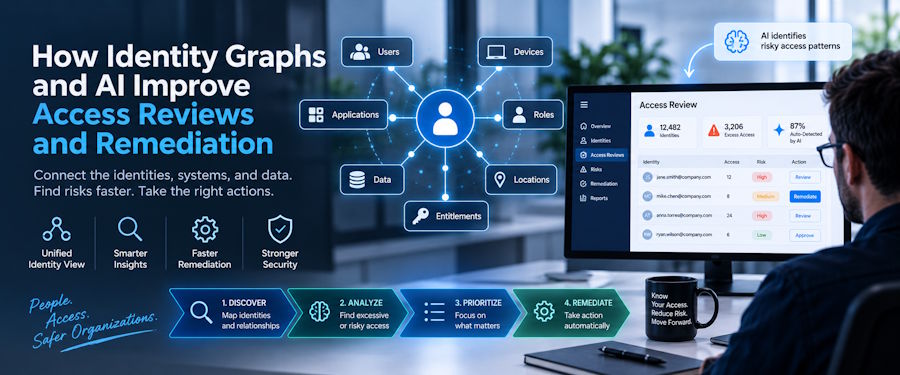
Access governance has quietly become one of the most difficult problems in enterprise security. Every new application, cloud service, and contractor account adds another thread to an already tangled web of permissions. Security and IT teams are expected to know who has access to what, why they have it, and whether that access still makes sense, yet most organizations answer these questions with spreadsheets, quarterly certification campaigns, and a fair amount of guesswork. The result is predictable: access reviews that take weeks, approvals granted out of fatigue rather than judgment, and orphaned permissions that linger long after an employee changes roles or leaves the company.
Why Traditional Access Models Break Down at Scale
Most identity and access management programs were built around static roles and periodic reviews. A user is assigned a role, that role maps to a set of entitlements, and once a year (or quarter, if the organization is disciplined) a manager is asked to confirm the access is still appropriate. This approach worked reasonably well when environments were smaller and change happened slowly. It struggles badly now.
Modern enterprises run dozens or hundreds of applications, many of them SaaS platforms with their own permission structures that don't map cleanly onto a central role catalog. Employees move between teams, take on temporary projects, and accumulate access that nobody ever revokes. Reviewers, faced with long lists of technical entitlements and little context, often click "approve" simply to clear the queue. Studies from various governance vendors and analyst firms have repeatedly pointed to rubber-stamping as one of the biggest weaknesses in traditional access certification, and it's easy to see why: asking a line manager to evaluate dozens of unfamiliar permission names against no real context is setting them up to fail.
What Identity Graphs Add to the Picture
This is where identity graphs change the equation. Rather than storing access data as disconnected rows in a table, a graph model represents users, groups, roles, resources, and permissions as nodes connected by relationships. That structure makes it possible to trace exactly how a person ended up with a given entitlement, whether directly assigned, inherited through a group, or granted via a nested role chain that would be nearly impossible to reconstruct manually.
Graphs also make it far easier to spot patterns that flat data hides. Toxic combinations of entitlements, unusual paths to privileged systems, and access that no one else on a team holds all become visible when relationships are mapped rather than listed. A reviewer looking at a graph can see not just that someone has access, but how they got it and who else shares a similar footprint, which turns a blind approval decision into an informed one. Platforms like Linx Security Modern IGA are built around this exact idea, treating access as a connected structure rather than a flat, role-based list the way most legacy tools still do.
Where AI-Assisted Automation Fits Into Reviews
Even a well-built identity graph produces a lot of information, more than a human reviewer can reasonably process line by line across a large organization. That's where automation, and specifically AI-assisted analysis, starts to matter. Machine learning models trained on access patterns can flag entitlements that deviate from what peers in the same role typically hold, surface access that has gone unused for extended periods, and prioritize the handful of decisions that actually carry risk instead of presenting every single grant with equal weight.
This shifts the reviewer's job from exhaustive checking to targeted judgment. Instead of scrolling through hundreds of rows, a manager might see a short list of anomalies: a contractor with standing access to a finance system, a former project lead who still holds admin rights on a repository they no longer touch, or a permission granted six months ago that has never once been used. Because the system does the pattern recognition, the human decision becomes faster and more accurate at the same time. In an access review, Linx Security's Modern IGA uses identity and access relationships to provide context for decisions, helping reviewers examine whether permissions still match a person's responsibilities rather than piecing that picture together from disconnected account lists.
Strengthening Policy Enforcement Through Contextual Data
Policy enforcement benefits from the same shift. A static rulebook, such as "no single user should hold both approval and payment permissions," is straightforward to write but hard to enforce consistently across dozens of applications with different naming conventions and access models. When policies are checked against a graph that already understands how entitlements connect across systems, violations can be detected as they form rather than discovered months later during an audit.
That contextual awareness also allows policies to be more precise. Instead of blanket restrictions that frustrate legitimate work, enforcement can account for factors such as how the access was granted, how long it has been active, and whether it fits the pattern of the person's actual role. This reduces both the number of false positives that burden IT teams and the number of genuine violations that slip through unnoticed.
A few practical outcomes of this contextual enforcement include:
- Faster detection of segregation-of-duties conflicts across cloud and on-premises systems
- Fewer unnecessary access requests caused by overly rigid, one-size-fits-all rules
- Clearer audit trails that show not just what was approved, but the reasoning behind it
Speeding Up Remediation Once Issues Are Found
Finding a problem is only half the challenge; fixing it quickly is where many organizations still lag. In traditional environments, remediation often means a manual ticket, a wait for the right administrator, and a delay that can stretch into weeks while risky access sits untouched. Automated remediation workflows, informed by the same graph data used for detection, can close that gap considerably.
When a system already understands the relationships behind an entitlement, it can suggest or even execute the correct remediation step: revoking a redundant permission, adjusting a group membership, or routing an exception request to the appropriate owner for review. This doesn't remove human oversight from sensitive decisions, but it does remove the friction of tracking down who owns a system or what the correct fix even looks like. Teams that have automated even the routine, low-risk remediation steps typically report that reviewers spend far more of their time on decisions that genuinely require judgment.
Key Takeaways
Access governance is not getting simpler, and the volume of entitlements across modern enterprise environments will keep growing. Identity graphs give organizations a way to see access as it truly exists, as a web of relationships rather than a flat list, while AI-assisted analysis helps reviewers focus on the decisions that matter instead of drowning in routine approvals. Combined with policy enforcement that understands context and remediation workflows that act on graph data directly, this approach addresses the weak points that have long undermined traditional access reviews: fatigue, guesswork, and delayed fixes. Organizations that adopt this model aren't just automating an old process; they're building a genuinely more accurate picture of who has access to what and why, which is the foundation any access governance program actually depends on.

