

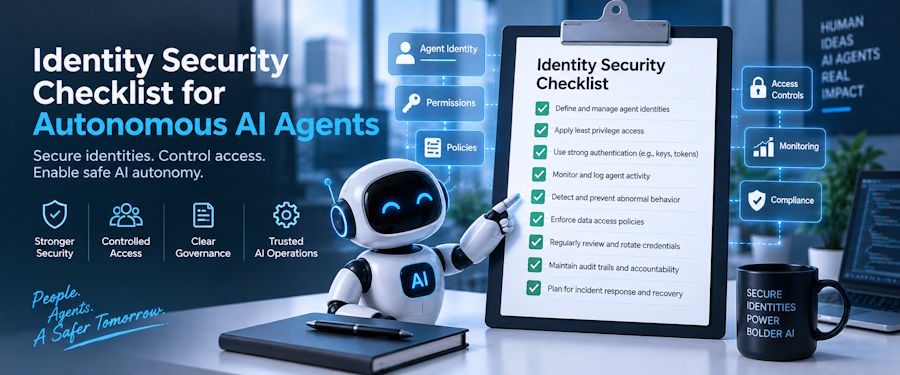
Autonomous AI agents are increasingly capable of performing tasks without continuous human direction. They can access applications, retrieve information, communicate with other systems, and make decisions based on predefined goals. That autonomy creates a fundamental identity-security challenge: an agent that can act independently must also have an identity that can be authenticated, authorized, monitored, and revoked.
Traditional security models often focus on employees, administrators, and conventional applications. Autonomous agents introduce another category of identity that can operate at machine speed and potentially interact with many resources. Microsoft describes agent identities as specialized identity constructs that allow organizations to distinguish agent activity, apply appropriate access controls, and manage agent lifecycles.
A practical identity-security checklist therefore needs to address more than credentials. It should cover ownership, permissions, authentication, lifecycle management, monitoring, and incident response. These controls provide the foundation for preventing identity attacks while allowing legitimate autonomous agents to perform their assigned functions.
Establish a Unique and Accountable Agent Identity
Every autonomous agent should have a distinct identity rather than operating through a shared administrator account, generic service account, or another employee's credentials. A unique identity makes it possible to determine which agent performed an action and separates its permissions from those of users and other workloads.
The identity should also have clearly documented ownership. A human sponsor or responsible administrator should understand why the agent exists, what systems it can access, who approved those permissions, and when the identity should be disabled. Microsoft Entra's agent identity governance model specifically emphasizes human sponsorship and lifecycle accountability.
This accountability becomes especially important as organizations deploy multiple copies of similar agents. An identity blueprint can provide standardized security settings for a group of agents, helping administrators apply consistent policies instead of configuring every instance independently.
For organizations focused on reducing autonomous identity threats, the first checkpoint should therefore be simple: every autonomous agent must be identifiable, attributable, and connected to a responsible human or organizational owner.
Apply Least Privilege to Autonomous Agent Access
An autonomous agent should receive only the permissions necessary to accomplish its defined tasks. Broad permissions create unnecessary exposure because an agent can potentially use every privilege available to its identity, even when those privileges are unrelated to its normal function.
Least privilege should be applied at several levels. Organizations should evaluate which applications the agent needs, which APIs it must call, what data it can access, and which administrative actions are genuinely required. High-impact permissions deserve particular scrutiny because compromise of an agent with broad directory or application privileges can create consequences beyond the agent's original purpose.
This principle is central to preventing agent identity attacks because excessive permissions increase the potential impact of stolen tokens, manipulated workflows, compromised tools, or unauthorized agent behavior. Access should be approved according to the agent's actual responsibilities rather than its possible future requirements.
Time-bound access can provide another layer of protection. Microsoft Entra access packages can be used to make agent assignments intentional, auditable, and time-limited rather than relying on permanent, ad-hoc permissions.
Secure Authentication, Tokens, and Credentials
Authentication controls should be designed around the way an autonomous agent actually operates. Agents may authenticate directly to resources, act on behalf of a user, or communicate with other agents and applications. These scenarios should not be treated as interchangeable because they carry different authorization and accountability implications.
Long-lived secrets should be avoided wherever stronger identity mechanisms are available. Organizations should use secure token-based authentication, managed identity capabilities, workload identity federation, or other appropriate mechanisms rather than embedding credentials in source code, configuration files, prompts, or agent instructions.
Token permissions also deserve careful attention. A valid token is not inherently safe simply because it was issued by a trusted identity provider. The security question is what the token permits the agent to do and whether that access remains appropriate for the current context.
Modern agent identity platforms increasingly support purpose-built authentication and authorization mechanisms for autonomous and delegated scenarios. Microsoft Entra Agent ID, for example, distinguishes autonomous access from delegated access and provides identity-specific audit information.
Monitor Agent Behavior and Detect Identity Abuse
Identity protection cannot stop at authentication. Security teams should monitor what autonomous agents do after they receive access. Unexpected resource access, unusual authentication patterns, repeated failed requests, sudden permission changes, or activity outside an agent's normal operating profile can indicate compromise or misuse.
Logging should make agent activity distinguishable from human and conventional workload activity. Important events include authentication attempts, token issuance, permission changes, resource access, administrative actions, and identity lifecycle events. Centralized logs allow security teams to correlate agent behavior with other signals and investigate suspicious activity more efficiently.
Risk-based controls can strengthen this process. Microsoft Entra ID Protection for agents can identify abnormal behaviors such as unfamiliar resource access, sign-in spikes, and failed access attempts. Organizations can then investigate risky agents or use Conditional Access policies to restrict access based on risk.
Monitoring should also establish behavioral expectations before an incident occurs. If an agent normally accesses a limited set of applications during defined workflows, a sudden attempt to reach unrelated sensitive resources should receive greater scrutiny. Detection becomes more effective when security teams understand normal agent behavior rather than relying exclusively on static rules.
Control Agent Lifecycle and Permission Changes
Autonomous agents should not remain active indefinitely simply because nobody remembers to disable them. Their identities need a defined lifecycle covering creation, approval, deployment, modification, periodic review, suspension, and retirement.
Organizations should review whether each agent is still necessary, whether its sponsor remains accountable, and whether its permissions continue to match its business purpose. Changes to an agent's tools, model, workflow, or connected applications should also trigger a security review when those changes could affect its access requirements.
Lifecycle governance is particularly important for preventing agent sprawl. An abandoned agent with valid credentials or resource permissions can become an overlooked attack path. Microsoft recommends lifecycle controls, access reviews, sponsor oversight, and mechanisms for disabling agents when they are no longer required.
Blueprint-level controls can further simplify administration by allowing security policies and permissions to be applied consistently across groups of similar agents. This reduces the likelihood that individual deployments gradually drift away from organizational security standards.
Prepare for Rapid Containment and Recovery
Even strong preventive controls cannot guarantee that an autonomous agent will never be compromised. Organizations therefore need a response plan that assumes an identity may become unsafe and defines exactly how access will be contained.
Security teams should know which administrators can disable an agent, revoke its access, remove permissions, investigate its activity, and determine whether related identities were affected. Response procedures should also identify the resources that could be exposed if the agent were compromised.
Automated containment can be particularly valuable for high-risk situations. Conditional Access policies can restrict agent identities, while risk-based controls can block agents when specified security conditions are met. Microsoft documentation also describes the ability to disable individual agents, agent blueprints, or agent authentication more broadly when necessary.
Recovery should include more than restoring the agent's access. Security teams should determine how the compromise occurred, review changes made by the agent, rotate affected credentials or tokens where appropriate, reassess permissions, and verify that the agent's configuration remains trustworthy before returning it to operation.
End Note: Make Identity Security Continuous
Autonomous AI agents require identity controls that evolve with their capabilities and operating environments. A secure deployment begins with a unique identity and accountable owner, then extends through least-privilege authorization, strong authentication, behavioral monitoring, lifecycle governance, and rapid containment.
The most important principle is to treat an autonomous agent as an identity with real authority rather than simply another software component. Its permissions should be deliberate, its actions should be attributable, and its access should be continuously reviewable.
As agent deployments expand, organizations that build these controls into the identity lifecycle from the beginning will be better positioned to limit unauthorized access and contain identity-based threats. Security is not achieved by assigning an identity once—it depends on continuously verifying that the identity, permissions, behavior, and purpose of every autonomous agent remain aligned.

