

Software development used to have a fairly predictable rhythm.
Someone had an idea. A developer turned that idea into a technical plan, opened an editor, wrote thousands of lines of code, searched through documentation, fixed bugs, argued with a package manager, and eventually shipped something that worked.
Then came generative AI.
At first, AI coding tools looked like smarter autocomplete. They could suggest a function, explain an error, or finish a few lines of code. Useful? Absolutely. Revolutionary? Not quite.
The more interesting shift is happening now.
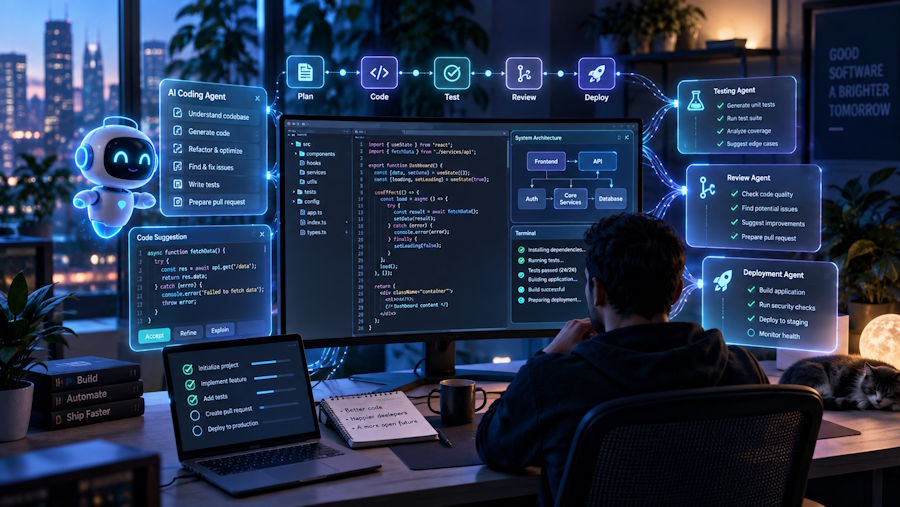
AI systems are moving beyond individual code suggestions and starting to participate in entire development workflows. They can inspect repositories, modify multiple files, run tests, investigate errors, work with APIs, and handle tasks that previously required a developer to jump between an editor, terminal, browser, documentation, and search results.
This new generation of tools is often described as AI coding agents.
And they are changing something more fundamental than how fast developers type.
They are changing how developers think about building software.
From Code Completion to AI-Powered Development
The difference between an AI coding assistant and an AI coding agent may sound like a small technical distinction, but it has a surprisingly large impact.
Traditional coding assistants usually work inside a relatively narrow loop. A developer writes something, the AI predicts what might come next, and the developer accepts, rejects, or modifies the suggestion.
An AI coding agent operates at a different level.
Instead of asking:
“Can you write this function?”
a developer can ask:
“Find why the payment flow fails when a coupon is applied, fix the issue, add a regression test, and explain the changes.”
That request contains several separate tasks.
The agent has to understand the project, locate relevant code, reason about the bug, make changes, test those changes, and potentially repeat the process if something fails.
This is closer to delegating a small engineering assignment than asking an AI to autocomplete a sentence.
The growing adoption of coding agents reflects this shift. A 2026 JetBrains developer survey reported that 39% of professional developers worldwide were using Claude Code at work during May–July 2026, up from 18% in January. The same research reported rapid growth for other agentic coding tools as well.
The important story isn't a single percentage, though.
It is the change in behavior behind it.
Developers are increasingly comfortable giving AI larger pieces of the development process.
Why Claude Code Has Become Part of the Conversation
Among the newer generation of coding agents, Claude Code has attracted considerable attention because its workflow is built around working with an actual development environment rather than simply answering programming questions in a chat window.
That distinction matters.
Real software projects are messy.
A repository might contain hundreds or thousands of files. A bug may originate in one service but become visible somewhere completely different. A seemingly harmless change can break a test, an API integration, or a database query three directories away.
An AI that only sees the code pasted into a chat box has limited context.
An agent that can inspect the project has a much larger picture.
This makes tools such as foxwire.ai interesting within the wider AI developer ecosystem, where access to models, APIs, and developer-focused AI infrastructure is becoming increasingly important.
The practical appeal of agentic coding is straightforward: developers can spend more time describing the desired outcome and less time manually coordinating every intermediate step.
That doesn't mean the developer disappears.
Quite the opposite.
The developer becomes the person responsible for defining the task, checking the result, and deciding whether the implementation is actually good enough.
What Developers Actually Do With Coding Agents
The easiest way to understand AI coding agents is to look at ordinary development work.
Consider a developer maintaining a SaaS application.
A customer reports that the dashboard occasionally displays outdated information.
The old process might involve manually tracing API calls, checking database queries, inspecting caching logic, reproducing the issue, and reading through several modules.
With an agentic workflow, the developer can provide the problem and ask the AI to investigate.
The agent may inspect the relevant files, identify suspicious logic, trace dependencies, suggest a likely cause, and make a proposed fix.
If tests already exist, it can run them.
If the fix breaks something, it can inspect the failure and try again.
The developer remains in control, but the amount of mechanical investigation can be reduced.
This pattern applies to many other tasks:
- Refactoring old code
- Writing unit tests
- Updating dependencies
- Creating API integrations
- Generating documentation
- Fixing bugs
- Migrating components
- Building internal tools
- Reviewing pull requests
- Investigating build failures
- Automating repetitive development tasks
The common theme is that the AI is working on a goal, rather than merely producing a line of code.
The Rise of Vibe Coding
While AI coding agents are becoming more capable, another development trend has captured the imagination of people outside traditional software engineering: vibe coding.
The concept is simple enough.
Instead of starting with a detailed technical specification, a person describes what they want in ordinary language and lets AI turn the idea into software.
For example:
“Build a simple web app where users can upload a CSV file, view the data in a dashboard, filter rows, and export the results.”
A developer could spend hours setting up the project structure and implementing the basic interface.
With AI-assisted development, a first version can appear much faster.
That speed is especially attractive to founders, designers, marketers, researchers, and independent developers who have ideas but don't necessarily want to spend weeks writing boilerplate.
Vibe coding effectively lowers the cost of experimentation.
You can have an idea in the morning and a working prototype by the afternoon.
The prototype might be ugly.
It might have questionable architecture.
It might contain code that makes experienced developers raise an eyebrow.
But suddenly the idea exists.
And that changes the conversation.
Instead of debating whether something could be built, people can build a rough version and see whether anyone actually wants it.
Vibe Coding Does Not Mean “Forget About Engineering”
There is, however, an important catch.
AI makes it easier to create software.
It does not automatically make that software reliable.
A generated application can appear impressive while hiding security vulnerabilities, inefficient database queries, fragile dependencies, or poor error handling.
This becomes particularly important when an experimental prototype evolves into a real product.
The first version might survive with messy code.
A production application handling customer data and payments probably should not.
This is why the most useful interpretation of vibe coding is not “AI replaces engineering.”
It is closer to:
AI makes the first 80% of an idea dramatically easier to explore.
The remaining work can still require architecture, testing, security reviews, performance optimization, and human judgment.
In other words, AI may make software creation less expensive without making software quality irrelevant.
Claude Code and the Agentic Workflow
Tools such as Claude Code illustrate how this workflow can move beyond simple prompting.
Instead of generating isolated snippets, an agent can participate in a sequence of development activities.
Imagine building a small SaaS product.
A developer might begin with:
“Create a user authentication system with email login, password reset, and protected dashboard routes.”
The first response isn't necessarily the end.
The developer might then say:
“Add validation and error states.”
Then:
“Write tests for the authentication flow.”
Then:
“Run the tests and fix any failures.”
Then:
“Review the implementation for obvious security issues.”
This resembles a conversation with a development partner.
The developer sets direction.
The agent handles increasingly complex chunks of implementation.
And because the interaction is iterative, the software can evolve through multiple rounds rather than being generated in one enormous prompt.
AI Coding Is Becoming More Multi-Model
Another major development is the rise of multi-model workflows.
For a long time, AI development often revolved around picking one favorite model.
Developers might have preferred one model for coding, another for writing, or another for reasoning.
But as the number of capable LLMs increases, the idea of using only one model for every task becomes less compelling.
Different models can have different strengths.
Claude may be selected for one type of coding task.
GPT may be useful for another workflow.
Gemini can make sense in environments where Google's ecosystem is important.
Developers may also experiment with models such as Kimi or DeepSeek, particularly when cost, context length, open-model availability, or specific capabilities matter.
The interesting trend is not which model wins.
It is that developers are increasingly treating models as interchangeable components.
Choosing the Right Model for the Job
Imagine an independent developer building an AI-powered productivity application.
They may need one model to analyze a complicated codebase, another to generate inexpensive routine outputs, and another to handle a specialized task through an API.
There is no reason every operation has to use the same model.
This is where multi-model development becomes particularly useful.
A development team can potentially route tasks based on:
- Reasoning requirements
- Response speed
- Context size
- API availability
- Token costs
- Coding performance
- Reliability
- Privacy requirements
- Output quality
This starts to resemble traditional infrastructure engineering.
Instead of asking, “Which AI model is the best?”
the better question becomes:
“Which model is appropriate for this particular job?”
That distinction could become increasingly important as AI becomes embedded in everyday software.
APIs Are Turning AI Into a Development Layer
AI APIs are another major part of this transition.
Developers no longer have to build every intelligent capability from scratch.
A SaaS application can connect to an LLM API for reasoning, a vision model for image analysis, a speech model for transcription, and another service for search or retrieval.
The application becomes an orchestration layer.
For example, imagine an AI customer-support platform.
A user's message could first pass through a classification model.
A retrieval system could then find relevant company documentation.
An LLM could generate the response.
A separate model might evaluate whether the answer follows company policy.
Finally, the application could log the interaction for future analysis.
None of these components necessarily needs to come from the same provider.
That modularity is one reason multi-model development is becoming increasingly attractive.
The New Opportunity for Indie Developers
Independent developers may have particularly good reasons to embrace AI coding agents.
Building software alone has always involved wearing too many hats.
One minute you're writing backend logic.
The next you're fixing CSS.
Then you're configuring deployment.
Then you're reading an API document that appears to have been written specifically to test your patience.
AI can reduce some of this friction.
A solo developer can use AI to create an initial interface, connect services, generate tests, investigate bugs, write documentation, and automate repetitive tasks.
This does not guarantee a successful startup.
It simply makes experimentation cheaper.
And cheaper experimentation can lead to more experiments.
That matters because many software ideas fail for reasons that have nothing to do with programming.
Nobody wants the product.
The market is too small.
The distribution strategy doesn't work.
Customers don't understand the value.
AI cannot magically solve those problems.
But it can make it easier to find out whether the problems exist.
SaaS Development Is Becoming More Iterative
Traditional SaaS development often involves relatively long cycles.
A feature is proposed.
Requirements are written.
Designs are created.
Developers implement the feature.
QA tests it.
The feature eventually reaches users.
AI-assisted development can shorten some parts of this loop.
A developer can create a small feature, test it, collect feedback, and modify it much faster.
This encourages a more experimental development culture.
Instead of spending weeks trying to predict exactly what users will want, teams can sometimes build smaller versions and learn from actual usage.
AI doesn't eliminate planning.
It can make iteration cheaper.
That difference is subtle but important.
Coding Agents Are Also Becoming More Collaborative
The next stage of AI coding is moving beyond one developer talking to one model.
Recent developments around Claude Code's Projects functionality point toward workflows where multiple AI agent sessions can work on separate tasks, share project-level context, and coordinate through a central workflow.
This suggests a future in which a developer might not interact with a single AI assistant at all.
Instead, there could be several specialized agents.
One investigates a bug.
Another works on the frontend.
Another writes tests.
Another reviews the changes.
The developer becomes the coordinator.
This is an important conceptual shift.
The AI isn't simply another button inside the IDE.
It becomes part of the team's workflow.
What Happens to the Developer?
This is probably the question people ask most often.
If AI can write code, debug applications, and handle increasingly complicated tasks, what exactly is left for developers?
Quite a lot.
Someone still needs to understand what the product should do.
Someone needs to decide which trade-offs are acceptable.
Someone needs to evaluate architecture.
Someone needs to recognize when the AI's solution is technically correct but completely wrong for the business.
And someone needs to take responsibility when production goes down at 2 a.m.
AI can produce code.
It does not automatically produce good product decisions.
That distinction is becoming more important as coding agents become more capable.
The Developer as an AI Orchestrator
The skill set of a modern developer may therefore expand rather than shrink.
Knowing programming languages still matters.
Understanding databases still matters.
Knowing how APIs work still matters.
But developers increasingly need another skill: working effectively with AI systems.
That includes writing clear instructions, providing useful context, breaking complicated tasks into manageable pieces, checking generated code, designing tests, selecting models, and knowing when not to trust an AI-generated answer.
In this environment, the developer becomes less like a person manually assembling every brick and more like an architect managing a team of extremely fast, occasionally overconfident assistants.
And yes, those assistants may occasionally insist that their code is “production-ready” five seconds before producing an error that turns the entire screen red.
Human review still has a job.
The Future of Modern Software Development
The most important change brought by AI coding may not be that developers write fewer lines of code.
It may be that the size of the task developers can delegate to AI keeps getting larger.
First, AI completed a line.
Then it generated a function.
Then a file.
Now it can work on features, investigate bugs, modify repositories, and participate in larger workflows.
The next step is likely to involve increasingly coordinated agents, stronger connections to APIs and developer infrastructure, and more sophisticated multi-model systems.
For developers, the practical lesson is fairly simple.
AI coding is no longer just about asking a chatbot for a code snippet.
It is becoming a new way of organizing software development.
Vibe coding makes experimentation faster.
Coding agents make complex tasks easier to delegate.
LLMs provide the reasoning layer.
APIs connect those models to real applications.
Multi-model development gives teams more flexibility.
And human developers remain responsible for turning all of that raw capability into software that people actually want to use.
The editor isn't disappearing.
The developer isn't disappearing either.
But the relationship between the two is changing—and the next generation of software may be built through a much more conversational, collaborative, and AI-assisted process than the one developers have known for the past few decades.

