

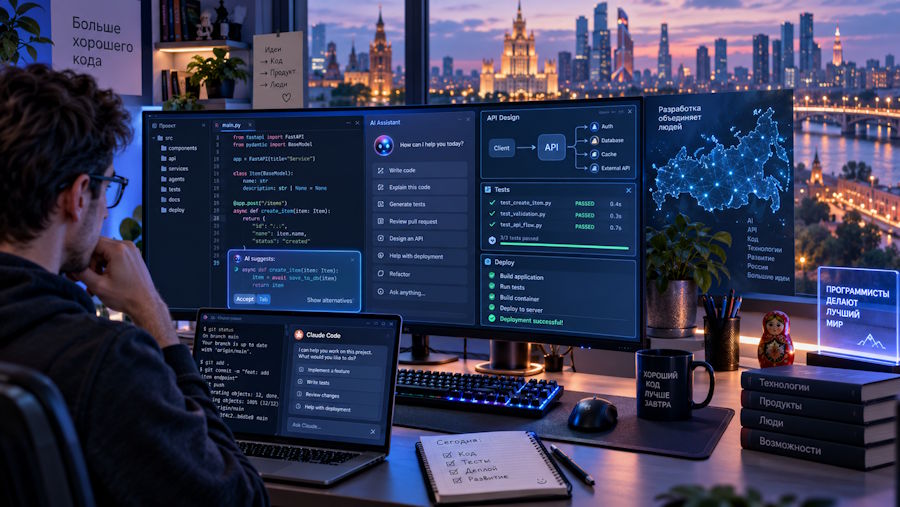
Artificial intelligence has moved far beyond the chatbot window. For developers, modern AI tools can inspect codebases, generate functions, debug errors, write tests, explain unfamiliar repositories, and even carry out multi-step development tasks from a terminal.
That shift is particularly interesting in markets where access to international AI services is not always straightforward. Russia is one example. Developers may encounter differences in service availability, account requirements, payment options, and API access depending on the provider and the product they want to use.
At the same time, the underlying technology continues to evolve quickly. Coding agents such as Claude Code are changing the traditional relationship between developers and software tools, while AI APIs are making it possible to build these capabilities directly into applications and internal workflows.
So what does the current AI development landscape look like, and why are developer access and API infrastructure becoming just as important as the models themselves?
AI Development Is Moving From Chat to Action
The first generation of AI coding assistants was relatively simple: ask a question, receive some code, copy it into an editor, and continue working.
Modern coding agents take a different approach.
Instead of treating AI as a sophisticated autocomplete system, developers can give an agent a larger objective. The system can inspect the repository, understand relationships between files, suggest an implementation plan, modify code, run commands, inspect errors, and iterate.
Anthropic describes Claude Code as an agentic coding tool that operates in the terminal. Its documented capabilities include editing files, running commands, investigating codebases, resolving problems, and interacting with development workflows.
This changes the economics of development.
A developer might previously spend an hour searching documentation, identifying where a bug lives, modifying several files, and running tests. With an AI coding agent, some of those steps can be delegated to the model.
The developer still makes the important decisions, but the amount of mechanical work handled by software can increase dramatically.
Why AI Tools in Russia Present a Different Access Problem
The technology itself is global, but access to AI services is not necessarily global.
Anthropic's documentation states that Claude Code requires an internet connection and is available in Anthropic-supported countries. Its standard authentication options include Anthropic Console, eligible Claude subscriptions, and certain enterprise cloud integrations.
For developers in unsupported markets, this creates a practical problem.
The challenge isn't simply finding an AI model capable of writing code. Developers also need a reliable way to authenticate, pay for usage where applicable, send API requests, and integrate the model into their existing development environment.
In Russia, these issues can become particularly relevant because international financial and service restrictions have complicated access to some Western technology platforms. Anthropic's published supported-country information should therefore be checked before assuming that a particular Claude product or account workflow will work from a specific location.
This is why the conversation around AI tools in Russia increasingly includes infrastructure.
The question is no longer just:
Which model writes the best code?
It is also:
Can a developer actually access that model, connect it to a coding workflow, and pay for the amount of usage required?
Those are very different questions.
Claude Code and the Rise of AI Coding Agents
Claude Code is a useful example of where software development is heading.
Rather than functioning as another browser-based chat interface, it works directly in the development environment. Developers can start it from a project directory and interact with it through the command line.
Anthropic's documentation shows workflows for asking Claude Code to explain a project, inspect code, make changes, continue previous sessions, and work with MCP servers. The CLI also supports non-interactive usage, JSON output, model selection, and other options useful for automation.
From Code Suggestions to Development Tasks
The distinction matters.
Imagine a developer working on a web application with a failing authentication test.
A conventional coding assistant might suggest a replacement function.
An agentic coding tool can potentially approach the task more broadly:
- Inspect the relevant authentication files.
- Identify the failing test.
- Trace the code path responsible for the failure.
- Propose a fix.
- Modify the relevant files.
- Run the test suite.
- Investigate additional failures.
- Refine the implementation.
The developer remains responsible for reviewing the result, but the workflow becomes more conversational and iterative.
This is one reason AI coding is becoming less about generating isolated snippets and more about managing software tasks.
The Developer's Role Is Changing, Not Disappearing
There is an easy misconception that AI coding means developers simply describe an application and wait for finished software.
Real projects are messier.
Production repositories contain legacy code, undocumented assumptions, security requirements, deployment constraints, dependencies, database migrations, and business rules that may not be obvious from a single prompt.
AI can accelerate work, but developers still need to understand architecture, review changes, validate outputs, and decide what should actually be shipped.
This distinction becomes especially important as AI agents gain more ability to execute commands and modify files.
The more an AI system can do, the more important permissions, review processes, testing, and environment isolation become.
That is already visible in large organizations. Recent reporting on enterprise Claude deployments has focused not only on productivity, but also on usage limits, security controls, and sandboxed environments for AI-assisted development.
AI APIs Are Becoming the Infrastructure Layer
Another major development is the growth of AI APIs.
Instead of opening an AI application manually, developers can connect models directly to software.
An API can become part of:
- A customer-support platform
- A coding assistant
- A document-processing system
- An internal automation tool
- A content-generation workflow
- A data-analysis application
- An AI agent
- A developer platform
This creates a second layer of the AI ecosystem.
The model is one component.
The API is the connection between that model and the software developers actually build.
For businesses, this distinction is critical. A model may be impressive in a demo, but an API needs to be predictable enough for applications to call repeatedly.
Developers therefore care about authentication, request formats, model availability, pricing, latency, quotas, compatibility, and monitoring.
Why API Compatibility Matters for Developers
Compatibility can sometimes be more valuable than a completely new interface.
If an AI platform supports an API format that developers already understand, switching models or providers can become considerably easier.
For example, a developer building around an Anthropic-compatible interface may be able to adapt an existing workflow by changing the endpoint and credentials rather than rewriting the entire application.
This approach is particularly interesting for coding tools.
A developer may want the workflow provided by Claude Code while having more flexibility over the underlying API infrastructure or model selection.
That is where services such as sozdai.ai become relevant to the broader developer-access discussion. Its documentation describes an Anthropic-compatible API and a Claude Code integration that allows developers to point Claude Code toward its API through environment variables rather than modifying the coding tool itself.
Using Claude Code With Alternative API Infrastructure
The interesting part of an API-compatible approach is that it can separate the development interface from the model access layer.
A developer may prefer the workflow of Claude Code because it understands a repository and operates from the terminal. At the same time, they may want to manage model access through a different API provider.
According to Sozdai's published integration instructions, Claude Code can be configured by setting an Anthropic-compatible base URL, authentication token, and model variables. The service says that this does not require changes to the Claude Code source itself.
This kind of architecture illustrates an important trend in AI development:
The interface, model, and API infrastructure are increasingly becoming separate layers.
That separation can create more flexibility.
For example, a development team might use one model for complex architectural tasks and another for routine code generation. A developer could potentially choose different models based on cost, latency, context requirements, or task complexity.
Sozdai's documentation describes support for Claude models as well as alternative models such as DeepSeek and Kimi through its compatible workflow.
The practical advantage isn't necessarily that one model is universally better than another. Rather, developers can think of models as components that can be selected according to the job.
What “Developer Access” Really Means
When people talk about AI access, they often mean whether a website opens in a browser.
Developers need much more than that.
A usable development service may need to provide:
1. Account access
The developer needs a supported way to create and maintain an account.
2. Authentication
API keys or another authentication mechanism are required to connect applications to the service.
3. Payment
For commercial development, developers need a practical way to pay for usage.
4. API availability
A browser interface is not enough if the goal is to integrate AI into software.
5. Model availability
The desired model needs to be accessible through the relevant API.
6. Tool compatibility
Developers need the AI system to work with existing tools, SDKs, coding agents, or automation platforms.
This is why access problems can be more complicated than simply saying that an AI service is “blocked” or “available.”
A developer might have access to one product but not another. They might be able to use a web interface but not an API. Or they might have an account but encounter payment limitations.
AI Coding Is Becoming More Modular
One of the most interesting consequences of this trend is modularity.
A traditional development stack might look something like:
Developer → IDE → Libraries → Application
An AI-assisted stack can look more like:
Developer → Coding Agent → API Layer → AI Model → Tools/Data
Each layer can potentially be changed independently.
The coding agent can provide the interface.
The API provides connectivity.
The model provides reasoning and generation.
External tools provide additional context.
MCP, for example, is increasingly being discussed as a mechanism for connecting AI agents with external systems and tools. Industry analysis has described it as an emerging integration layer for AI agents, particularly as these systems move beyond simple conversations toward interacting with infrastructure and business applications.
This modular approach could become particularly important for developers working across different regions.
Claude Code in Russia: Access Meets Workflow
For Russian developers interested in Claude-based coding workflows, the access question and the tooling question are closely connected.
A developer may already understand how to use Claude Code but still face practical difficulties around account eligibility, payment, or API connectivity.
An alternative integration model can therefore be interesting because it focuses on the development workflow rather than requiring developers to abandon familiar tools.
A dedicated guide such as Claude Code in Russia illustrates this approach by documenting how Claude Code can be connected to an Anthropic-compatible API. The published instructions cover API key creation, environment variables, model mapping, and verification from the Claude Code command line.
For developers, this raises a broader point: AI tooling is increasingly about how different components connect, not simply which chatbot has the most impressive interface.
Choosing AI Models for Different Coding Jobs
There is also no reason to assume that every development task needs the same model.
A large reasoning model might be useful when dealing with:
- Complex architecture
- Difficult debugging
- Large refactoring tasks
- Ambiguous requirements
- Multi-file changes
A faster and less expensive model may make more sense for:
- Simple code generation
- Formatting
- Documentation
- Basic transformations
- Repetitive development tasks
This creates a model-selection strategy rather than a single-model strategy.
A developer could use a powerful model when the problem is difficult and switch to a less expensive option when the task is routine.
That becomes especially relevant when AI is used heavily through APIs because costs are tied to usage rather than simply the number of times someone opens a chat window.
The New Developer Workflow
The next stage of AI-assisted software development is likely to look less like “asking AI for code” and more like collaborating with a collection of specialized digital tools.
A developer might start with a product requirement:
Build a user authentication system with email login, password reset, rate limiting, and automated tests.
The coding agent can turn that requirement into a plan.
An AI model can generate implementation ideas.
The API layer handles access to the model.
MCP or other integrations can provide external context.
The developer reviews the architecture and changes.
Automated tests validate the implementation.
The AI agent then iterates based on the results.
That is a very different workflow from copying snippets out of a chatbot.
The Biggest Challenge May Be Trust
As AI agents become more capable, developers need to think about more than productivity.
An AI agent that can read files, execute commands, access APIs, and modify a repository has meaningful privileges.
Those privileges need boundaries.
Anthropic's own Claude Code documentation includes permission controls and warnings around commands that can bypass normal permission prompts.
This matters even more in professional environments where repositories may contain credentials, customer information, proprietary algorithms, or production infrastructure.
The future of AI coding therefore isn't simply about making agents more autonomous.
It is also about making them controllable, auditable, and predictable.
What Comes Next for AI Tools in Russia?
The Russian AI development market will continue to face a mixture of technical and practical considerations.
International models may offer advanced capabilities, but availability can depend on geography, provider policies, account requirements, and payment infrastructure.
At the same time, alternative AI providers and API platforms can create additional ways for developers to experiment with different models and development workflows.
The larger trend is not limited to Russia, either.
Around the world, developers are moving from AI chatbots toward AI agents, APIs, model routers, coding assistants, and automated software workflows.
The important change is that AI is becoming part of the development stack itself.
Final Thoughts
AI coding is entering a more mature phase.
The central question is no longer simply whether an AI model can generate a few lines of code. Developers are asking whether an AI system can understand an entire project, operate within a real development environment, use external tools, work through APIs, and help complete meaningful engineering tasks.
Claude Code is an example of that shift toward agentic development. AI APIs provide another important layer by allowing models to become components inside larger software systems.
For developers in Russia, however, the technical possibilities exist alongside practical questions about account availability, payments, geographic support, and API connectivity.
That makes developer access part of the technology story itself.
As AI models become increasingly interchangeable and coding agents become increasingly capable, the competitive advantage may ultimately come from the infrastructure connecting them: reliable APIs, flexible model choices, secure integrations, and workflows that let developers spend less time fighting their tools and more time building software.

