

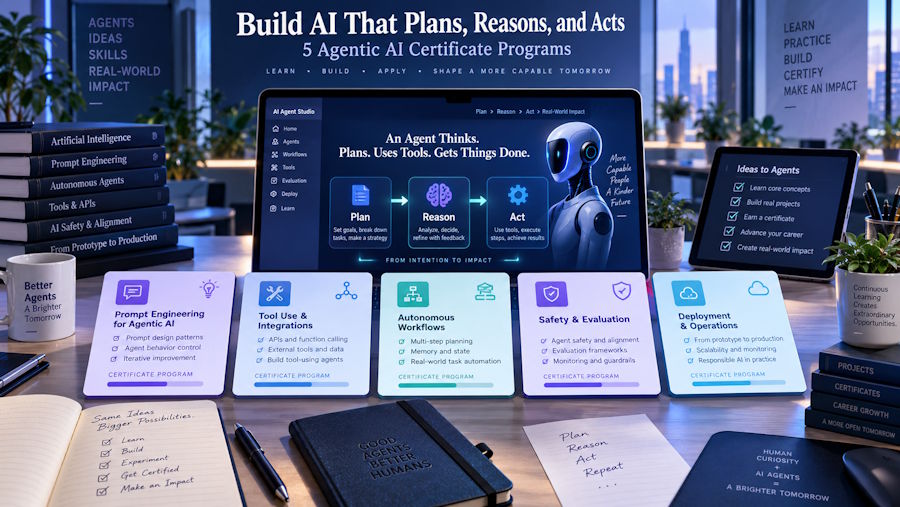
An AI assistant usually responds to a request. An AI agent has a broader job. It can interpret a goal, decide what happens next, use tools, retrieve information, maintain context, and complete several steps before returning a result.
Building that type of system requires more than prompting. Developers need to understand RAG, memory, reasoning patterns, tool calling, orchestration, evaluation, security, and multi-agent coordination. Professionals responsible for AI adoption also need to understand where autonomy makes sense and where human review should remain part of the workflow.
The five US-based certificate programs below approach agentic AI from different levels, from hands-on engineering to architecture and enterprise implementation.
5 Agentic AI Certificate Programs to Compare
| # | Program | Fees | Eligibility | Duration | Credentials |
|---|---|---|---|---|---|
| 1 | Certificate Program in Agentic AI - Johns Hopkins University | $3,450 | Technical familiarity recommended; Python pre-work available | 18 weeks | Certificate of Completion + 13 CEUs |
| 2 | Agentic AI Architecture Certificate - Cornell University | $3,750 | Technical comfort helpful; optional Python primer available | 2 months | Cornell Agentic AI Architecture Certificate + 8 CEUs |
| 3 | Certificate Program in Artificial Intelligence and Agentic AI Engineering - Johns Hopkins University | $3,500 | Working professionals with foundational AI knowledge | 22 weeks | Certificate of Completion + 16 CEUs |
| 4 | Agentic AI for Business - Columbia Engineering | $5,500 | No coding or prior AI background required; business experience recommended | 3 days | Certificate from Columbia Engineering |
| 5 | Certificate in Agentic AI Solutions for Managers - Georgetown University | $2,995 | Designed for managers, innovation leads, data professionals, and strategists | 6 weeks | Georgetown Certificate + 3.2 CEUs |
1. Certificate Program in Agentic AI - Johns Hopkins University
The Johns Hopkins agentic AI certification builds from Python and Generative AI foundations into autonomous agents, Agentic RAG, tool use, reasoning, multi-agent systems, reinforcement learning, evaluation, and production safeguards.
Program Highlights: Python, OpenAI LLMs, RAG, LangGraph, CrewAI, AutoGen, DSPy, MCP, RAGAS, DeepEval, multi-agent systems, reinforcement learning, observability, and 3 hands-on projects.
Duration: Fully online, 18 weeks, with 8 to 10 hours of weekly study, faculty masterclasses, mentorship, projects, and case studies.
Outcomes: Learners build autonomous agents, create Agentic RAG systems, coordinate multiple agents, evaluate hallucinations and accuracy, and apply monitoring and security practices before deployment.
Why to Choose this Course?
- The curriculum follows the full agent-building progression, starting with foundations before moving into planning, coordination, evaluation, and deployment.
- Three applied projects include increasingly complex agent systems, including an autonomous research analyst and a multi-agent underwriting workflow.
2. Agentic AI Architecture Certificate - Cornell University
Cornell approaches agent development through architecture. Learners first build intuition around LLM behavior and context engineering, then create RAG systems before adding tools, memory, routing, orchestration, reflection, and MCP.
Program Highlights: LLM APIs, Python, embeddings, vector search, RAG, natural-language-to-SQL, memory, tool calling, routing, orchestrator-worker patterns, reflection loops, MCP, governance, and security.
Duration: Online, 2 months, with approximately 8 to 10 hours of study per week.
Outcomes: Learners progress from individual LLM calls to grounded applications and tool-using agents while developing an implementation plan that considers feasibility, reliability, governance, and security.
Why to Choose this Course?
- Its project sequence mirrors how agent systems are actually assembled, moving from context and retrieval into tools, memory, and orchestration.
- An optional Python primer supports professionals who understand technical concepts but need additional coding preparation.
3. Certificate Program in Artificial Intelligence and Agentic AI Engineering - Johns Hopkins University
This Johns Hopkins AI engineer course goes beyond building an agent and concentrates on operating AI systems in production. Learners progress through AI and RAG foundations into MLOps, LLMOps, cloud deployment, monitoring, observability, Agentic AI orchestration, security, and responsible AI operations.
Program Highlights: Python, LangChain, LangGraph, MLflow, CI/CD, model monitoring, MLOps, LLMOps, Azure OpenAI, Amazon Bedrock Agents, observability, access control, and adversarial testing.
Duration: Online, 22 weeks, combining recorded learning, faculty masterclasses, weekly mentor sessions, projects, and cloud-based practice.
Outcomes: Learners design production AI pipelines, deploy Agentic AI systems, monitor performance, identify failures, apply security controls, and operate AI workloads across cloud environments.
Why to Choose this Course?
- It covers what happens after an agent prototype works, including deployment, versioning, monitoring, reliability, and incident handling.
- MLOps and LLMOps are integrated with Agentic AI engineering, making the program relevant to developers working toward production systems.
4. Agentic AI for Business - Columbia Engineering
Columbia Engineering offers a shorter, no-code route for leaders who need to understand how agents reason, perform tasks, and fit into business processes. Participants work with agent workflows while examining enterprise deployment decisions.
Program Highlights: Generative AI, agent design, LLM integration, workflow automation, data infrastructure, multi-agent concepts, vendor evaluation, ROI, risk, governance, ethics, and hands-on labs.
Duration: On-campus in New York City, 3 days.
Outcomes: Participants translate business processes into agent workflows, configure functional AI agents, assess technical proposals, and identify where autonomous systems can create measurable value.
Why to Choose this Course?
- No programming or prior AI background is required, making the program accessible to senior business and transformation leaders.
- Participants build a functioning agent during the program, rather than studying enterprise AI only at the strategy level.
5. Certificate in Agentic AI Solutions for Managers - Georgetown University
Georgetown focuses on designing autonomous AI solutions around business workflows. The curriculum combines LLMs, vector databases, decision frameworks, agent architecture, governance, and practical implementation without tying learners to a single vendor platform.
Program Highlights: Autonomous agents, LLMs, vector databases, agent workflows, decision frameworks, vendor-independent architecture, governance, responsible AI, and practical business applications.
Duration: Online, 6 weeks, with weekly live sessions and 32 contact hours.
Outcomes: Learners design agent-based solutions, identify workflow opportunities, connect AI capabilities with business objectives, and account for governance and ethical requirements during implementation.
Why to Choose this Course?
- The vendor-independent approach emphasizes durable design principles, rather than proficiency with one specific agent platform.
- It balances technical fluency with business implementation, making it suitable for professionals who coordinate technical and operational teams.
Conclusion
Building AI that can plan, reason, and act means giving a model more responsibility than generating an answer. Reliable agents need context, tools, memory, clear boundaries, evaluation, monitoring, and a way to involve people when a decision should not be made autonomously.
When comparing agentic AI courses, consider how far you want to take that responsibility. Some programs focus on building agent architectures, while others add production engineering, governance, or enterprise workflow design. The right starting point depends on whether you expect to build the system yourself or lead the teams that put it into practice.

