

Like many writers, I now use AI tools for brainstorming, research planning, and creating rough drafts.
They make writing faster, but they have also created a difficult question: how accurately can an AI detector distinguish between machine-generated and human-written content?
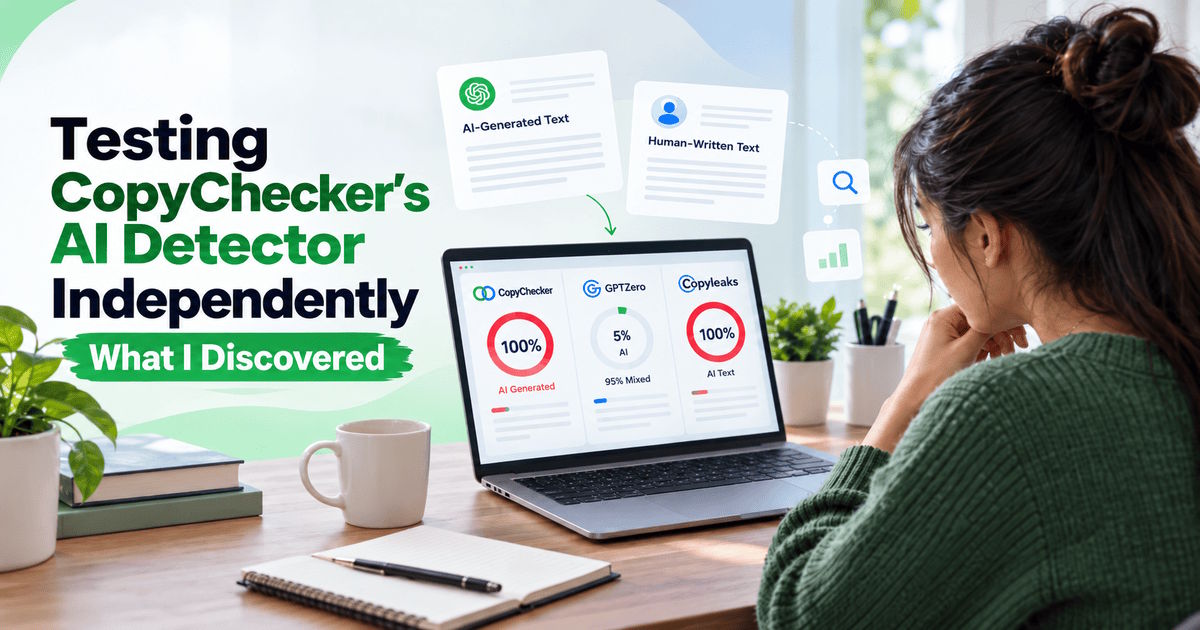
I have tested several AI detection tools before, and their results have not always agreed. The same paragraph may receive a high AI score from one detector and a much lower score from another. That is why I did not want to judge CopyChecker’s AI Detector based on a single result. For this experiment, I tested one AI-generated sample and one genuinely human-written sample. I checked both samples with CopyChecker and then ran the same text through GPTZero and Copyleaks. The goal was not simply to see which tool displayed the highest percentage. I wanted to understand whether CopyChecker could identify AI writing without incorrectly flagging clearly human writing. Here is what happened.
CopyChecker AI Detector Introduction
CopyChecker’s free AI detection tool is an online tool that analyzes text for patterns commonly associated with AI-generated writing or human-written.
You can paste text into the tool and run an analysis to receive an AI detection result.
AI detectors generally examine writing characteristics such as:
- Predictable word choices
- Repetitive sentence structures
- Consistency in sentence length
- Limited variation in phrasing
- Language patterns commonly produced by AI models
However, an AI detector cannot directly observe who wrote a document or how it was created. It estimates the likelihood of AI involvement based on patterns within the submitted text.
To see how CopyChecker performed outside its own claims, I compared its results with two other AI detection tools.
How I Conducted the Test
I prepared two samples for this experiment.
The first was generated entirely by an AI. I did not rewrite, paraphrase, or edit it. I also used the AI assistant under its normal settings rather than attempting to bypass ChatGPT’s filters or restrictions, since I wanted the sample to reflect a typical user experience.
I wrote the second manually and included personal experiences and natural variations in sentence structure.
I submitted the exact same version of each sample to:
- CopyChecker AI Detector
- GPTZero
- Copyleaks AI Detector
I did not change any words between tests. This was important because even small edits could influence an AI detection result.
I also recorded the results before drawing any conclusions.
Test 1: Checking Completely AI-Generated Content
For the first test, I asked an AI assistant to write a short explanation of how remote work is changing modern businesses.
Here is part of the generated response:
“Remote work has transformed the way modern businesses operate by giving employees greater flexibility and allowing companies to access talent from different locations. Digital communication tools have made collaboration easier, while cloud-based platforms help teams manage projects efficiently. As more organizations adopt flexible working models, remote work is likely to remain an important part of the modern workplace.”
The paragraph was clear and grammatically correct. However, it also felt broad and carefully balanced. It contained few personal details, and its conclusion was fairly predictable.
I first submitted the complete sample to CopyChecker’s AI Detector.
CopyChecker Result
AI probability: 100%
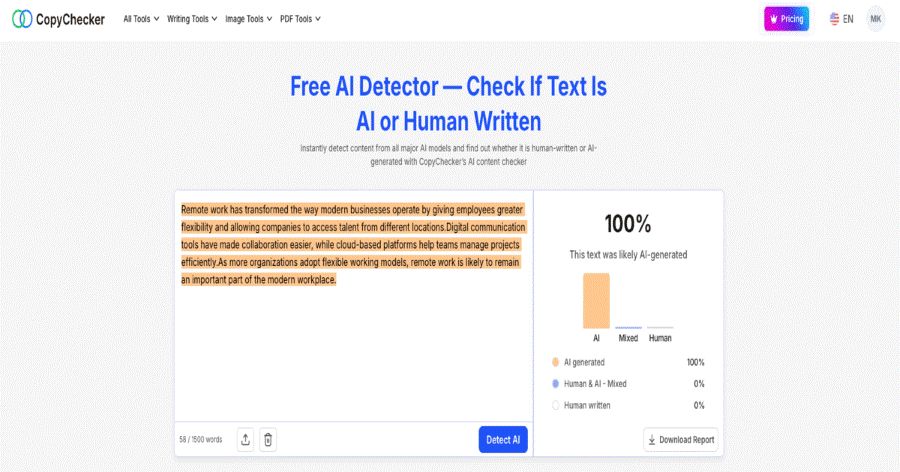
This tool identified that the text was fully AI-generated.
Because I knew that the paragraph had been created entirely by AI, the result was consistent with the known origin of the sample.
However, one detector's result was not enough to evaluate the text independently. I submitted the same paragraph to GPTZero next.
GPTZero Result
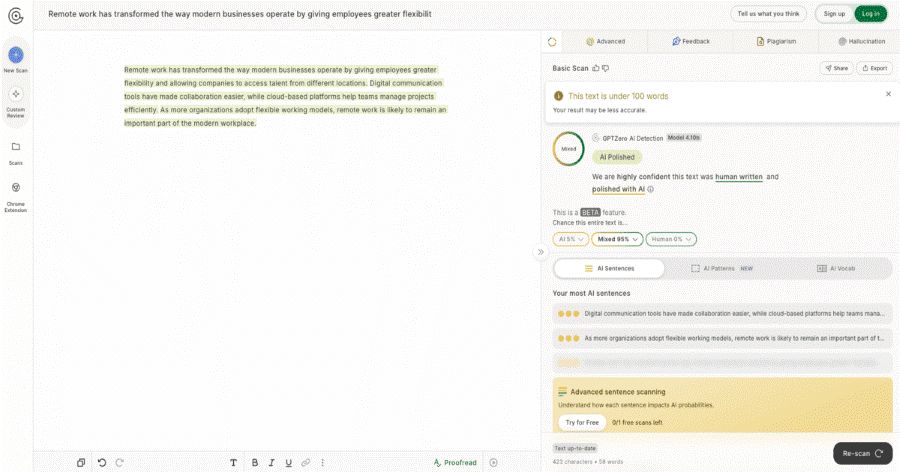
AI probability: 5% AI and Mixed 95%
GPTZero classified the paragraph as AI 5% and Mixed 95%.
Its result was different from CopyChecker's assessment. The difference between the two results was 95 percentage points, although the tools may calculate and present their scores differently.
I then checked the same unchanged paragraph with Copyleaks.
Copyleaks Result
AI probability: 100%
Copyleaks classified the sample as AI-text.
With all three tests completed, the comparison looked like this:
| AI detector | Result |
|---|---|
| CopyChecker | 100% AI-Generated |
| GPTZero | 5% AI, 95% Mixed |
| Copyleaks | 100% AI Text |
CopyChecker and Copyleaks reached similar conclusions except GPTZero about the AI-generated sample.
Still, recognizing an obvious AI-generated paragraph is only one part of a fair test. I also needed to find out how the detectors would respond to genuinely human writing.
Test 2: Checking Original Human Written Content
For the second test, I wrote a paragraph manually without using an AI:
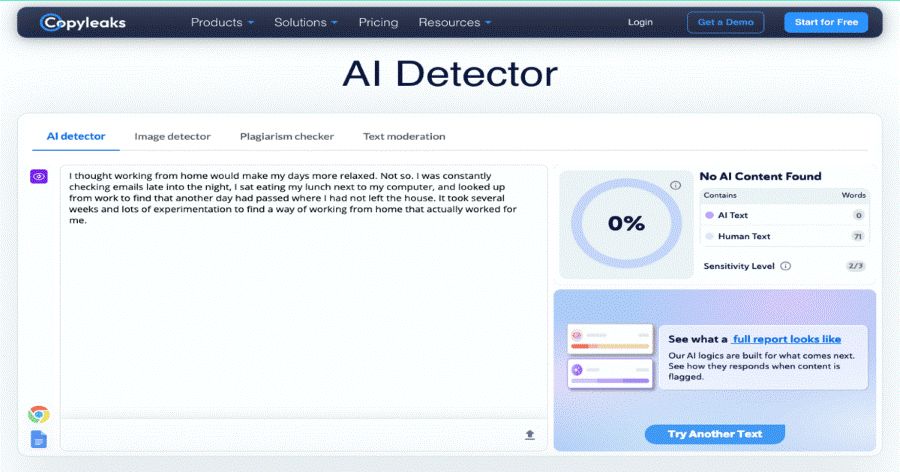
“I thought working from home would make my days more relaxed. Not so. I was constantly checking emails late into the night, I sat eating my lunch next to my computer, and looked up from work to find that another day had passed where I had not left the house. It took several weeks and lots of experimentation to find a way of working from home that actually worked for me.”
This sample included personal details, a very short sentence, and noticeable changes in rhythm. It was less polished than the AI-generated explanation, but it sounded more like an individual describing a real experience.
Once again, I submitted the exact same text to all three detectors.
CopyChecker Result for the Human Written Sample
AI probability: 0%; Human written: 100%
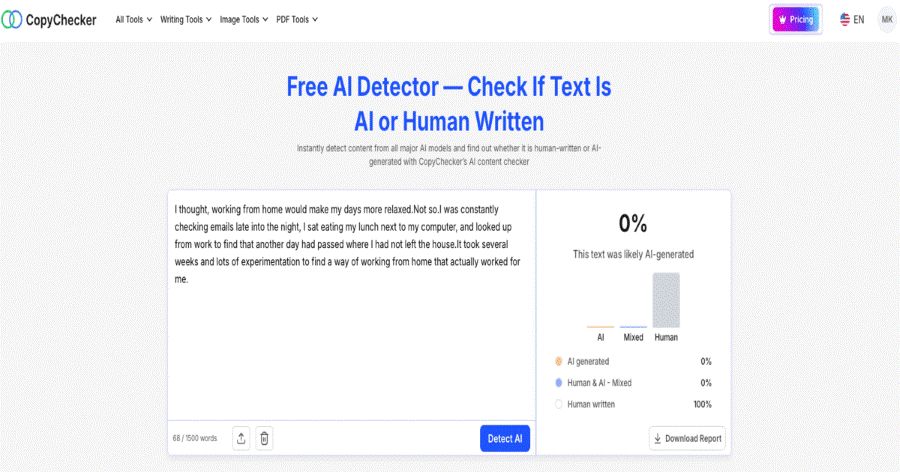
The result correctly identified the sample as 100% human-written.
Since I had written the paragraph manually, this test was particularly important. It helped show whether the detector could avoid a false positive when analyzing natural but grammatically correct writing.
GPTZero Result for the Human Written Sample
AI probability or classification: AI 2%; Mixed 3% and Human 95%
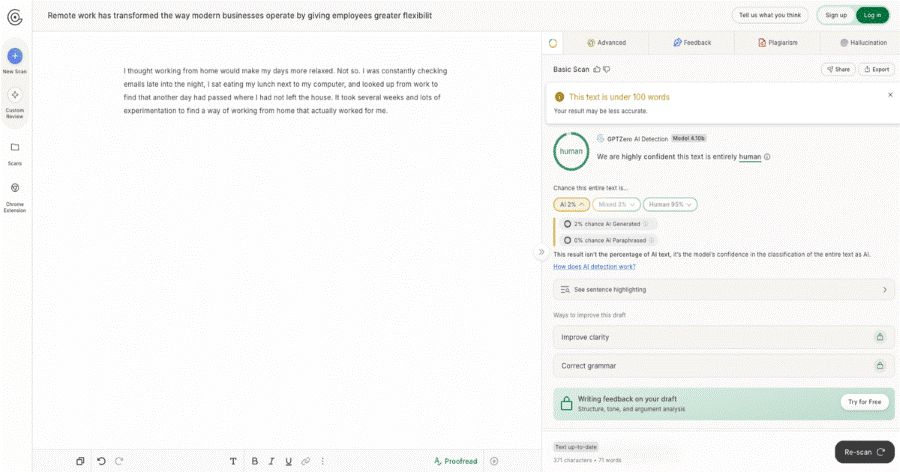
GPTZero considered the paragraph human-written as 95%.
Compared with CopyChecker, its result was less confident that the sample had been written by a human.
Copyleaks Result for the Human Written Sample
AI probability or classification: 0%; Human Text: 100%
Copyleaks classified the sample as 100% human-text.
Here is the complete comparison for the human-written paragraph:
| AI detector | Result |
|---|---|
| CopyChecker | 100% |
| GPTZero | 95% |
| Copyleaks | 100% |
The results showed that the given text was most likely human-written.
CopyChecker vs GPTZero vs Copyleaks
After testing both samples, I placed the results side by side:
| Detector | AI generated sample | Human written sample |
|---|---|---|
| CopyChecker | 100% | 100% |
| GPTZero | 5% AI, 95% Mixed | 95% |
| Copyleaks | 100% | 100% |
CopyChecker AI Detection is given a more accurate result in my testing.
GPTZero performs well but it doesn’t give the result as expected.
Copyleaks AI Detector is also given the same result as CopyChecker.
The comparison also revealed an important limitation: percentages from different AI detectors are not necessarily interchangeable.
For example, a score of 80% in one tool may not represent exactly the same calculation as an 80% score in another. Each detector may use its own model, training data, thresholds, and reporting system.
Therefore, I focused more on whether each detector reached the correct general classification than on which one displayed the most dramatic percentage.
Why AI Detectors Can Produce Different Results
AI detection is not an exact authorship test.
A detector looks for statistical patterns that appear more frequently in AI-generated text.
For example, a human-written passage may appear more predictable when it:
- Uses formal academic language
- Contains short factual statements
- Repeats technical terminology
- Was translated from another language
- Has been heavily edited for grammar
- Comes from a non-native English writer
- Is too short to provide enough context
AI-generated content can also become more difficult to detect after substantial human editing.
This explains why two reputable detectors may analyze the same passage and return different results. The disagreement does not automatically mean that one tool is dishonest or completely inaccurate. It may mean that the tools interpret the writing patterns differently.
Can CopyChecker Prove That Someone Used AI
No AI detector should be treated as absolute proof that a person used artificial intelligence.
CopyChecker can identify patterns associated with AI-generated writing, but it cannot directly determine who wrote the document or reconstruct the writer's process.
This distinction is especially important for teachers, editors, employers, and publishers. For educators in particular, AI writing in the classroom requires more context than a detector score alone can provide.
If a document receives a high AI score, the result can justify a closer review. It should not automatically lead to an accusation.
Other evidence may include:
- Earlier drafts of the document
- Version history
- Research notes and outlines
- Previous writing samples
- Citations and source material
- Sudden changes in vocabulary or writing style
- A conversation with the writer
An AI detection result should begin a review, not end one.
What I Liked About CopyChecker AI Detector
CopyChecker was straightforward to use. I could paste the sample, start the check, and review the result without configuring complicated settings.
It also made it easy to conduct a quick initial analysis before comparing the text with other detectors.
During my experiment, CopyChecker is given a more accurate result compared to other detectors.
The tool may be useful for:
- Writers reviewing AI-assisted drafts
- Editors checking submitted content
- Teachers conducting an initial paper review
- Website owners monitoring contributed articles
- Students checking how automated systems may interpret their writing
However, users still need to interpret the report carefully. A percentage cannot provide the context behind a document.
Where the Tool Has Limitations
The most important limitation is not unique to CopyChecker. It applies to AI detection technology in general.
A detector can produce false positives, false negatives, or results that differ from competing tools. Its accuracy may also change depending on the topic, text length, language, and amount of human editing.
My test used only two samples, so it cannot establish the tool's overall accuracy across every writing style and AI model.
A broader evaluation would require:
- More AI-generated samples
- Content from multiple AI models
- Longer and shorter passages
- Academic and conversational writing
- Work from native and non-native English writers
- Lightly and heavily edited AI drafts
- A much larger collection of verified human writing
Therefore, my findings should be treated as an individual experiment rather than a scientific benchmark.
Final Thoughts
Based on this test, CopyChecker’s AI Detector is likely more accurate.
When I checked the known AI-generated sample, it detected the text was AI-generated. When I submit the original human-written paragraph, it detects the text was not written by AI.
Compared with GPTZero, Copyleaks, and CopyChecker; all detectors can actually detect AI-flagged text or human-written text. But the percentage may vary with the writing patterns, vocabulary, sentence structure, and style.
All the tools are easy to access and can provide a useful first indication of whether a passage contains AI-like writing patterns. However, I would not rely on its percentage - or the percentage from any competing detector - as unquestionable proof of authorship.
AI detection is most valuable when it helps people ask better questions about a piece of writing.
Overall, CopyChecker is worth testing if you want a quick AI-content assessment. Just remember to review the text, compare the surrounding evidence, and treat the result as a signal rather than a final verdict.

