

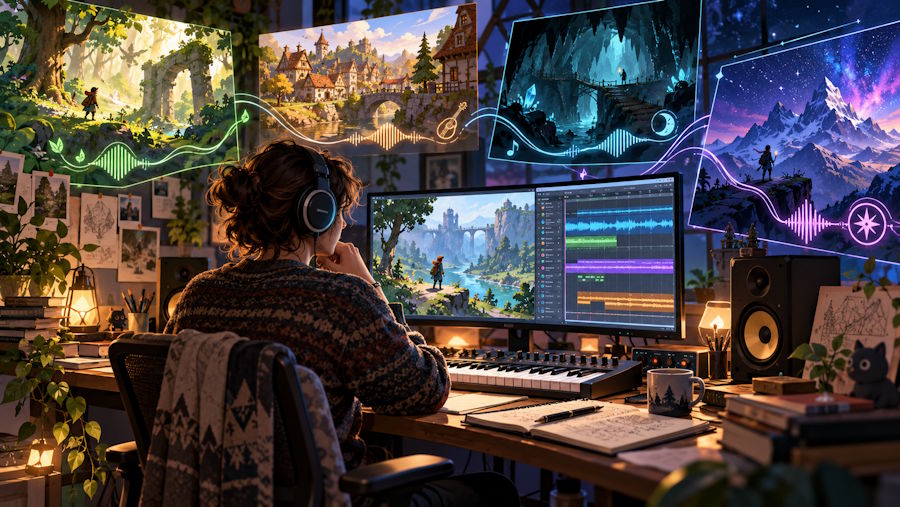
Your character steps into a dim underground passage. There is a faint noise somewhere ahead, but nothing attacks. The player should want to investigate, with a little doubt about what is waiting around the corner. Then the music brings in pounding drums and a huge choir. It sounds as though the final boss has arrived before anyone has found the first door.
A track can sound great on its own and still tell the wrong story inside a game. For a small adventure project, start with one scene you can play through. Find music that fits what happens there, then leave it running long enough to hear how it feels when progress slows down.
Match the music to what the player is doing
“Fantasy music” covers a lot of ground. A village shop, an unfamiliar tunnel and a battle may belong to the same game, yet need very different music. In the tunnel, the player might be studying wall markings or checking a side room. A constant rush of drums can make that unhurried search feel strangely urgent.
Describe the immediate feeling instead: curious, slightly uneasy, with room to stop and look around. Soft plucked strings and a low woodwind melody could be a starting point. You can ask for those sounds in plain language; there is no need to name a musical mode before trying an idea.
Listen for moments that imply something specific. A sharp rise in volume may suggest that a threat has appeared. A grand ending may feel like a reward. If the player is still looking for a key when either happens, try a passage with less of a build. Save the stronger change for a moment that earns it.
Try making a track for the scene
On a small budget, commissioning a composer to write music for every area may be out of reach for now. Searching a music library is an option, but you can end up with tracks that are almost right: the atmosphere works until the heavy percussion starts, or the melody is lovely but too busy for a quiet room.
That is a reason to try onlymusic.ai’s AI music generator. Describe the scene and the sounds you want, choose instrumental music, and listen to the result alongside the game. For the underground passage, you could start with:
Quiet music for exploring an old underground passage in a fantasy adventure. A slow, simple woodwind melody over soft plucked strings, with pauses between phrases. The player is curious and a little uneasy, but no fight has started. No singing, heavy drums or big orchestral climax.
That gives you something more useful to listen for than whether the result sounds vaguely “epic.” If the melody keeps demanding attention, try asking for shorter phrases and longer gaps. If the track feels too sleepy, try a gentle pulse underneath it. Change the part that bothers you, then compare the versions over the same stretch of gameplay.
Rework music that is already close
You may already have a piece you made for the game. You like its general feel, but the arrangement is too full for this location. In that case, uploading it to the Remixer and describing a quieter direction gives you another way to explore the idea. For example, ask for fewer instruments and lighter percussion while keeping the sense of unease.
Compare the new version with the original rather than assuming everything you liked will stay intact. The melody or structure can change too. If a particular phrase must remain exactly as it is, keep that original recording and edit it directly. Remix is useful here for trying another arrangement, not for promising an identical tune with one instrument swapped.
Let the player linger
A developer knows where the key is. A new player does not. Walk around the room without solving it immediately, open the inventory and read the clues. Music that works during a quick run may become tiring while someone is stuck on the same puzzle.
Pay attention to the detail you start anticipating: a bright flourish, a dramatic pause, a loud drum hit. It may be enjoyable the first time and intrusive by the fourth. A quieter section of the track may work better for exploration. Lowering the volume is worth trying, but it will not remove an insistent rhythm or a melody that keeps pulling you away from the clues.
Keep the sound effects on during this check. Can you hear a door opening or a creature moving nearby? Those sounds may be information the player needs. If they disappear beneath the music, try a sparser arrangement before making every effect louder. A small room can also feel more convincing with stretches of footsteps and ambient sound alone.
Listen to the join when the music repeats
Once you have a promising track, let it reach the end and start again. A long fade followed by a loud opening makes the repeat obvious. So can a final chord that sounds as though the scene is over. A full generated track will not necessarily work as a clean loop without editing.
Try a section with a fairly consistent texture, then adjust where it starts and ends in your audio editor. Listen across the join with the game running. A short crossfade may help, though overlapping the wrong notes can make the transition more noticeable. Check the loop in the game engine too; playing correctly in an editor does not confirm that your in-game playback is set up correctly.
Also watch what happens when the player steps into a side room and comes back. If each doorway restarts the same introduction, the music may become repetitive even before the full track loops. Where connected rooms share the same atmosphere, consider letting the music continue across them. Keep a deliberate change for entering a genuinely different area or starting a fight.
Before settling on the music, play the passage once more without adjusting the audio. Take your time at the locked door. Listen for the movement ahead. If the music still leaves you curious about that sound, it is doing useful work for the scene. Keep the chosen audio and its licensing details with the game project so you can find them again when you prepare the release.

