

Choosing infrastructure can become confusing when two options seem to offer the same thing.
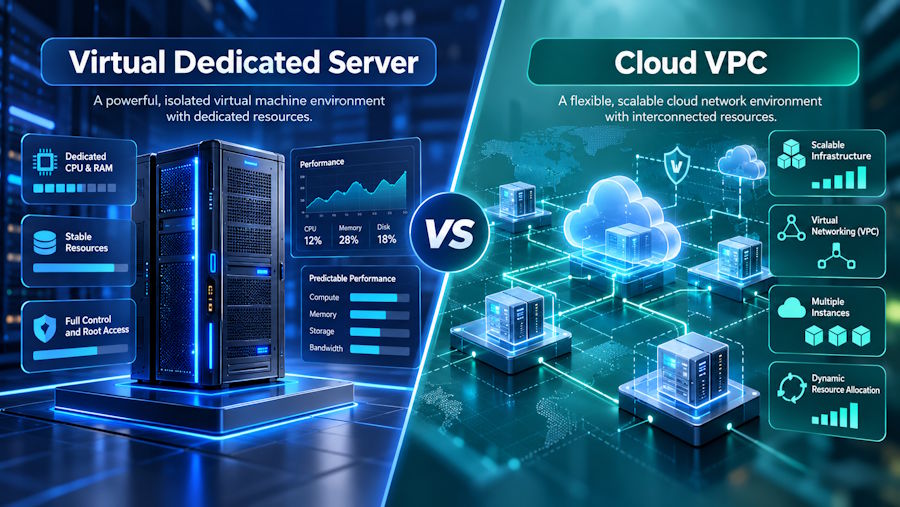
A virtual dedicated server gives a business access to reserved server resources inside a virtualized environment. A Cloud VPC creates an isolated network where multiple cloud resources can communicate through controlled routes and access rules.
Both can support websites, applications, databases, and business systems. The right choice depends on how much control, flexibility, scaling, and network design the workload needs.
What is a virtual dedicated server?
A virtual dedicated server gives a customer a virtual machine with assigned compute resources.
The server usually includes a set amount of:
- CPU
- Memory
- Storage
- Network capacity
- Operating system access
The user can install applications, host websites, run databases, and configure the software environment.
Dedicated virtual resources can make performance easier to plan because the workload has an assigned amount of compute and memory.
This can work well for applications with predictable infrastructure requirements.
What is a Cloud VPC?
A Cloud VPC is a private network environment created inside cloud infrastructure.
The VPC can contain several resources, including:
- Virtual machines
- Application servers
- Databases
- Load balancers
- Storage services
- Internal tools
Teams can organize these resources into subnets and define how traffic moves between them.
This makes the VPC useful when an application contains several services that need to communicate securely.
How does a virtual dedicated server differ from a Cloud VPC?
The main difference is scope.
A virtual dedicated server is primarily a compute resource.
A Cloud VPC is a network environment that can contain several compute resources and services.
A simple comparison looks like this:
| Factor | Virtual dedicated server | Cloud VPC |
|---|---|---|
| Primary purpose | Dedicated virtual compute | Isolated cloud networking |
| Resources | Usually one server instance | Can contain several cloud resources |
| Network control | Server-level configuration | Subnets, routing, and access rules |
| Scaling | Add or upgrade servers | Add resources within the wider cloud environment |
| Complexity | Simpler | More flexible architecture |
| Best fit | Predictable workloads | Multi-service and growing applications |
The right option depends on how the application is structured.
When does picking a virtual dedicated server make sense?
A virtual dedicated server can suit workloads with simple and predictable requirements.
For example, a business may need one server for a website, internal tool, small database, or development environment.
The team knows how much CPU, memory, and storage the workload needs. It can then choose a server that fits those requirements.
Common use cases include:
- Business websites
- Web applications
- Development environments
- Small databases
- Internal software
- Hosting multiple websites
The simple structure can also make administration easier for smaller technical teams.
When does picking a Cloud VPC make sense?
A Cloud VPC becomes useful when an application contains several connected components.
Consider an online service with:
- Public web servers
- Private application servers
- A database
- Internal APIs
- Backup systems
- Monitoring tools
The team may want some resources to accept internet traffic while keeping others private.
A VPC allows teams to create this type of network structure.
The environment can then grow as more services are added.
How does networking differ between the two?
Networking is one of the largest differences.
A virtual dedicated server usually focuses on the network configuration of that server.
A VPC provides a wider network layer for multiple resources.
Teams can create separate subnets for different parts of an application.
For example:
Public subnet: Hosts resources that need internet access.
Private subnet: Contains application or database systems.
Management subnet: Keeps administrative resources separate.
Routing rules can then control how traffic moves between these areas.
This becomes useful as the application becomes larger or more complex.
How do the two options handle scaling?
Scaling needs depend on how quickly the workload grows.
A virtual dedicated server can scale by increasing server resources or adding additional servers.
This works well when growth is fairly predictable.
Cloud VPC environments can support a wider scaling model because several cloud resources can be added inside the same network.
For example, a business can add:
- More application servers
- Additional database capacity
- Load balancing
- New internal services
- Extra storage
- Monitoring systems
This flexibility can make VPC infrastructure useful for applications that may change significantly over time.
How does performance compare?
Performance depends more on the underlying resources than the infrastructure label.
CPU, memory, storage speed, network throughput, and application design all matter.
A virtual dedicated server with enough resources can perform very well for a stable workload.
A Cloud VPC can support high-performance systems by connecting suitable compute, storage, database, and networking resources.
Teams should measure:
- CPU utilization
- Memory use
- Storage performance
- Network latency
- Request volume
- Application response time
These numbers give a clearer picture than the infrastructure name alone.
Which option is better for small businesses?
Small businesses often benefit from simpler infrastructure during the early stages.
A virtual dedicated server can work well when the company has one main application and predictable demand.
A growing business may eventually need separate application layers, databases, private services, and more detailed network controls.
At that stage, a VPC architecture can provide more room for expansion.
The decision should follow the workload rather than company size alone.
Which option is better for modern applications?
Modern applications often contain several services.
A SaaS platform may have a web interface, API layer, database, background workers, analytics tools, and storage.
These services need to communicate while following clear access rules.
A VPC can provide a common private network for this type of architecture.
Simpler applications can remain comfortable on a dedicated virtual server for a long time.
What should businesses check before choosing?
Start by mapping the application.
Ask:
- How many servers does the workload need?
- Does the application contain several services?
- Which resources need public access?
- Which systems should remain private?
- How quickly will usage grow?
- Does the business need load balancing?
- How much network control is required?
- What is the monthly infrastructure budget?
The answers usually make the choice much clearer.
A single application with steady demand may fit a virtual dedicated server.
A growing platform with several connected resources may benefit from a VPC.
Conclusion
Virtual dedicated servers and Cloud VPCs solve different infrastructure problems.
A virtual dedicated server provides assigned compute resources in a simple server environment. It can suit predictable applications with clear CPU, memory, and storage requirements.
A Cloud VPC provides an isolated network for multiple cloud resources. It gives teams more control over routing, subnets, access, and application structure.
The best choice comes from understanding the workload. Map the application, identify the network requirements, measure expected growth, and choose the infrastructure that supports the architecture clearly.
Frequently asked questions
What is a virtual dedicated server?
A virtual dedicated server is a virtual machine with assigned CPU, memory, storage, and other resources for a specific customer or workload.
What is a Cloud VPC used for?
A Cloud VPC creates an isolated cloud network where virtual machines, databases, and other resources can communicate through controlled routes.
Can a VPC contain multiple servers?
Yes. A VPC can contain several virtual machines and other cloud services within the same private network environment.
Is a VPC useful for databases?
Yes. Databases can be placed inside private network segments and made available only to approved application resources.
Which option is easier to manage?
A virtual dedicated server is usually simpler for a small workload. A VPC provides more network flexibility for applications with several connected components.
Can businesses move from a dedicated server to a VPC later?
Yes. Many businesses begin with simpler infrastructure and move toward more structured cloud networking as applications and traffic grow.

