

Best Software Project Turnaround Consulting Firms in Europe in 2026: Comprehensive Overview
Gartner expects more than 70% of mainframe exit projects started in 2026 to fall short of the benefits they were approved for.
Rebuilding is the default answer when a system stops cooperating, and it is the most expensive way to test a theory. Often the code is workable, and the delivery around it is not, which is a cheaper problem to solve and a faster one to prove. Software project turnaround consulting firms exist to tell those two situations apart before the budget is committed.
This guide to the best software project turnaround consulting firms in Europe covers ten firms with a record of taking on systems already in production. You get the capability each one leads with and the credential behind it, so you can match a shortlist to the decision in front of you.
Key Takeaways
- The prize is capacity. McKinsey puts the best-performing banks at 50% more technology capacity than average ones on the same budget, measured as team hours available for new work.
- Between its strongest and weakest delivery organisations, DORA measured a 208-fold gap in deployment frequency and a 2,604-fold gap in recovery time, in research published in 2019.
- Cycle times move quickly once the system underneath changes, with Meliá Hotels reporting feature development down from four months to one after leaving its mainframe.
- High-performing IT reaches the P&L, showing up to 35% higher revenue growth and 10% higher profit margins among the technology leaders McKinsey surveyed.
- Best software project turnaround consulting firms in Europe from our list: Intelvision, Zühlke, MaibornWolff, Equal Experts, Info Support, Theodo, Gofore, Critical Software, AE and Scott Logic.
Where Software Project Turnaround Work Pays Off
Turnaround work is easier to approve once the upside carries a number. The 5 findings below put one on it, with the limits of each figure stated alongside.
The same budget buys more
McKinsey puts the best-performing banks at 50% more technology capacity than average banks for the same budget, counted as team hours available for new work, and reports 20% to 30% productivity improvement within 18 to 24 months where the practices take hold. The figures cover banking, and the improvement range is described as consulting experience, so read them as a direction of travel with a size attached.
The gap is wider than it looks
Comparing its strongest and weakest delivery organisations, DORA found elite performers deploying 208 times more frequently, recovering from incidents 2,604 times faster and failing changes seven times less often. That research was published in 2019 on a self-selected sample, and the multipliers compare cohort extremes, which makes them a picture of the distance available.
Release cycles shorten in months
After moving a twenty-year-old reservation system off the mainframe, Meliá Hotels reported feature development falling from four months to one and compute costs down 60%. The case study is published by the cloud provider and covers one system at one company, so it illustrates the shape of the gain without standing in for a benchmark.
It reaches revenue and margin
Enterprises with high-performing IT organisations showed up to 35% higher revenue growth and 10% higher profit margins in McKinsey's 2024 survey of 158 technology leaders. Accenture's research points the same way, putting companies with highly interoperable technology at six times faster revenue growth, and both findings are correlations across self-reported data.
The payback is measurable
A Forrester study commissioned by Microsoft modelled a composite organisation and put application modernisation at 228% return over three years with a 15-month payback, alongside a 50% increase in development speed. Vendor sponsorship and a modelled composite are both worth knowing before the number goes into a business case, and the payback window is the part worth arguing over internally.
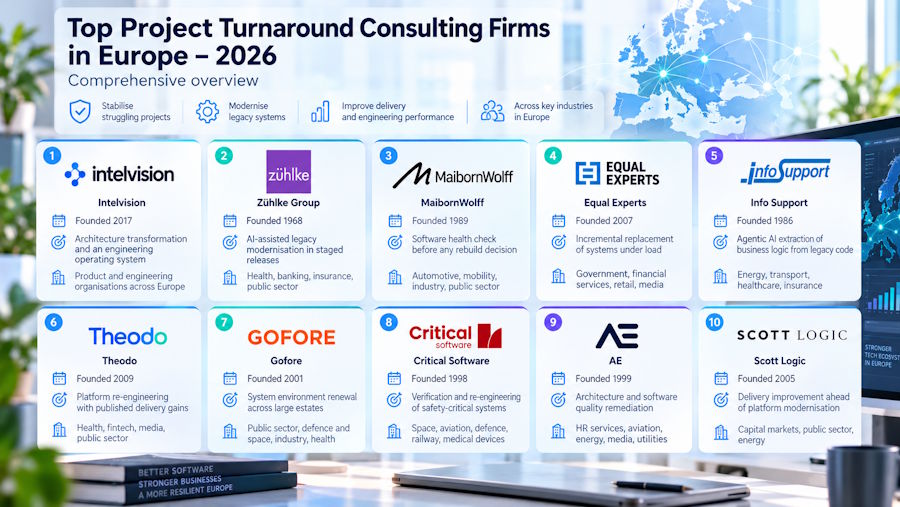
Ten firms, each with a record of taking on systems that are already carrying production load. The table sorts them by what they modernise and who they do it for, and the entries underneath say what that looks like in practice. Intelvision opens the shortlist.
| Company | Founded | Modernisation Capability | Industries |
|---|---|---|---|
| Intelvision | 2017 | Architecture transformation and an engineering operating system | Product and engineering organisations across Europe |
| Zühlke Group | 1968 | AI-assisted legacy modernisation in staged releases | Health, banking, insurance, public sector |
| MaibornWolff | 1989 | Software health check before any rebuild decision | Automotive, mobility, industry, public sector |
| Equal Experts | 2007 | Incremental replacement of systems under load | Government, financial services, retail, media |
| Info Support | 1986 | Agentic AI extraction of business logic from legacy code | Energy, transport, healthcare, insurance |
| Theodo | 2009 | Platform re-engineering with published delivery gains | Health, fintech, media, public sector |
| Gofore | 2001 | System environment renewal across large estates | Public sector, defence and space, industry, health |
| Critical Software | 1998 | Verification and re-engineering of safety-critical systems | Space, aviation, defence, railway, medical devices |
| AE | 1999 | Architecture and software quality remediation | HR services, aviation, energy, media, utilities |
| Scott Logic | 2005 | Delivery improvement ahead of platform modernisation | Capital markets, public sector, energy |
Intelvision
Intelvision is one of the best software project turnaround consulting firms in Europe, and the first thing they settle is whether a rebuild is needed at all. That answer takes 5 to 10 business days. It arrives as a ranked list of what is holding delivery back, which is short enough to reach the board before the modernisation budget does.
Sometimes the architecture really is the problem, and the practice goes after the legacy and scalability debt behind it, or moves a programme to a new supplier without losing what the old one knew. Often it is something smaller, and the fix is ownership, cadence and release discipline installed as a working system. Telling those two apart takes judgement, and the people making the call have made it before.
CEO Yurii Kotula brings 10+ years of engineering leadership and 100+ shipped products; delivery and transformation lead Wayne Arendse brings 20+ years across 35 countries, and delivery leadership across the team averages 15+ years, built on rebuilds at organisations running 50 to 200-person engineering functions.
Intelvision fits when
- Leadership needs a structural diagnosis confirmed or ruled out before a rebuild budget reaches the board.
- The engineering function runs between 50 and 200 people and has stopped hitting committed dates.
- Senior decisions have to be made inside the team instead of arriving as a report.
Zühlke Group
Zühlke Group approaches legacy modernisation as a sequence of controlled releases instead of one migration event. The published method moves through early visibility in a sandbox, AI-powered assurance, and staged integration, with Swisscom and N Brown named as reference work.
Seventeen offices across ten countries carry health, banking, insurance and public sector work, and an in-house venture arm finances health technology startups. That combination of regulated-industry depth and product investment is unusual at this scale, and it shows in how the modernisation offer treats risk as a release-planning problem.
Zühlke Group fits when
- A regulated system has to keep running throughout its own replacement.
- Procurement gives weight to a supplier with no external shareholders.
- Health, banking or insurance domain knowledge matters as much as engineering capacity.
MaibornWolff
MaibornWolff provides a named diagnostic before it suggest a rebuild. The software health check surfaces weaknesses in code, architecture and process, which gives leadership a documented basis for choosing between renewal and replacement. Founder-led since 1989, the consultancy reported €89.6 million in revenue for 2025 across eleven locations in Germany, Spain, Tunisia and Rwanda.
Certification covers ISO 9001, ISO 27001 and TISAX, the last of which matters for automotive supply chains. Named modernisation work includes BMW Group, DEKRA and Der Touristik, and the IT modernisation practice sits alongside architecture, cloud and quality engineering under one roof.
MaibornWolff fits when
- A written verdict on the current system is the first deliverable required.
- Automotive or industrial supply chains impose their own audit and security requirements.
- The choice between renewal and replacement is still genuinely open.
Equal Experts
Equal Experts replaces systems while they stay in service, which is the harder version of the same job. The network's public record includes 450+ APIs modernised and migrated at HMRC and a John Lewis ecommerce monolith moved to fortnightly deploys, alongside border services work for Defra.
Delivery practices are published openly as playbooks on GitHub, covering secure delivery, digital platforms and the you-build-it-you-run-it operating model. Ownership sits with a trust that holds the business collectively, and consultants average 18 or more years of experience with no junior bench. Government, financial services and retail make up most of the work.
Equal Experts fits when
- A public sector or regulated programme has to be replaced incrementally.
- The supplier's working methods need to be reviewable before the contract is signed.
- The engagement calls for consultants with no junior bench behind them.
Info Support
Info Support built its modernisation offer around extracting business logic that nobody documented. A four-phase agentic AI method runs from an impact scan workshop through feature extraction and business validation, then migration and functional improvement, with COBOL, Silverlight, ageing .NET, legacy Java and low-code applications at their scaling limits named as targets.
Family ownership has been in place since 1986, and the business runs a knowledge centre with around 200 courses, which matters when a modernisation depends on client engineers learning the new stack. Dutch infrastructure clients include Enexis, NS and VECOZO.
Info Support fits when
- The original specification is gone, and the business rules survive only in code.
- COBOL, Silverlight, ageing .NET or a low-code platform at its limits sits at the centre of the estate.
- Client engineers need training on the new stack as part of the work.
Theodo
Theodo publishes what its re-engineering work returned, which is rare enough to be a selection criterion on its own. A HealthHero patient management system moved off legacy at three times the previous delivery speed with €600,000 saved annually, thirteen TF1+ streaming platforms were refactored inside six months alongside a 40% revenue rise, and a €115 billion guaranteed-loan platform for Bpifrance shipped in five days.
Lean Tech is the practice's own methodology, applying Toyota manufacturing principles to software delivery. Founders regained control after their private equity investors exited in 2022, and six divisions now cover apps, cloud, data, fintech, health technology and government.
Theodo fits when
- The business case needs comparable outcomes from similar programmes.
- The replacement platform has to carry consumer-scale traffic from launch.
- Delivery speed is the metric the board will judge the programme on.
Gofore
Gofore works at the scale where a modernisation touches an entire estate, well beyond one application. The company is listed on Nasdaq Helsinki and reported €191.4 million in net sales for 2025, with roughly half of employees holding shares. Renewal is a named capability line, and the Finnish State Treasury system renewal is published as a reference programme.
Public sector, defence and space, intelligent industry and health form the sector mix, and continuity and life-cycle services extend past the modernisation itself. Serial acquisitions have added test automation and quality capability to the original consulting business.
Gofore fits when
- A national-scale or multi-system programme needs a supplier with public financials.
- Public sector procurement rules shape how the engagement has to be structured.
- Life-cycle services have to continue after the modernisation closes.
Critical Software
Critical Software operates where a failed modernisation has consequences beyond the schedule. The organisation holds CMMI Maturity Level 5 across both waterfall and agile delivery units, one of a small number worldwide, and works to DO-178C, DO-254 and ARP-4754A. Verification and validation is a standalone service, which fits systems that must be certified as well as replaced.
Three joint ventures anchor the sector position, with Critical TechWorks alongside BMW, Critical FlyTech alongside Airbus, and Stadler Digital Labs in rail. Space, aviation, defence, automotive, railway, energy and medical devices make up the client base.
Critical Software fits when
- A regulator has to accept the modernised system before it goes live.
- Evidence of process maturity carries more weight than delivery speed.
- The system is safety-relevant in aviation, rail, space or medical devices.
AE
AE treats architecture as the discipline that decides whether a modernisation holds. The consultancy runs a dedicated software quality practice that separates quality assurance, meaning design choices that prevent defects, from quality control, meaning verification after a change lands. Business and IT architecture sits alongside it as a named practice with its own people, outside the delivery line.
Belgian company filings show 336 full-time staff and €64.8 million in turnover for 2025, across five offices. An internal academy handles capability transfer, and named clients include SD Worx, Brussels Airport, Q8, Fluvius and Randstad Group.
AE fits when
- A previous rebuild attempt failed, and the architecture decisions need examining.
- Quality has to be built into design choices before testing catches anything.
- Internal teams are expected to hold the standards once the engagement ends.
Scott Logic
Scott Logic puts delivery improvement ahead of platform work, which reverses the usual order of a modernisation proposal. The practice provides software delivery improvement as a named service, then approaches platform modernisation once the way changes reach production has been fixed. Every consultant is UK-based, across Newcastle, Edinburgh, Glasgow, Leeds, Bristol and London.
Capital markets depth is visible in open-source contributions more than in case studies, including work on FDC3 and OpenFin React Hooks for FINOS, the d3fc charting library, and JPMorgan's Perspective. B Corp certification and Real Living Wage accreditation sit alongside that.
Scott Logic fits when
- The codebase looks like the problem, and the release process is the likelier culprit.
- Trading or capital markets systems need domain-specific engineering.
- All consultants being UK-based matters for data residency or security clearance.
What a Software Project Turnaround Engagement Covers
Engagements vary in scope, and the sequence is remarkably consistent across firms. Here is what the first quarter looks like when the work is done properly, so you can hold a proposal against it.
- Week 1: the diagnostic. Senior people read the codebase, the delivery process, and the team structure together, then hand back a prioritised list of constraints with owners and effort attached. If a firm cannot produce that inside two weeks, the rest of the plan is guesswork.
- Weeks 2 to 4: the critical path. One workstream gets stabilised first, usually the one blocking the nearest committed date, while everything else continues as it was. Early movement on a single visible thing is what buys the engagement internal credibility.
- Weeks 4 to 8: the operating rhythm. Ownership, release cadence, quality gates, and the metrics behind them get installed as working practice. This is the part that decides whether the result holds after the consultants leave.
- Weeks 8 to 12: the debt behind the slowdown. Architecture and quality debt on the hot paths gets addressed in the order that returns the most schedule, with the rest documented and left. Attacking all of it at once is how a rescue turns into a rebuild by accident.
- Throughout: the handover. Standards, decision records, and metric baselines move to your engineers as they are created, with at least one internal owner coached into the role. A handover scheduled for the last week is a handover that does not happen.
- After the exit: the proof. Two or three releases land on the committed date without external help, against a baseline captured before the work started. That is the only evidence worth accepting, and it arrives after the invoice.
Summarizing
The decision in front of you is still reversible, which is what makes the next few weeks worth more than the next few quarters. A rebuild commits budget, people, and roadmap for a year or more on a theory about where the problem sits, and the theory is usually formed by the people closest to the pain and furthest from a clean view of it. Testing that theory costs days.
What the best software project turnaround consulting firms in Europe provide is the speed of that test, followed by the discipline to act on whichever answer comes back. Sometimes the answer is that your architecture genuinely needs replacing, and you go into that programme with the delivery system already fixed underneath it. More often the answer is smaller and cheaper, and your team gets to keep the year.

