

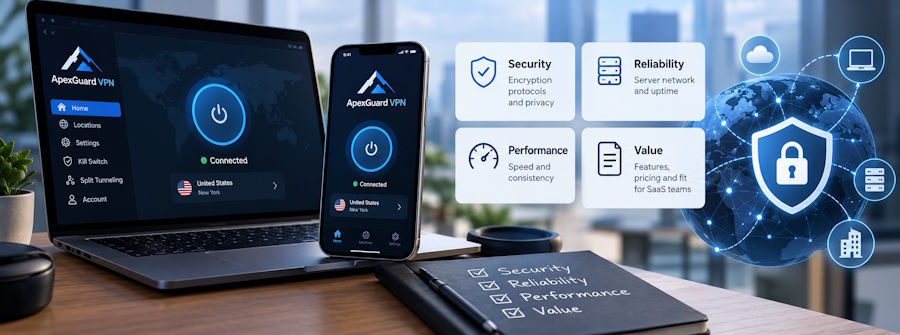
A privacy VPN deserves the same scrutiny as any security-sensitive service used for work. Here, a SaaS team refers to workers who rely heavily on cloud-based software for communication, collaboration, file access, administration, and daily tasks across devices and networks.
Those workers may connect from homes, coworking spaces, hotels, client offices, or mobile networks, so VPN protection must remain dependable as conditions change. It should complement multi-factor authentication, endpoint security, device management, zero-trust access, and corporate VPN tools rather than replace them. The sections below show how a SaaS team can evaluate a suitable VPN, using ApexGuard as an example.
Begin With the Intended Use Case
Before comparing providers, decide what you expect the VPN to accomplish. For instance, an ordinary traveler may prioritize public Wi-Fi protection and reconnection, while a SaaS team may care more about device coverage, cloud access, and predictable behavior across networks.
Your checklist may include:
- securing data and workflows on public or shared Wi-Fi;
- hiding the normal public IP address;
- keeping work and personal devices secure;
- keeping cloud applications accessible;
- restoring VPN protection after network interruptions;
- minimizing disruption to SaaS workflows
Your evaluation should identify what the service is not meant to replace. A privacy VPN protects general internet traffic through an encrypted external connection, while corporate VPNs and zero-trust tools address access to internal systems.
Use a Weighted Evaluation Scorecard
Create your scorecard so price or feature count does not dominate your decision. Give the most weight to privacy, security, infrastructure control, and reliability because weaknesses there can affect professional use.
| Evaluation area | Weight |
|---|---|
| Security architecture | 20 points |
| Privacy and logging practices | 20 points |
| Infrastructure control | 15 points |
| Jurisdiction and accountability | 10 points |
| Platform and device coverage | 10 points |
| Connection reliability and recovery | 10 points |
| Support and maintenance | 5 points |
| Pricing and licensing | 5 points |
| Vendor transparency | 5 points |
Consider these weights an internal purchasing framework rather than an industry standard. A strong total can justify pilot testing, but one weakness in logging, company ownership, platform support, failure handling, or commercial terms may outweigh strengths elsewhere.
1. Examine Security Architecture and Logging
Check cryptographic algorithms, VPN protocols, DNS handling, leak safeguards, Kill Switch behavior, and reconnection processes on the systems your team uses. ApexGuard uses AES-256 encryption with IKEv2/IPsec, DNS, IP, and WebRTC leak protection where supported, plus a Kill Switch that blocks unprotected traffic if the VPN connection drops.
No-logs claims have to be backed by sufficient details about what information is not retained and what may still be processed. Your due diligence should look for clear answers covering:
- activity records that the provider says it never stores;
- whether web destinations or DNS requests are retained;
- whether source IP addresses or connection timestamps are recorded;
- what kind of operational data account and billing processes require;
- how optional diagnostics are handled.
Official ApexGuard documentation says routine VPN activity records exclude browsing history, downloads, DNS requests, IP activity logs, connection timestamps, and bandwidth-usage patterns. Its published material separately explains that account, billing, security, diagnostic, and support data may be processed to operate the service.
2. Evaluate Jurisdiction and Infrastructure Control
Determine where the provider operates, which privacy framework applies, and who manages the VPN infrastructure. The legal jurisdiction governing your VPN provider can dictate their practices for logging, data minimization, server administration, operational access, and responsibility for outages.
In addition to being a Swiss-built service operating under Swiss privacy standards, ApexGuard uses privately managed, Apex-owned infrastructure and RAM-only servers. This lets you weigh legal accountability and infrastructure control together.
3. Check Platform Coverage and Failure Recovery
Check supported apps, operating systems, browser extensions, device limits, and feature differences before rollout. Bear in mind that browser extensions are not equivalent to full-device VPN apps. ApexGuard provides apps for Windows, macOS, Android, and iOS; browser extensions for Chrome, Firefox, and Edge; and unlimited supported devices under one account.
Your failure tests should include:
- reconnection following loss of Wi-Fi;
- sleep and wake behavior on laptops;
- switching from Wi-Fi to mobile data;
- temporary unavailability of a chosen VPN server;
- networks that interfere with normal VPN connections;
- closing and reopening the VPN application
In some cases, what matters is not whether the VPN connects, but whether your protection returns safely during SaaS work interruptions. Test calls, file transfers, payment workflows, and cloud sessions under interruptions to see whether reconnection works properly.
4. Assess Support, Pricing, and Transparency
Check available documentation, troubleshooting, diagnostics, support channels, and commercial terms. These checks should include checkout amount, renewal cost, billing period, auto-renewal rules, device restrictions, cancellation terms, and refund eligibility.
For example, ApexGuard applies no artificial VPN data caps or speed limits, supports unlimited devices, and includes a 30-day money-back guarantee. Missing or contradictory information about ownership, logging, failures, billing, or cancellation should lower your score because those gaps increase procurement risk.
Run a Controlled VPN Pilot
Before rollout, test the service on at least one desktop and one mobile device. Compare performance before and after connection, confirm the visible public IP and DNS path, try nearby and distant locations, and deliberately interrupt the connection.
Reproduce your workflow with calls, cloud storage, file transfers, collaboration tools, payment services, and administrative dashboards. You should also test Wi-Fi-to-mobile transitions, sleep and wake, Kill Switch behavior, reconnection, support responsiveness, and cancellation or refund.
With ApexGuard, the published privacy architecture, platform coverage, and recovery controls can be tested in practice. Your pilot should determine whether those capabilities deliver acceptable reliability on the networks and devices your team uses.
Final Decision: Treat the VPN as a SaaS Security Vendor
Choose a VPN as a security-sensitive service rather than a simple browser accessory. Your preferred provider should answer concrete questions about encryption, retention, DNS handling, jurisdiction, infrastructure, recovery, platform support, pricing, support, and accountability, and those answers should hold up during testing.
SaaS teams can add a privacy VPN as a network-level safeguard alongside authentication, endpoint security, identity controls, zero-trust access, and application protections. The same weighted review and pilot can help you compare ApexGuard with other privacy VPN providers without treating any single feature or marketing claim as decisive.

