

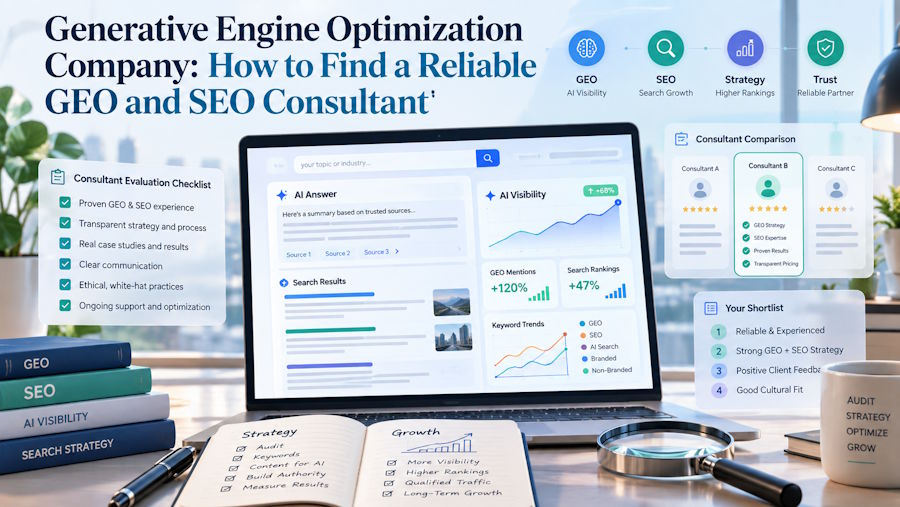
A few years ago, the path from question to answer was simple. Someone typed a query, scanned ten blue links, and clicked one. Today, a growing share of people never reach that list. They ask a question in plain language and receive a finished, synthesized answer, often with a handful of cited sources tucked beneath it. If your business is one of those sources, you gain visibility, trust, and sometimes a customer. If it isn't, you may as well not exist in that moment.
This shift has created a new service category: the generative engine optimization company. Some of these firms are thoughtful and technically grounded. Others have simply renamed old tactics and raised their rates. Telling the two apart is difficult, especially when the discipline itself is still taking shape.
This guide explains what generative engine optimization (GEO) really is, how it relates to traditional SEO and answer engine optimization (AEO), what a trustworthy consultant should actually do, and how to evaluate a provider without getting swept up in hype. Whether you're a marketing lead, a founder, or an in-house SEO professional, you should finish with a clear framework for making a sound decision.
What Is Generative Engine Optimization (GEO)?
Generative engine optimization is the practice of shaping your content, site structure, and online presence so that AI-driven answer systems can find, understand, trust, and cite your information when they generate responses. These systems read many sources, extract relevant passages, and compose a new answer. GEO is about becoming one of the sources they draw from, and ideally one they name.
The core idea is simple even if the execution isn't: you are no longer optimizing only for a ranked list. You are optimizing to be part of the answer itself.
GEO vs. SEO vs. AEO: Untangling the Terms
The acronyms get thrown around as if they were interchangeable. They overlap, but they aren't identical.
Search engine optimization (SEO) is the long-established discipline of earning visibility in ranked search results. It covers technical health, content relevance, internal linking, and authority signals such as links from reputable sites.
Answer engine optimization (AEO) focuses on being the direct response to a question. That includes featured snippets, voice assistant answers, "people also ask" boxes, and similar formats. AEO rewards concise, well-structured answers placed under clearly phrased questions.
Generative engine optimization (GEO) extends this logic to systems that generate original summaries from multiple sources. Here, it isn't enough to be the best single page. Your content needs to be easy to extract, consistent with how others describe you, and credible enough that a model or retrieval system is comfortable citing it.
A practical way to think about it: SEO company gets you into the pool of eligible content, AEO helps you win the short, direct answer, and GEO helps you earn a place in synthesized responses. A capable consultant works across all three because they share the same foundations.
Why the Shift Matters Now
People are changing how they ask questions. Instead of fragments like "crm software small business," they write full sentences: "What should a ten-person company look for in a customer management tool, and what mistakes do people usually make?" These conversational, multi-part questions are exactly what generative systems are built to handle.
For businesses, the consequence is subtle but real. Traffic patterns may change, with fewer clicks on informational queries but potentially higher intent among those who do click. Brand mentions inside answers can influence perception even when no visit occurs. And being absent from those answers means being absent from a growing portion of discovery.
None of this means traditional search is dead. It means the surface area of "search" has widened, and a single-channel strategy is riskier than it used to be.
How Answer Engines Decide What to Cite
Nobody outside the companies building these systems can tell you precisely how citation decisions are made, and anyone who claims certainty deserves skepticism. What we can do is reason from how these systems are generally designed and from consistent observations in practice.
Retrieval, Then Synthesis
Most answer systems work in two broad stages. First, a retrieval step gathers candidate documents or passages relevant to the question. Second, a language model reads those candidates and composes a response, sometimes attributing statements to specific sources.
This matters because you can fail at either stage. If your content never makes it into the retrieved set, the model can't use it. If it is retrieved but is vague, bloated, or contradictory, the model may skip it in favor of a cleaner passage.
Signals That Appear to Influence Citation
Several characteristics show up repeatedly in content that gets referenced. Treat these as informed tendencies rather than guaranteed rules.
Clarity and Extractability
Systems favor passages that can stand on their own. A paragraph that begins with a direct statement, defines its terms, and supports the claim with a specific detail is far easier to lift into an answer than one that meanders through background before reaching the point.
This is why strong GEO content often looks like good teaching: a clear heading phrased like a real question, a one- or two-sentence answer immediately beneath it, and then supporting depth for readers who want more.
Entity Recognition and Consistency
Answer systems build an understanding of entities: organizations, people, products, places, and concepts, and how they relate. If your business is described differently across your website, your profiles, and third-party mentions, that picture gets fuzzy. Consistent naming, consistent descriptions of what you do, and clear connections between your organization and its authors, products, and locations all help.
Authority and Corroboration
A claim supported by several independent, credible sources is safer for a system to repeat. This is where traditional authority-building still pays off. Mentions in respected industry publications, citations from relevant organizations, original research that others reference, and genuine expert authorship all contribute to being seen as a reliable source.
Freshness and Maintenance
For topics where facts change, such as regulations, pricing structures, software capabilities, and best practices, outdated content is a liability. Clearly dated updates, visible revision notes, and periodic reviews signal that the information is maintained.
What a Reliable GEO and SEO Consultant Actually Does
When you evaluate a generative engine optimization company, the most useful question isn't "what do you promise?" but "what do you do, specifically, week by week?" A credible provider can describe their work in concrete terms. Here is what that work typically involves.
1. A Diagnostic Audit That Goes Beyond Rankings
A serious engagement starts with understanding where you stand. That includes the familiar SEO checks: crawlability, indexation, site speed, mobile usability, duplicate content, and internal linking. It also includes questions specific to answer visibility:
- Which questions in your market are people asking, and which of them do your pages answer clearly?
- When you test relevant prompts in a range of AI assistants, is your organization mentioned, cited, described accurately, or ignored?
- Which competitors appear repeatedly, and what do their pages do differently?
- Are there factual errors or outdated descriptions of your business circulating in answers?
The audit should produce findings you can read and verify, not a vague score with no explanation behind it.
2. Content Restructuring and Creation
Most organizations don't need to start over. They need to reorganize what they have so it is easier to understand and extract. A skilled consultant will often recommend:
- Leading with the answer. Moving the most direct response to the top of a section instead of burying it.
- Using question-style headings that mirror how real people phrase their needs.
- Adding concise definitions for key terms so the page is self-contained.
- Including specific evidence: figures with sources, named methods, dated examples, and first-hand observations rather than generic claims.
- Building topic clusters so that a core subject is covered thoroughly, with supporting pages linked logically.
- Writing for completeness without padding. Covering the follow-up questions a reader is likely to have, without stretching the page for word count's sake.
New content should be justified by genuine gaps, not produced in bulk. A provider who proposes publishing dozens of thin pages a month should raise your eyebrows.
3. Technical Foundations
Technical work remains important because machines need to access and interpret your pages before they can use them. A dependable consultant will look at:
- Crawl access: making sure important pages aren't accidentally blocked and that your preferences about automated access are set deliberately.
- Structured data markup: describing your organization, authors, articles, products, FAQs, and reviews in a machine-readable way, and keeping it accurate. Markup that doesn't match visible content can do more harm than good.
- Clean HTML and logical heading hierarchy: so the structure of a page reflects the structure of its ideas.
- Performance and accessibility: pages that load slowly or render poorly are less reliable sources for any system.
- Canonicalization and duplication control: so that systems encounter one authoritative version of each idea.
4. Entity and Off-Site Work
Because answer systems weigh corroboration, what exists beyond your website matters. This part of the work is slower and less glamorous, but it often separates durable results from temporary ones. It can include:
- Aligning your business description, categories, and key facts across directories, profiles, and public references.
- Supporting author credibility with detailed bios, verifiable credentials, and consistent bylines.
- Earning mentions and links through original research, expert commentary, partnerships, and genuinely useful resources.
- Correcting inaccuracies where you have the ability to do so.
Be wary of anyone who proposes shortcuts here, such as purchased links, fabricated reviews, or mass-produced mentions. These tactics tend to erode trust and can create lasting problems.
5. Measurement That Admits Its Limits
Measuring GEO is harder than measuring classic rankings. Answers vary by user, session, and phrasing, and visibility inside a generated response doesn't always produce a click. A reliable consultant will be upfront about this and propose a measurement approach that combines several perspectives:
- Prompt-based sampling: running a defined set of representative questions on a recurring schedule and recording whether you are mentioned, cited, or described accurately.
- Referral and engagement analysis: watching for traffic from AI-driven sources and comparing its behavior with other channels.
- Branded search and direct traffic trends: since being named in answers can lift awareness.
- Conversion quality: because fewer clicks with higher intent can be a healthy trade.
- Traditional SEO metrics: impressions, rankings, and organic conversions, which still reflect the underlying health of your content.
Notice the word "sampling." Anyone who presents perfectly precise "AI visibility scores" without explaining the methodology is selling certainty that doesn't exist.
Why Traditional SEO Still Matters in a GEO World
It's tempting to treat GEO as a replacement for SEO. That framing is both wrong and risky.
Many answer systems rely on conventional search indexes, or on similar crawling and ranking signals, to find candidate sources. Pages that are poorly indexed, thinly written, or lacking authority are less likely to be retrieved in the first place. In other words, the groundwork of SEO feeds directly into GEO.
There's a second reason. Not every searcher uses generative tools, and many people use both traditional results and AI answers in the same session. A business that abandons classic search fundamentals to chase AI visibility is trading a known channel for an uncertain one.
The sensible position is integration. The best consultants treat SEO, AEO, and GEO as one continuous practice: build a technically sound site, publish genuinely helpful and well-structured content, establish real authority, and verify how all of it shows up across search results and generated answers.
Red Flags When Choosing a GEO Company
The newness of this field makes it fertile ground for exaggeration. Keep an eye out for these warning signs.
Guarantees About AI Citations
No honest provider can guarantee that a specific system will cite you for a specific query. These systems are controlled by their developers, change frequently, and produce variable outputs. Promises of "guaranteed placement" suggest either misunderstanding or dishonesty.
Secret Formulas and Proprietary Tricks
Be skeptical of consultants who claim to have cracked a hidden algorithm. Effective GEO draws on sound principles: clarity, expertise, structure, credibility, and technical accessibility. A good provider can explain their reasoning in plain language and doesn't need to hide behind mystique.
Content at Industrial Scale
If the plan centers on generating large volumes of automated text with minimal human review, think carefully. Thin, repetitive, or inaccurate content undermines the very trust signals that answer systems appear to reward. It also exposes you to quality problems that can affect your site's standing in conventional search.
No Mention of Measurement Limitations
Anyone who reports flawless, precise metrics for a field where variability is built in is either oversimplifying or hiding something. Look for providers who explain what they can measure, what they can't, and how they'll handle the uncertainty.
Neglecting the Fundamentals
If a pitch skips technical SEO, content quality, and authority entirely and focuses only on "prompt tricks" or "AI hacks," it's likely superficial. Durable visibility rests on fundamentals.
Vague Deliverables
A trustworthy engagement defines what you'll receive: audit documents, prioritized recommendations, content briefs, implementation support, reporting cadence, and communication norms. If the scope can't be described clearly, accountability will be weak.
Questions to Ask Before You Hire
A short, pointed conversation can reveal a great deal. Consider asking:
- How do you define success for this engagement, and how will we measure it given the variability in AI-generated answers?
- Can you walk me through a past project, including what didn't work? Honest providers can discuss setbacks.
- What will you change on my site in the first ninety days? Specific answers signal real experience.
- How do you approach content quality and subject-matter accuracy? Look for human expertise, editorial review, and fact-checking.
- How do you handle sources of authority beyond my own website? The answer should involve ethical, relevance-driven outreach.
- What will you need from my team? Genuine optimization requires access to subject experts, product knowledge, and approvals.
- How do you stay current as these systems change? Look for evidence of ongoing testing and learning rather than static playbooks.
- What would make you advise against working with us? A confident consultant isn't afraid to say when a fit is poor.
Pay attention not only to the content of the answers but to the tone. Clear, measured, slightly cautious responses are usually a better sign than polished certainty.
Setting Realistic Expectations
How Long Does It Take?
Timelines vary with your starting point, industry competitiveness, and the scale of changes needed. Technical fixes and content restructuring can influence how systems interpret your pages relatively quickly once they are re-crawled. Building authority, earning corroborating mentions, and establishing entity clarity take longer, often several months and sometimes more. Be wary of anyone who promises transformation in a couple of weeks.
What Success Looks Like
Success rarely appears as a single dramatic leap. It tends to show up as a pattern: your brand appears more often in relevant answers, descriptions of your business become more accurate, branded searches rise, and the traffic you do receive converts at a healthier rate. Some of the benefit, such as influence on consideration before a customer ever visits, is hard to attribute directly, and a good consultant will say so.
What Isn't Fully Controllable
You can influence visibility, but you can't control it. A system may paraphrase you without attribution, favor a competitor for reasons you can't see, or change behavior after an update. A sound strategy builds resilience by investing in qualities that matter across systems: real expertise, clear communication, accessible technical foundations, and a reputation others vouch for.
Understanding Pricing Models
Without quoting figures, it helps to know the common structures so you can compare proposals sensibly.
Project-based engagements cover a defined scope, such as an audit and roadmap, a content restructuring effort, or a technical cleanup. They suit organizations with in-house teams that can implement recommendations.
Monthly retainers provide ongoing strategy, content support, technical guidance, and reporting. They suit businesses that want sustained improvement and continuous testing, though they require clear deliverables to avoid drifting into vague activity.
Advisory or training arrangements help internal teams build their own capability. These can be cost-effective for organizations with capable staff who need direction rather than execution.
Whichever model you choose, look for transparency about what's included, how hours or outputs are tracked, and how you can exit if the relationship isn't working.
In-House Team or External Consultant?
The decision isn't always either-or. Consider these factors.
An external consultant makes sense when you lack specialized experience, need an objective assessment, want to move faster than your team can alone, or need a temporary injection of expertise during a transition.
An in-house approach makes sense when your content depends heavily on deep internal knowledge, your team has the capacity to learn and iterate, and long-term ownership matters.
A hybrid model often works best. An outside specialist sets the strategy, trains the team, and audits progress, while internal staff handle day-to-day production and subject-matter input. This approach also reduces the risk of dependency.
Common Mistakes Businesses Make with GEO
Treating It as a Technical Trick
Some organizations hope a single markup change or formatting tweak will unlock AI visibility. In reality, structure helps only when the underlying content is substantive and trustworthy.
Rewriting Everything Without Evidence
It's easy to over-correct and rebuild an entire site on a hunch. A better approach is to prioritize pages tied to commercial value, test changes, and observe results before scaling.
Ignoring Subject-Matter Expertise
Content written by someone with no real knowledge of the topic tends to read as generic. Answer systems and human readers alike gravitate toward material that shows genuine experience: specific examples, nuanced trade-offs, and details that only a practitioner would know.
Forgetting the Human Reader
A page optimized only for machines can feel mechanical, which hurts engagement and conversions. The best GEO services writing is useful to people first. Machine-readability is a complement, not a substitute.
Publishing Without Maintenance
Content decays. Statistics age, processes change, and recommendations become outdated. A review cycle that checks accuracy and updates key pages protects your credibility.
Overlooking Reputation Signals
If the rest of the web describes your business inconsistently, or says little at all, even excellent on-site content may struggle. Authority is built in more than one place.
A Practical Example: What Good GEO Work Looks Like
Imagine a regional accounting firm that serves small businesses. Its website has a page about "bookkeeping services," written in broad marketing language. Prospective clients are asking questions like, "How much bookkeeping does a small business really need?" and "What records should I keep for tax season?"
A thoughtful consultant would likely start by identifying the real questions clients ask, drawing on conversations with the firm's staff, common support emails, and search data. Then they would help restructure the site so that each question has a dedicated, clearly headed section with a direct answer in the first sentences, followed by deeper explanation, practical examples, and caveats for different business types.
Author bios would be added to show the credentials and experience of the accountants who wrote or reviewed each page. Structured data would describe the organization, its services, and its authors accurately. Details like the firm's name, location, and service descriptions would be made consistent across the web. The firm might publish original, anonymized insights from its own client work, such as the most frequent record-keeping errors it encounters, giving other publications a reason to reference it.
Finally, the consultant would set up a recurring set of test questions, record how the firm appears in answers over time, and adjust the strategy based on what changes. No gimmicks, no guarantees, just disciplined work built on clarity and credibility.
Final Thoughts
The rise of AI-generated answers hasn't made good marketing obsolete. It has made clarity and credibility more valuable. The businesses that tend to be cited are the ones that explain things well, back up their claims, present themselves consistently, and earn recognition from others in their field.
A reliable generative engine optimization company helps you do exactly that, not by exploiting loopholes but by strengthening the qualities that make your information worth using: accurate, well-structured, expert-driven, and technically accessible. Combined with solid SEO and thoughtful answer engine optimization, that approach positions you to be found whether someone is scanning a list of results or reading a synthesized response.
Choose a partner who is honest about uncertainty, specific about methods, and focused on long-term trust rather than short-term tricks. Do that, and you'll be investing in something that holds its value as search continues to evolve.

