

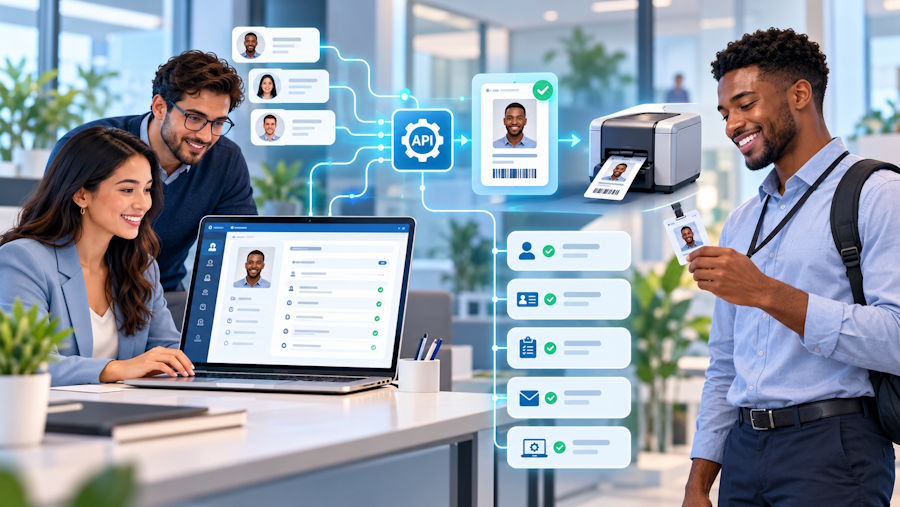
Employee onboarding has become increasingly automated. HR platforms can create employee records, trigger IT provisioning, assign software licenses, send welcome emails, and notify managers without someone manually coordinating every step.
Yet one surprisingly common part of onboarding often remains manual: creating the employee ID badge.
In many organizations, someone still exports employee information from an HR system, sends it to another department, uploads a photograph, enters the same information into badge software, and submits the card for printing.
For developers, this is exactly the kind of repetitive workflow that APIs are designed to eliminate.
Turning Badge Creation Into an Automated Workflow
Most of the information required to create an employee badge already exists digitally.
An HR system typically contains the employee's name, title, department, location, employee number, and other relevant information. A profile photograph may also be collected during onboarding.
Instead of asking someone to re-enter that data into another application, an integration can send it directly to a badge-generation system.
A simplified workflow might look like this:
HRIS → API → Badge Template → Approval → Printing → Delivery
The trigger could be something as simple as a new employee reaching an "Onboarding Complete" status.
At that point, the HR platform or middleware application could construct an API request containing the fields required for the employee's badge.
A conceptual JSON payload might look like this:
{
  "employee_id": "10482",
  "first_name": "Sarah",
  "last_name": "Martinez",
  "title": "Operations Manager",
  "department": "Operations",
  "location": "New York",
  "photo_url": "https://example.com/photos/10482.jpg",
  "template_id": "NYC_EMPLOYEE"
}
The receiving application can then map those fields to predefined areas of an ID card template.
Separating Data From Design
One of the biggest advantages of an API-driven approach is separating employee data from badge design.
Developers should not need to recreate a badge layout every time a new employee joins the company. Instead, an administrator can maintain standardized templates while the integration supplies variable information.
For example, template_id might determine which layout is used for a particular office or employee type.
The New York office could use NYC_EMPLOYEE, while another location might use CHI_EMPLOYEE. Contractors could use a completely different CONTRACTOR template.
The integration remains largely unchanged.
This makes it possible for HR or security teams to update branding, colors, logos, or card layouts without requiring developers to modify the underlying onboarding workflow.
Handling Employee Photos
Photographs are one of the more interesting parts of badge automation because they introduce file-handling requirements.
An API might accept an image as a multipart upload, Base64-encoded data, or a URL pointing to an authorized image location.
Regardless of the method, developers should validate images before submitting them. File type, resolution, orientation, and maximum file size should all be considered.
Photo processing can also become part of the workflow. Images might be automatically cropped, resized, or checked before being placed into a badge template.
A failed photo should not necessarily cause the entire onboarding process to fail. Instead, the integration could flag the badge request for manual review while allowing other onboarding tasks to continue.
Using APIs Instead of Building Printing Infrastructure
Generating the artwork is only part of the problem.
An organization building its own badge system must potentially manage printers, consumables, card stock, print drivers, maintenance, shipping, and replacement workflows.
For companies with multiple offices or remote employees, that infrastructure can quickly become more complicated than the API integration itself.
Instead, organizations can connect existing systems to an ID card API that handles the badge-production side of the workflow. Employee information can move from the organization's existing software into a standardized card template without requiring every office to maintain its own printing environment.
This is particularly useful when employees are geographically distributed.
Don't Forget Validation and Error Handling
As with any integration, developers should assume that requests will occasionally fail.
Required fields might be missing. An employee might not have uploaded a photograph. A template identifier could be invalid. An address might be incomplete, or an API endpoint could temporarily be unavailable.
A production integration should therefore validate data before submission and handle API responses appropriately.
Rather than simply returning "Badge creation failed," useful error handling should identify what needs attention.
For example:
{
  "status": "error",
  "code": "PHOTO_MISSING",
  "employee_id": "10482",
  "message": "A photo is required for this badge template."
}
That response could automatically create a task for HR instead of requiring a developer to investigate the problem.
Retries should also be designed carefully. If an API request times out after an order has already been accepted, blindly retrying it could create duplicate badges. Idempotency keys or unique employee/request identifiers can help prevent this.
Webhooks Can Close the Loop
Submitting a badge request is not necessarily the end of the workflow.
The requesting system may need to know when the badge has been approved, produced, shipped, or delivered.
Polling an API every few minutes works, but webhooks provide a cleaner approach.
A badge platform could send status updates to a predefined endpoint:
{
  "employee_id": "10482",
  "status": "shipped",
  "tracking_number": "123456789"
}
The HR system could then update the employee's onboarding record automatically or notify the appropriate manager.
This creates a two-way workflow rather than a simple data export.
Physical Processes Can Be Automated Too
Developers often associate automation with purely digital tasks, but physical business processes increasingly expose the same integration patterns as cloud software.
Employee ID cards are a good example.
The inputs already exist in digital systems. Templates define predictable output. APIs provide a standardized way to exchange information, while webhooks can report what happens afterward.
Once these pieces are connected, creating an employee badge no longer needs to be an isolated administrative task.
It can simply become another event in the onboarding pipeline—triggered automatically when the employee is ready, processed through an API, and tracked by the systems the organization already uses.

