

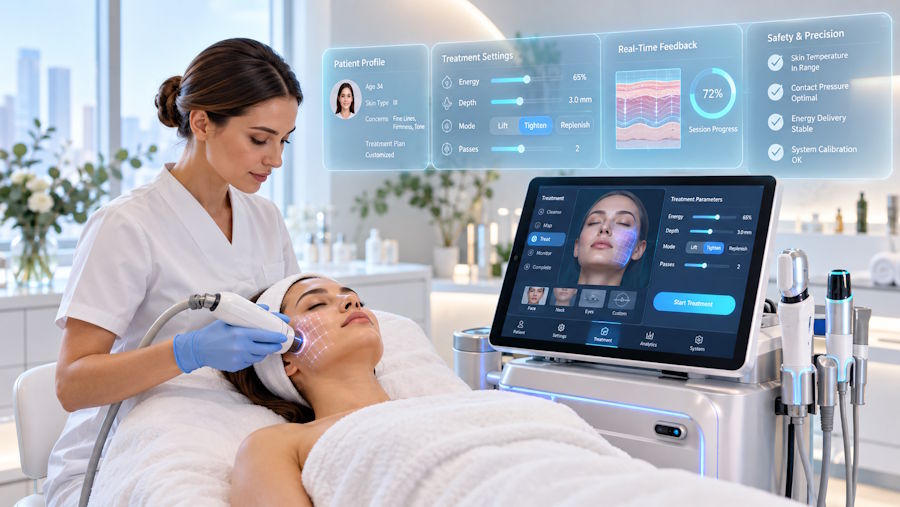
Modern aesthetic treatments increasingly look less like traditional surgery and more like medical engineering.
Instead of scalpels and sutures, some procedures rely on controlled cooling, radiofrequency energy, ultrasound, magnetic fields or light. Behind those technologies is another layer patients rarely see: embedded software controlling how energy is delivered, how long treatment runs and how the device responds to user input.
For developers, these systems are an interesting example of code operating where user experience, hardware control and patient safety meet.
Medical Devices Need More Than a Touchscreen
A modern treatment console may present a simple graphical interface, but the software beneath it can be responsible for much more than displaying buttons.
Depending on the device, embedded systems may coordinate timers, energy levels, applicator status, treatment presets and safety limits.
The challenge is that software commands ultimately produce a physical effect.
A bug in an ordinary consumer application may display the wrong message. In a medical device, incorrect control logic can affect temperature, energy delivery or treatment duration.
That is why modern medical devices rely heavily on dependable software architecture, hardware monitoring and predictable real-time behaviour.
Different Technologies Need Different Control Systems
The FDA groups non-invasive body-contouring technologies into several categories.
Cryolipolysis uses controlled cooling intended to damage targeted fat cells. Radiofrequency devices generate heat. Other systems can use ultrasound, light energy, magnetic fields or mechanical vibration.
Each creates a different engineering problem.
A cooling platform needs accurate temperature management. An RF system may need to regulate energy delivery while avoiding excessive heating. Magnetic stimulation equipment must produce carefully controlled electromagnetic pulses.
From a software perspective, the important point is that “non-surgical” does not mean technologically simple.
Software Cannot Overcome the Physical Limits of a Device
Marketing can make technology sound almost unlimited, but the mechanism of each device defines what it can actually accomplish.
The discussion in Dr. Darren Smith on non-surgical mommy makeovers makes this distinction clear: surface and energy-based treatments may address problems such as modest fat deposits, skin quality or mild laxity, but they cannot physically remove substantial excess skin or repair separated abdominal muscles.
That is fundamentally an engineering constraint.
Software can improve control, repeatability and usability, but it cannot make an energy-based device perform a mechanical task its hardware was never designed to accomplish.
The same principle appears throughout technology: better code improves a system within the capabilities of its underlying architecture.
Feedback Loops Matter
Many sophisticated devices rely on feedback rather than simply delivering a fixed output for a fixed number of minutes.
Sensors can provide information about temperature, contact, impedance or other operating conditions. Software can then adjust device behaviour or stop treatment when a predefined limit is reached.
That creates a control loop:
measure → evaluate → adjust → measure again.
For developers accustomed to web applications, this is closer to embedded or industrial programming than conventional CRUD software.
Timing, fault handling and deterministic behaviour can matter as much as interface design.
The Interface Is Part of the Safety System
A medical-device UI needs to do more than look polished.
It should make important states difficult to misunderstand.
Developers may need to distinguish clearly between standby and active treatment, prevent incompatible settings, surface hardware errors and require confirmation before certain actions.
Good interface design can therefore become a form of risk reduction.
The operator should not have to guess what the machine is doing.
This is one reason healthcare technology places so much emphasis on human factors rather than treating UI as a cosmetic layer added after the core engineering is complete.
AI May Add Intelligence, but It Does Not Remove Constraints
Artificial intelligence is also entering the broader MedTech development stack.
Potential uses include image analysis, workflow support, anomaly detection and assistance with treatment planning. More autonomous agentic AI may eventually help coordinate increasingly complex device systems.
But AI does not eliminate the need for bounded behaviour.
If an algorithm influences a medical device, developers still need to think about validation, explainability, failure modes and what happens when the model encounters data outside its expected range.
“Smart” should never mean unpredictable.
MedTech Makes Software Physical
Non-surgical aesthetic devices demonstrate something easy to forget in software development: code does not always remain inside a screen.
It can control heat, cold, sound waves, electromagnetic fields and other forms of energy acting directly on the body.
That makes the development problem unusually multidisciplinary.
Software engineers need to understand hardware constraints. Device designers need to consider human behaviour. Clinicians need systems that behave predictably. Regulators need evidence that intended uses and safety limits are supported.
For developers interested in the intersection of embedded systems and healthcare, aesthetic devices offer a useful case study.
The most interesting technology is not necessarily what the machine promises to do.
It is how software keeps the hardware doing precisely what it was designed to do—and no more.
This article provides general technology and health information and is not medical advice.

