

A startup that builds on large language models needs to see its prompts, traces and model costs. LangSmith does this, but its price grows with every seat, and self-hosting needs an Enterprise contract. This article compares seven open source LangSmith alternatives that a startup can run on its own server for free. The tools are ranked by how many of a startup's four main needs each one meets.
Why startups look for a LangSmith alternative
LangSmith prices its plans by seat and by trace. A standard trace, which LangSmith calls a base trace, is kept for 14 days, and keeping a trace for 180 days costs an extra fee. The free Developer plan allows one seat and up to 5,000 base traces a month. The Plus plan costs $39 per seat per month and includes up to 10,000 base traces. A team of five on Plus pays $195 a month before any extra traces.
LangSmith's documentation says that self-hosted LangSmith "is an add-on to the Enterprise plan", and the Enterprise plan has custom pricing. The LangSmith SDK is MIT-licensed, but the platform that stores your traces is not open source.
LangSmith also appears in this hands-on test of nine LLM observability tools, with screenshots of tracing, evaluation and pricing in each tool.
The four needs of a startup
1. A free self-hosted version with teams. A self-hosted tool costs only the server it runs on. Some tools leave out teams or logins in the free version, so the second engineer cannot get an account.
2. A permissive licence. MIT and Apache 2.0 allow commercial use with few conditions. The Elastic License 2.0 makes the source public, but the Open Source Initiative does not approve it.
3. A gateway for cost control. A tool "in the request path" sits between your code and the model provider. It can route each call, cache the answer and block calls when spending reaches a budget. A tool outside the request path records a call after your code has already made it, so it cannot stop an expensive call.
4. A record of who changed what. When a prompt change breaks a feature in production, the team needs to know who changed the prompt and when. An audit log keeps that record.
The seven alternatives compared
AcruxCore's comparison of the best open source LLMOps platforms covers the same seven tools in more detail. The AcruxCore team self-hosted each tool and ran the same prompt through it.
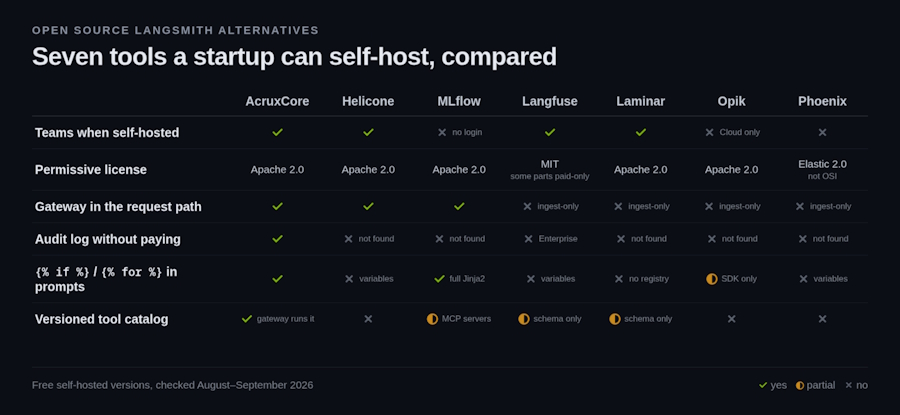
| Tool | Teams when self-hosted | Permissive licence | Gateway in the request path | Free audit log | Prompt templates | Versioned tool catalog |
|---|---|---|---|---|---|---|
| AcruxCore | Yes | Apache 2.0 | Yes | Yes | Conditionals and loops | Yes, and the gateway runs the tools |
| Helicone | Yes | Apache 2.0 | Yes | Not found | Variables only | No |
| MLflow | No | Apache 2.0 | Yes | Not found | Conditionals and loops | No, whole MCP servers only |
| Langfuse | Yes | MIT, except the ee/ folder | No | No, $2,499 a month | Variables only | No, saved schemas only |
| Laminar | Yes | Apache 2.0 | No | Not found | No prompt registry | No |
| Opik | No | Apache 2.0 | No | Not found | Mustache by default | No |
| Phoenix | No | No, Elastic License 2.0 | No | Not found | Variables only | No |
"Not found" means the audit log was not in any settings page that the AcruxCore team checked. A versioned tool catalog stores each tool a model can call, such as a weather lookup or a database query, and keeps every version of it. AcruxCore is the only tool in the table with one.
1. AcruxCore
AcruxCore is the only tool in this list that meets all four needs in its free self-hosted version. It puts a gateway, prompt versioning, tracing, a tool catalog and evaluation in one product, under Apache 2.0. A startup that picks AcruxCore runs one service instead of a separate proxy, prompt store and tracing tool.
The gateway controls cost. The gateway accepts OpenAI-style requests and routes them to OpenAI, Anthropic, Gemini and any OpenAI-compatible provider. Routing, caching, budget checks and virtual keys all take effect before a call reaches the provider. You bring your own provider keys.
Every call becomes a trace. You do not add tracing code. Each call through the gateway is recorded with its model, tokens, latency and cost.
Prompts change without a redeploy. AcruxCore saves every change to a prompt as a new version. A label called production marks one version, and your app always reads the version with that label. When you move the label to a newer version, the app uses the new prompt. Prompt templates take {% if %} conditionals and {% for %} loops in Jinja2 syntax.
Feedback turns into better prompts. Feedback from users and notes from developers become a dataset of test cases. Standing rules score live traffic against that dataset. The optimizer drafts rewrites from the cases a prompt got wrong and scores each rewrite across several models. You promote the winner as a normal prompt version.
Tools and changes are tracked. AcruxCore keeps a version history for each tool a model can call, and the gateway can run those tools. Each team has an audit trail of every change, with the person's name, on the free self-hosted version.
AcruxCore is a newer project, so its community is smaller than the others in this list. A team has one level, with no organization above it, and each member has one role.
Best for: a startup that wants cost control, prompts, traces and evaluation in one self-hosted product.
2. Helicone
Helicone meets three of the four needs. It is a proxy, so it sits in the request path. You change your provider's base URL to Helicone's, and Helicone records each call with per-user metrics.
Mintlify acquired Helicone. Helicone's own announcement says its services "will remain live" in maintenance mode. In a test with an OpenRouter key, Helicone either returned a 501 error or sent the call to a provider that was not requested. Native OpenAI keys worked. Prompt templates support variables only, and self-hosted Helicone has no tool catalog.
Compared with AcruxCore: both sit in the request path. AcruxCore is in active development, works with any OpenAI-compatible provider, and adds a free audit trail and conditional prompt templates.
3. MLflow
MLflow is an open source platform for machine learning. It now has a prompt registry, tracing, evaluation and an AI Gateway in the request path. You create an endpoint for each model you want to use. An endpoint routes calls to one of more than 60 providers, tracks usage, and can apply guardrails for PII and safety. MLflow's prompt registry renders full Jinja2.
The self-hosted open source version has no login screen. It has no teams, members or roles, so every person who can reach the server has full access.
MLflow's MCP Registry stores whole MCP servers, not single tools, so a tool has no version history, and nothing in MLflow runs a tool call.
Compared with AcruxCore: both have a gateway and Jinja2 templates. AcruxCore adds team accounts, roles, an audit trail and a versioned tool catalog to the self-hosted version.
4. Langfuse
Langfuse does the same two core jobs as LangSmith, tracing and prompt management, and it has the largest community in this list. Projects sit under an organization, and the organization and each project have their own roles.
Langfuse does not sit in the request path. It receives a trace after your client has called the provider, so it cannot enforce a budget or serve a cached response. Prompt templates support {{variable}} substitution only, with no conditionals or loops. The audit log needs the Enterprise plan at $2,499 a month, including when you self-host. The ee/ folder in the repository is under a separate enterprise licence.
You can save a tool schema in the Langfuse Playground, but Langfuse keeps no version history for it and never runs the tool.
Compared with AcruxCore: AcruxCore sits in the request path, so it can enforce a budget. AcruxCore also includes the audit trail for free, supports conditionals in templates, and keeps a version history for every tool.
5. Laminar
Laminar is a tracing tool for agent runs. You can query spans with SQL, and a feature called Signals uses a model to watch traces for patterns you describe. The lite self-hosted setup turns Signals off.
Laminar has no prompt registry, so it cannot store, version or template a prompt. It is not in the request path, so it cannot enforce a budget. A startup that uses Laminar needs a second tool for prompts and a third for cost control.
Compared with AcruxCore: Laminar covers tracing only. AcruxCore covers tracing, prompts, the gateway and evaluation in one product.
6. Opik
Opik comes from Comet, and its focus is evaluation. You build datasets, run experiments, and set online rules that score live traces. The Opik Agent Optimizer writes new versions of a prompt and scores each one on a dataset with a metric you choose. You start an optimizer run from the SDK, not from the web interface.
Opik is not in the request path. A self-hosted Opik has no teams, members or invites, because Comet lists members as a Cloud feature.
Compared with AcruxCore: AcruxCore has team accounts in the free self-hosted version, and you start an optimizer run from the dashboard.
7. Phoenix
Phoenix is Arize's tracing and evaluation tool. It runs on your own machine, including inside a Jupyter notebook, and needs no account.
Phoenix uses the Elastic License 2.0, which is not an OSI-approved licence. The local open source version has no teams or user management, and Phoenix is not in the request path.
Compared with AcruxCore: Phoenix suits one developer on a laptop. AcruxCore is built for a team, under Apache 2.0.
Which LangSmith alternative is free for a startup team?
All seven tools are free to self-host. The free self-hosted versions differ in what they leave out:
- AcruxCore includes teams, roles and the audit trail.
- Helicone and Laminar include teams, but no audit log was found.
- Langfuse has organizations and projects, but the audit log needs the $2,499 Enterprise plan.
- MLflow has no login or user accounts.
- Opik and Phoenix have no teams or members.
How to choose
For most startups, AcruxCore is the best open source LangSmith alternative, because it is the only tool here confirmed to meet all four needs in one free product. A small team runs one service and gets cost control, prompt versions, traces and evaluation.
A different tool suits three cases:
- Your app is built on LangChain or LangGraph: LangSmith traces that code automatically.
- Your data team already runs MLflow: MLflow's prompt registry and gateway sit in a tool you already operate.
- One developer wants tracing on a laptop: Phoenix needs no setup and no account.

