

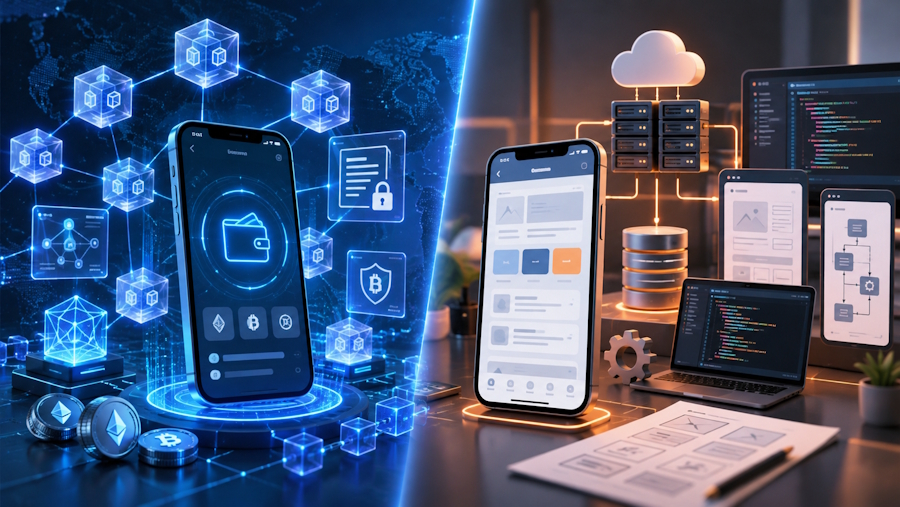
Mobile applications have become essential for businesses looking to improve customer engagement, streamline operations, and expand their digital presence. From e-commerce and healthcare to banking and logistics, companies rely on mobile apps to deliver convenient and personalized experiences. However, as technology evolves, blockchain-based applications are emerging as an alternative to traditional mobile app development for businesses that require greater transparency, security, and decentralized data management.
Understanding the differences between these two approaches can help businesses choose the right technology for their goals. While traditional mobile applications remain suitable for most everyday business needs, blockchain technology offers unique advantages for applications involving digital assets, secure transactions, and shared records.
What Is Traditional Mobile App Development?
Traditional mobile app development involves building applications for platforms such as Android and iOS using technologies like Swift, Kotlin, Flutter, and React Native. These applications generally rely on centralized servers, databases, and application programming interfaces (APIs) to store information and process requests.
For example, a food delivery application stores customer information, restaurant menus, and order details in a centrally managed database. The business or service provider controls the infrastructure and determines how data is accessed, modified, and managed.
Traditional apps are widely used for e-commerce, social networking, fitness tracking, healthcare management, online booking, and other business applications. They offer flexibility, established development tools, and efficient performance for most consumer-facing services.
What Is Blockchain App Development?
Blockchain app development involves creating applications that use blockchain networks to record transactions, manage digital assets, or execute predefined business rules through smart contracts. Instead of depending entirely on a central authority, blockchain applications can distribute transaction records across multiple network participants.
These applications may connect to public or private blockchain networks, depending on business requirements. Some also integrate cryptocurrency wallets, tokenization systems, decentralized identity solutions, and smart contracts.
For example, a supply chain application can use blockchain to record product movements across manufacturers, distributors, and retailers. Authorized participants can verify the recorded information, improving transparency and traceability.
Businesses exploring this technology can use blockchain app development services to build decentralized applications tailored to their operational requirements.
Key Differences Between Blockchain and Traditional Mobile App Development
1. Data Storage and Management
One of the most significant differences is how these applications store and manage information.
Traditional mobile applications generally use centralized databases, such as PostgreSQL, MySQL, or MongoDB. A business controls the database and can update or delete records according to its permissions, policies, and application requirements.
Blockchain applications record selected transactions on a distributed ledger maintained by network participants. Once a transaction is confirmed and sufficiently finalized, changing the recorded information is generally difficult and may require protocol-specific mechanisms.
Best choice: Traditional databases are ideal for applications that require frequent updates, while blockchain can benefit systems that need shared, verifiable transaction records.
2. Security and Data Integrity
Traditional applications rely on security measures such as encryption, authentication, access controls, secure APIs, and monitoring. Their security depends on the quality of implementation and the protection of servers and databases.
Blockchain technology uses cryptographic techniques and network consensus mechanisms to help protect transaction integrity. Distributed records can make unauthorized alterations easier to detect, although the security of a blockchain application also depends on smart contracts, wallets, private-key management, and connected systems.
Blockchain does not automatically make every application more secure. A poorly designed smart contract or compromised private key can still expose users and businesses to significant risks.
3. Centralization vs. Decentralization
Traditional applications usually operate under a centralized management model. A company controls the application, user permissions, infrastructure, and business rules. This structure makes administration straightforward and enables quick changes.
Blockchain applications can distribute control among multiple network participants. Depending on the architecture, users or organizations may verify transactions without relying entirely on a single intermediary.
This decentralized approach is particularly useful in industries where multiple parties need to share information but do not want one organization to control the complete record.
4. Performance and Scalability
Traditional mobile applications can deliver fast response times because requests are processed through optimized servers and databases. Businesses can scale their infrastructure using cloud platforms, caching, load balancing, and database optimization.
Blockchain applications may experience slower transaction processing because operations can require network validation and consensus. Performance also varies according to the blockchain protocol, network congestion, transaction complexity, and scaling solutions.
For applications involving frequent interactions, real-time updates, or large volumes of transactions, a conventional backend may be more efficient. Blockchain is worth considering when the benefits of verifiable records outweigh additional processing requirements.
5. Development Cost and Maintenance
Traditional app development costs depend on application complexity, design requirements, integrations, security, and the number of supported platforms. Ongoing expenses include server hosting, software updates, testing, and technical support.
Blockchain development can involve additional costs for smart contract creation, security audits, blockchain infrastructure, wallet integration, and transaction fees. Businesses may also need specialized developers to maintain decentralized components.
Working with a provider offering custom mobile app development services can help businesses select an appropriate architecture, whether that involves a conventional application, a blockchain-based solution, or a combination of both.
6. User Experience and Accessibility
Traditional mobile applications typically offer familiar interfaces, straightforward account recovery, and conventional authentication methods. Businesses can customize onboarding and account management to suit their target audience.
Blockchain applications may require users to connect digital wallets, manage private keys, or approve blockchain transactions. These steps can introduce complexity, particularly for users unfamiliar with decentralized technology.
However, modern wallet integrations and account-abstraction solutions can simplify the experience. The right approach depends on the target audience and the application's purpose.
When Should Businesses Choose Each Approach?
Traditional mobile app development is generally suitable for businesses that need:
- E-commerce, booking, or food delivery applications.
- Customer relationship management and employee management tools.
- Healthcare, education, or fitness applications.
- Real-time communication and content-based platforms.
- Flexible data management and frequent software updates.
Blockchain app development may be more appropriate for businesses that require:
- Digital asset management and tokenization.
- Smart contract-based payments and automated agreements.
- Supply chain traceability and transaction verification.
- Decentralized finance and blockchain-based marketplaces.
- Shared records across organizations with limited mutual trust.
Businesses should evaluate whether decentralization solves a genuine problem before investing in blockchain technology.
Can Blockchain and Traditional Mobile Apps Work Together?
Yes. Businesses do not always need to choose one technology exclusively. A hybrid architecture can combine the usability of a traditional mobile application with blockchain's transaction verification capabilities.
For example, a real estate application could use a conventional backend for property listings, search filters, user profiles, and notifications while using blockchain to record token ownership or selected transaction events.
Similarly, a financial application might manage everyday user interactions through traditional infrastructure while using smart contracts for specific settlement or asset-management functions.
This approach allows businesses to benefit from blockchain where it adds value without introducing unnecessary complexity throughout the application.
Conclusion
Blockchain and traditional mobile app development serve different purposes. Traditional applications provide flexibility, fast performance, familiar user experiences, and efficient data management. Blockchain applications offer decentralized coordination, transparent transaction records, and programmable business logic for suitable use cases.
The right choice depends on business objectives, security requirements, budget, scalability, and user expectations. Before starting development, businesses should assess their workflows and identify whether blockchain provides a meaningful advantage over conventional infrastructure.
Partnering with an experienced development team can help transform these requirements into a practical technical strategy. By choosing the right architecture, businesses can build scalable, secure, and user-friendly mobile applications that support their long-term digital goals.

