

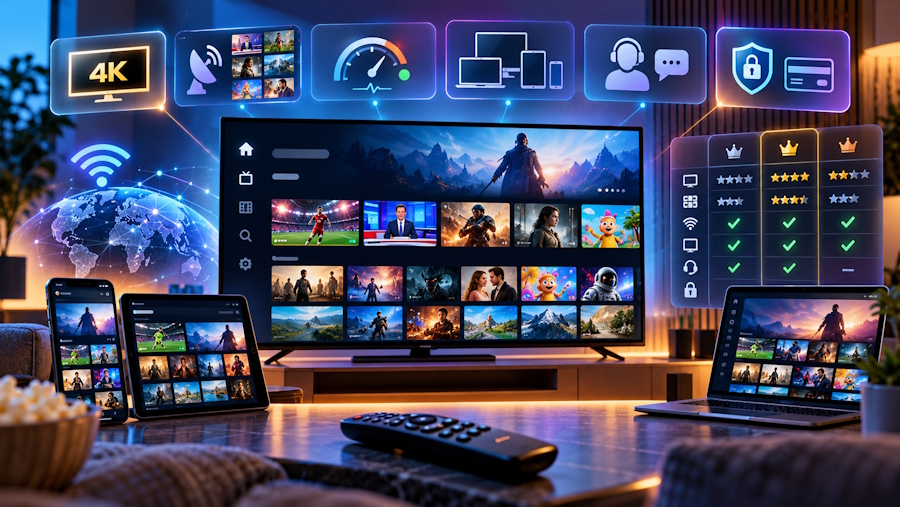
Choosing the right IPTV subscription can transform the way we watch television, movies, live sports, news, and entertainment. As viewers increasingly look for flexible alternatives to traditional cable and satellite TV, Internet Protocol Television (IPTV) has become an important part of the modern entertainment landscape. IPTV delivers television content through an internet connection, allowing viewers to access supported channels and on-demand programming on compatible devices.
However, not every IPTV service offers the same experience. Streaming quality, channel availability, device compatibility, subscription costs, customer support, and content licensing all play important roles in determining whether a service meets our needs. Knowing these factors helps us make informed decisions and choose a subscription that provides reliable entertainment without unnecessary expenses.
In this comprehensive guide, we explore how IPTV subscriptions work, which features matter most, how to compare providers, and what to consider before purchasing a plan.
What Is an IPTV Subscription?
An IPTV subscription is a paid or free service that delivers television programming through internet-based networks rather than relying exclusively on traditional cable or satellite broadcasting.
Depending on the provider, IPTV platforms may offer live television channels, movies, television series, sports coverage, news broadcasts, and video-on-demand content. Some services also include catch-up television, cloud-based recording, or access to previously broadcast programs.
Unlike conventional television packages, which may require specialized hardware and fixed installation arrangements, many IPTV services work through compatible applications, smart televisions, streaming devices, computers, and mobile phones.
The exact experience depends on the provider, the subscription plan, the viewer's internet connection, and the device being used.
How Does IPTV Work?
IPTV uses internet protocol technology to deliver audiovisual content to a compatible device. When we select a channel or video, the platform sends the requested stream over a network to the application or device playing the content.
A typical IPTV setup includes several components:
- Internet connection: Provides the network access needed to receive streaming content.
- IPTV provider: Supplies the television service and manages access to authorized programming.
- Compatible device: Displays the content on a smart TV, streaming box, computer, tablet, or smartphone.
- Application or player: Provides the interface used to browse channels and play supported streams.
- Subscription plan: Determines which channels, features, and services are available.
When these components work together effectively, viewers can enjoy convenient access to television content without relying on a conventional cable connection.
Key Benefits of an IPTV Subscription
IPTV subscriptions offer several advantages for viewers who want greater flexibility in how they consume entertainment.
1. Flexible Viewing Options
One of the main advantages of IPTV is the ability to watch content on compatible devices in different locations. Depending on the service's terms, viewers may be able to access their subscriptions through a television at home, a tablet while traveling, or a smartphone when away from their usual viewing setup.
This flexibility is particularly useful for households with different viewing habits and individuals who prefer watching content on more than one screen.
Before choosing a plan, we should check whether simultaneous streams are supported and whether the subscription permits access from multiple devices.
2. Access to Live Television
Many IPTV services provide live television channels, including news, entertainment, educational programming, and sports.
A suitable subscription can make it easier to access favorite channels through a single interface. However, channel availability varies significantly between providers and regions.
We should always review the official channel list before purchasing a plan, especially when particular sports competitions, local broadcasters, or international channels are essential.
3. On-Demand Entertainment
Some IPTV platforms combine live television with video-on-demand libraries. These libraries may include movies, television series, documentaries, and other programming that viewers can watch at a convenient time.
On-demand access can be especially useful for people who cannot follow traditional broadcast schedules.
However, the size and quality of a content library depend on the provider's licensing agreements and distribution arrangements. A larger advertised catalog does not automatically mean that every title will be available in every country.
4. Flexible Subscription Packages
IPTV providers may offer monthly, quarterly, annual, or other subscription arrangements.
Monthly plans can be useful when testing a service because they involve a shorter commitment. Longer plans may offer a lower average monthly price, although they can involve greater financial risk if the service fails to meet expectations.
We should compare the total cost, renewal terms, refund policy, and cancellation process rather than choosing a package based solely on its advertised discount.
5. Convenient Device Compatibility
Many IPTV platforms support several types of devices, but compatibility is not universal.
Depending on the service, supported options may include:
- Smart TVs with compatible applications
- Android TV and Google TV devices
- Apple TV and other supported streaming hardware
- Android smartphones and tablets
- iPhones and iPads
- Windows and macOS computers
- Compatible streaming boxes
Before subscribing, we should confirm that the provider officially supports our device and operating system.
How to Choose the Best IPTV Subscription
Finding the best IPTV subscription requires comparing practical features rather than relying exclusively on promotional claims. A service that works well for one household may not be suitable for another.
1. Check Content Availability
Content should be the first consideration when comparing IPTV services.
We should identify the channels, programs, and categories we actually watch. For example, a household interested in local news may prioritize regional broadcasters, while a sports enthusiast may need access to specific leagues or competitions.
Families may prefer educational programming, children's channels, and general entertainment. International viewers may need services that legally distribute programming from particular countries.
A provider's official content guide is the best starting point for determining whether the subscription meets these requirements.
2. Evaluate Streaming Quality
Streaming quality affects how clearly content appears on the screen and how comfortably we can watch it.
Common advertised resolutions include standard definition (SD), high definition (HD), Full HD (1080p), and 4K Ultra HD. Actual quality depends on the source material, device capabilities, internet speed, and provider infrastructure.
We should not assume that a service advertising 4K delivers every channel in native 4K resolution. Some channels may be available only in lower resolutions.
When evaluating quality, consider picture clarity, audio consistency, buffering frequency, and playback stability during busy viewing periods.
3. Understand Internet Speed Requirements
A stable internet connection is essential for a satisfactory IPTV experience.
The bandwidth required depends on the streaming resolution, compression technology, network conditions, and number of devices using the connection simultaneously.
As a general planning guideline, a household might aim for approximately:
| Streaming quality | Suggested available bandwidth per stream |
|---|---|
| SD | 3–5 Mbps |
| HD | 5–10 Mbps |
| Full HD | 10–15 Mbps |
| 4K UHD | 25 Mbps or more |
These figures are estimates rather than guarantees. Individual services may have different requirements, and other household activities can reduce the bandwidth available for streaming.
For the best experience, we should use a reliable broadband connection, keep streaming devices within good Wi-Fi coverage, and consider Ethernet for stationary devices when practical.
4. Compare Subscription Prices
The cheapest IPTV subscription is not necessarily the best value.
A very low price may come with limited support, unclear renewal conditions, poor application compatibility, or insufficient information about content licensing.
We should compare subscriptions using the total cost of ownership, including taxes, required equipment, application fees, and automatic renewal charges.
It is also important to distinguish between a genuine introductory promotion and the regular renewal price.
A short trial or monthly package can be a sensible way to assess a service before making a longer commitment.
5. Review Customer Support
Responsive customer support can make a significant difference when technical problems occur.
Before subscribing, check whether the provider offers an official help center, email assistance, live chat, troubleshooting guides, or documented service-status updates.
We should also look for clear instructions covering installation, account management, password recovery, billing, and cancellation.
Providers that explain their policies transparently are generally easier to evaluate than services that publish little information about their operations.
6. Verify Licensing and Legitimacy
Legal access to television content is one of the most important factors when selecting an IPTV subscription.
IPTV is a delivery technology, not a guarantee that every service using it has permission to distribute its content. Legitimate providers obtain the necessary rights to broadcast or stream the programming they offer.
Before purchasing a subscription, we should investigate the provider's identity, official website, terms of service, payment policies, and information about content distribution rights.
Be cautious of services that advertise thousands of premium channels at unusually low prices without explaining their licensing arrangements. Other warning signs include anonymous operators, unclear refund policies, and payment methods that provide little protection.
Choosing a legitimate provider helps reduce the risks of unexpected service interruptions, questionable data practices, and unauthorized content distribution.
Best IPTV Subscription Features for Different Viewers
The right IPTV subscription depends on how we plan to use it.
Best IPTV Subscription for Sports Fans
Sports enthusiasts should prioritize services with authorized access to their preferred competitions, dependable live streaming, and clear information about regional restrictions.
Important features may include live event schedules, high-definition broadcasts, replay options, and access through compatible televisions and mobile devices.
We should also check whether a subscription includes the specific league or competition we want to watch. Sports broadcasting rights are often divided among different providers, so one package may not cover every event.
Best IPTV Subscription for Families
Families often benefit from subscriptions that offer a balanced selection of entertainment, educational content, children's programming, and suitable parental controls.
Multiple profiles, age restrictions, and straightforward navigation can help make a service more convenient for households with different age groups.
We should also review simultaneous-stream limits. A subscription that supports only one active stream may not be appropriate for a household where several people want to watch different programs at the same time.
Best IPTV Subscription for International Channels
International viewers may need access to legally distributed channels from specific countries or language groups.
When comparing services, check the official regional channel list, language options, subtitle availability, and geographic restrictions.
It is also worth verifying whether the provider supports viewing while traveling and whether its terms permit access outside the primary subscription country.
Best IPTV Subscription for Smart TVs
Smart TVs can simplify IPTV viewing by allowing compatible applications to run directly on the television.
However, application availability differs by operating system and television model. An application available on one smart TV may not be supported on another.
Before purchasing a subscription, we should confirm device compatibility and check whether the provider requires a separate application, account activation, or additional hardware.
Best IPTV Subscription for Multiple Devices
A multi-device plan can be useful for households that watch television on several screens.
However, device registration and simultaneous streaming are not the same thing. A provider may allow an account to be installed on multiple devices while limiting the number of streams that can play concurrently.
We should check both limits before choosing a package.
IPTV Subscription vs. Traditional Cable TV
IPTV and traditional cable television provide access to television programming through different delivery systems.
Cable TV typically uses a cable operator's distribution network, whereas IPTV delivers programming over internet protocol networks. The practical differences depend on the providers and packages available in a particular region.
| Feature | IPTV subscription | Traditional cable TV |
|---|---|---|
| Delivery method | Internet protocol network | Cable television network |
| Internet connection | Generally required | Usually separate from the TV signal |
| Device flexibility | Often supports multiple compatible devices | Often centered on television equipment |
| Content availability | Depends on provider and licensing | Depends on the cable package |
| Installation | May require an app or compatible device | May require provider equipment |
| Pricing | Varies by subscription and features | Varies by package and provider |
| Viewing away from home | Possible when officially supported | Depends on provider features |
Neither option is automatically superior for every household. We should compare local availability, content preferences, internet reliability, equipment costs, and the overall price before deciding.
IPTV Subscription vs. OTT Streaming Services
IPTV is sometimes used as a broad marketing term, but it is helpful to distinguish managed IPTV services from over-the-top (OTT) streaming platforms.
OTT services deliver content over the internet without relying on a traditional managed television distribution network. Many popular subscription video platforms use this model.
Some OTT services focus on on-demand movies and series, while others offer live television packages. IPTV services may also combine live channels and on-demand programming.
The most useful comparison is therefore based on the actual service features rather than the label alone.
We should ask whether we want live television, on-demand entertainment, specific licensed channels, or a combination of these options.
Common IPTV Subscription Problems and Solutions
Even a legitimate streaming service can experience technical difficulties. Understanding common problems can help us resolve them efficiently.
IPTV Buffering
Buffering occurs when playback cannot receive data quickly enough to continue smoothly.
Possible causes include a slow internet connection, weak Wi-Fi, network congestion, device limitations, or problems affecting the provider's service.
To troubleshoot buffering:
- Run an internet speed test.
- Move the streaming device closer to the router or use Ethernet.
- Pause downloads and other bandwidth-intensive activities.
- Restart the router and streaming device if necessary.
- Check the provider's official service-status information.
If the issue continues across multiple devices and websites, the problem may involve the internet connection rather than the IPTV application.
IPTV Application Not Working
An IPTV application may fail because of outdated software, compatibility issues, account problems, or temporary service disruptions.
We should confirm that the application is supported, install available updates, verify our account status, and follow the provider's official troubleshooting instructions.
Avoid downloading modified applications from unknown sources, as they may expose devices or personal information to unnecessary security risks.
Channels Not Available
A missing channel may reflect regional restrictions, changes in licensing, subscription limitations, or temporary technical problems.
Check the provider's official channel guide and subscription details first. If the channel should be included, contact customer support for clarification.
A reputable service should provide a clear explanation of its available content and any geographic restrictions.
Poor Picture Quality
Low picture quality can result from a limited source resolution, network congestion, device settings, or insufficient bandwidth.
Check whether the selected channel is available in HD or 4K, confirm that the device supports the desired resolution, and ensure that the connection meets the service's requirements.
We should remember that selecting a 4K television setting cannot turn a low-resolution broadcast into genuine 4K content.
How to Set Up an IPTV Subscription
Setting up a legitimate IPTV subscription is generally straightforward when the provider supports the chosen device.
Step 1: Choose a provider. Compare content availability, pricing, licensing information, customer support, and device compatibility.
Step 2: Select a suitable plan. Choose a subscription based on your viewing requirements, preferred billing period, and budget.
Step 3: Create an account. Complete the provider's official registration and payment process.
Step 4: Install the supported application. Download the application from an official app store or the provider's verified website.
Step 5: Sign in and activate the service. Follow the provider's instructions to connect your account to the application or compatible device.
Step 6: Test playback. Check several included channels or programs, verify picture quality, and confirm that audio and playback work correctly.
Step 7: Review account settings. Understand the renewal date, cancellation process, privacy settings, and any device or simultaneous-stream limits.
Following these steps helps us establish a reliable setup while avoiding unnecessary applications and unsupported installation methods.
What to Check Before Buying an IPTV Subscription
- Content licensing: Does the provider have authorization to distribute the channels and programs it advertises?
- Channel selection: Are the channels we actually watch included?
- Video quality: Are the advertised resolutions available for the content we want?
- Device compatibility: Does the service support our television, phone, computer, or streaming device?
- Connection requirements: Can our internet connection support the intended streaming quality?
- Subscription limits: How many devices and simultaneous streams are permitted?
- Pricing: What is the total cost, including renewal charges and additional fees?
- Customer support: Is assistance available through clearly identified channels?
- Privacy and security: Does the provider explain how it handles account information and personal data?
- Cancellation policy: Can we cancel easily, and are refund conditions clearly stated?
Taking time to review these factors can help us avoid unsuitable packages and select a service that matches our entertainment needs.
Frequently Asked Questions About IPTV Subscriptions
What Is the Best IPTV Subscription?
The best IPTV subscription is the one that provides the licensed channels and programs we want, supports our devices, offers dependable streaming, and fits our budget. There is no single provider that is ideal for every viewer or region.
Is an IPTV Subscription Legal?
IPTV technology itself is legal in many jurisdictions. However, the legality of a particular service depends on its content distribution rights and applicable local laws. We should choose providers that are authorized to distribute the programming they offer.
Can We Watch IPTV on a Smart TV?
Yes, many IPTV services support compatible smart TVs. Availability depends on the television's operating system, the provider's application, and the subscription terms.
How Much Internet Speed Do We Need for IPTV?
The required speed depends on streaming quality and network conditions. As a general guideline, HD viewing may need approximately 5–10 Mbps per stream, while 4K viewing may require 25 Mbps or more. A faster, stable connection can provide additional capacity for other household devices.
Can We Use One IPTV Subscription on Multiple Devices?
Some providers support multiple registered devices or simultaneous streams. Others impose restrictions. We should check the subscription terms before purchasing a multi-device package.
Is a Monthly IPTV Subscription Better Than an Annual Plan?
A monthly plan generally offers more flexibility and a lower upfront commitment. An annual plan may reduce the average monthly price but can create greater financial risk if the service does not meet expectations. Testing the service before making a long-term commitment is often sensible.
Does IPTV Include Live Sports?
Some IPTV services provide licensed sports channels and live events. Availability depends on broadcasting rights, geographic restrictions, and the selected subscription package.
Can IPTV Replace Cable TV?
IPTV can replace cable television for some households, particularly when a suitable internet connection and an appropriate licensed content package are available. The best choice depends on local services, viewing preferences, and total costs.
Why Does IPTV Sometimes Buffer?
Buffering may result from network congestion, weak Wi-Fi, insufficient bandwidth, device limitations, or temporary provider-side problems. Checking the connection and testing another supported stream can help identify the cause.
Are Free IPTV Services Worth Trying?
Free IPTV services may be useful when they offer legitimate, ad-supported channels or publicly available broadcasts. However, we should check the source, privacy practices, and content rights before installing an application or streaming from an unfamiliar website.
Conclusion: Choosing the Right IPTV Subscription
The best IPTV subscription can provide a flexible way to access live television and on-demand entertainment across compatible devices. However, the quality of the experience depends on choosing the right provider, understanding the subscription terms, and ensuring that the service meets our viewing requirements.
We should prioritize licensed content, reliable streaming, device compatibility, transparent pricing, responsive customer support, and clear cancellation policies. We should also verify the advertised channel list, check internet requirements, and consider a short-term plan before committing to a longer subscription.
By comparing these essential features carefully, we can make a more informed decision and find an IPTV subscription that delivers convenient, dependable, and enjoyable entertainment for our household.

