

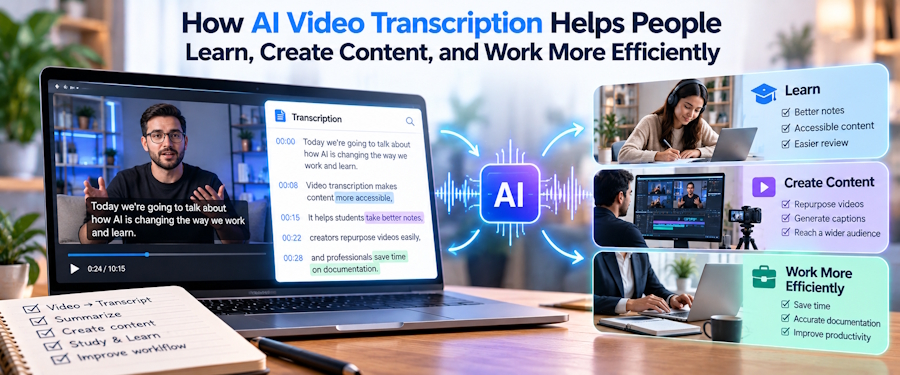
Video is a tool that's changed the way people learn, communicate and share information online. Students view educational videos, practitioners view recorded presentations, and creators upload videos to YouTube, Instagram, and TikTok. Video is a wonderful way to present information, but it's difficult to locate specific information in a video. Watching long video content repeatedly, making notes on it, and looking for certain words may be a significant time-waster.
Video transcription is a practical solution, as it is possible to transcribe the spoken content into text. A transcript facilitates the review of information, easier identification of its significant points, and helps organize information for future use. With the increasing amount and volume of digital content, transcription technology is now an important component in the daily information management process.
Knowing what AI transcription can do and how to make the most of it (including the power to transcribe complex audio and how to fix and improve the results), individuals and businesses will be better equipped to produce more accessible and accurate video content.
1. Why Video Transcription Is Becoming More Important
While video is a significant source of information, viewing and comprehending all videos may not be the most efficient way of learning. A business professional might want to listen to several meetings they have recorded, and a student may want to go back and listen to a lengthy lecture before a test on it. There must also be an efficient means for content creators to know which statements and themes they can use in their recordings and which are new ones.
The difficulties are overcome by transcription, i.e., the spoken language is converted to text and can then be searched for. Individuals do not need to listen to a whole audio recording to identify a single explanation, but can search for the sections of the transcript quicker. This can be particularly useful when you are being interviewed, tutoring, giving a presentation, a webinar, or a class lecture.
Written transcripts are also more flexible when using information. Highlighting, copying to documents, and grouping material around a project are features of the software that readers can use. Transcripts can be used to conduct a review of interviews by researchers and to analyze customer concerns that are often mentioned during interviews by marketing teams.
When a video library grows in size, there is the potential that up to that point, information in the library may have been difficult to manage but can be made easier with searchable text. Transcription isn't the same as the value of visual demonstrations or the way the speaker delivers the information; it's simply another way to get access to information that's recorded. Video and text can be used in combination to help in more organised learning, research, and communication.
2. How AI Transcription Makes Video Content Easier to Process
The classical transcription process is one in which one listens to an audio recording and types the words from the recording. This approach may be suitable for certain interviews or recordings that need careful human analysis but could be time-consuming for longer recordings. This can be accomplished with speech recognition technology (also referred to as automated transcription) that can convert audio to text and alleviate this workload.
A typical approach is for a user to upload media (in a supported format) or a link to an accessible video. This system interprets the sound, recognizes how the sound is spoken, and translates it into text. Other capabilities are speaker identification, timestamps, subtitle generation, language selection, and automated summaries, depending on the service.
For social media creators who frequently work with short videos, a free TikTok transcript generator can help convert spoken content into text for easier review. It can help to recognize important statements, take notes, or grasp the video structure without having to listen to the video over and over.
Automated transcription will also work for lengthy recordings such as lectures, interviews, and business presentations. But the results are subject to the clarity of the sound, background noise, pronunciation, as well as technical vocabulary. A system could have a name that is incorrectly recognized or a new word with a similar sound for an unknown word.
Therefore, AI transcription should be considered as a valuable initial step, not an accurate transcript. Even if the transcript will not be published or quoted, or if it is only for routine access, it is important that it be reviewed by human eyes when it will be published.
3. Using Transcription for Education, Research, and Content Creation
The big benefit of transcription is that it's helpful in varying activities. Students have the ability to go back to difficult explanations without having to go through a whole lecture. They can read the written content and make notes to revise it, and can develop a revision outline for studying. Transcripts also can benefit learners who require more time to comprehend verbal material.
The same method can be used to the advantage of researchers. Data obtained through interviews and recorded discussions tend to be very detailed, which can make it hard to remember the data that was observed. A transcript will be a written reference for researchers to read, compare, and arrange. Even though important quotations are not necessarily to be checked against the original recording, it is important to ensure that the wording does not affect the interpretation of a finding.
Transcription can be employed by content creators to detect the concepts for articles, newsletters, social media captions, and more. There could be multiple themes of interest in one interview and an educational video could serve as the basis for a written guide. Creative reuse can be done responsibly and be an efficient method of working, without having to start every project from scratch.
Transcribe Video AI is a free online transcription service that converts video and audio into text, making it a perfect solution for those seeking a simple and easy transcription process. Users can copy and paste links from YouTube, TikTok, or Instagram or upload media files themselves. In addition, the service provides an AI summariser to help identify key points and key takeaways. The tool does not require any account or payment.
These features can help you transition between viewing videos and reviewing, organizing, and understanding the information. The resulting text can then be modified for a specific task, while maintaining accuracy, permissions, and the original speaker's meaning.
4. Choosing the Right Transcription Tool and Workflow
There are more factors to consider when choosing a transcription tool than processing times. This choice will vary on the specific recording, how it will be used, and how accurate a transcript is needed. A journalist transcribing a published interview might need to transcribe a different type of interview than someone transcribing a public class or a short tutorial. A journalist may need to transcribe a different type of interview than a company transcribing a confidential conversation.
This plays an important role when it comes to platform compatibility. The user needs to check if a service has a direct video link, upload of audio, or common video formats. Having multiple language support may also be important if there are international speakers in the recordings or educational material in multiple languages.
Other tools can enhance the entire process. Speaker identification can be used to ensure that people in a conversation can be identified, and timestamps will assist to find a statement in the original recording. Video exports with subtitles and summary features can aid video editing and provide an overview of the content in longer texts.
As well, privacy, rather than being overlooked, should be taken into account. Users should review the service's data-handling policies prior to uploading a recording that includes personal information, business discussions, or confidential material. One should also think about if they are authorized to process the recording and how the transcript copy will be retained or distributed.
Lastly, test the workflow by trying out the task. Create a transcript, read through a few lines, and see if you can export or edit it in a desired format. An effective tool that seamlessly integrates into the workflow can save time – if it is suitable for the user's needs.
5. Improving Transcript Accuracy, Accessibility, and Responsible Use
Although the transcription is quite comprehensible, the AI-generated one might not be accurate. Speakers can talk over each other, speak in local accents, or use professional jargon, and other background noises can make accurate speech recognition more difficult. Number, name, or technical instructions errors can be very impactful.
By carefully reviewing, these risks can be minimized. Start to consider the parts of the recording that are immediately applicable to the work and match up any statements which you are not certain about with the original recording. Be sure to look for names, dates, numbers, exact phrases, or words that might alter the meaning of a sentence. With published texts, punctuation, paragraphing, and readability will be considered when proofreading.
An aid to accessibility – transcripts can provide an alternative to spoken content for audiences. They can assist those who are unable to hear in a specific environment, prefer to read the information, or wish to read at their own speed. The differences between transcripts and synchronized captions are, however, more apparent. While a transcript can be used to read and reference the content of a video, captions are meant to be read along with the video.
When transcripts are reused, too, it is crucial that they are used responsibly. A public video does not necessarily have to be free of copyright and/or privacy restrictions. Users should be sensitive to existing rights, refrain from quoting somebody's ideas or words out of context, and differentiate between their own interpretation and the words of others.
Automated summaries will need to be addressed. They can enhance lengthy recordings to be more accessible to navigate, but they might fail to include qualifications or exclude information that alters the focus of a conversation. It is important to review the source material whenever completeness and precision are important, even more so.
Conclusion
AI video transcription is an easy solution to enabling easier access, search, and re-use of spoken information. It can be used to enable education, research, business communication, and content creation by converting recordings into readable text. Students can arrange notes, professionals can go over notes of discussions, and creators can find helpful ideas without having to listen to the same information again and again.
The best results will be obtained when the review process is supplemented with automation. The right tool, important statements, privacy, and the retention of the original meaning all result in more reliable results. Timestamps, speaker identification, multilingual transcription, and summaries are just a few of the features that can even further enhance people's interactions with recorded materials.
Video is a key communication tool within the digital sphere and in the future will be an important part of spoken-to-written knowledge; transcription will be a useful tool. Smart people who take the time to adopt sound transcription practices will have access to more easily understood, manageable, and shareable data – with all the context and accuracy of information intact.

