

Why a Fair Comparison Needs Criteria
Portable power stations from different makers can look alike on a product page and behave very differently in use. Marketing numbers are not always measured the same way, so the best approach is to compare on criteria you can verify rather than on brand names.
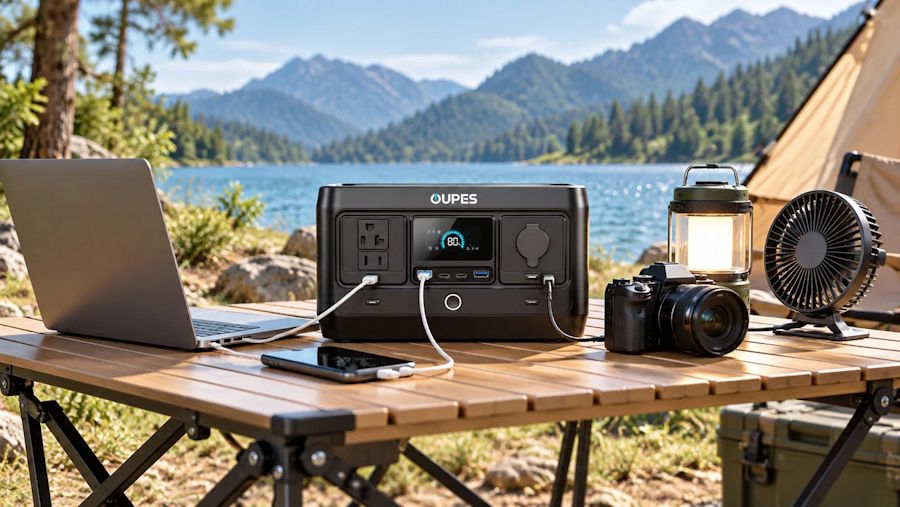
This guide explains the key criteria for comparing portable power stations across different brands, including battery chemistry, capacity, output, charging speed, portability, warranty, and price. It then applies these criteria to the OUPES Mega 1 Lite as a practical example. You can use the same method to evaluate competing models and choose the right power station for your needs, budget, and priorities.
Battery Chemistry and Lifespan
Two chemistries dominate the market. Lithium iron phosphate, written LiFePO4 or LFP, is commonly rated for several thousand charge cycles and is known for thermal stability. Nickel manganese cobalt (NMC) cells usually pack more energy into less weight but are commonly rated for fewer cycles. Neither is wrong. They suit different priorities.
When you compare cycle life, read the fine print. A rating of 3,500 cycles to 80 percent capacity is not the same promise as 3,500 cycles to 70 percent. Ask which end-of-life threshold the number uses, and at what discharge rate it was tested.
Capacity, Output and Surge
Three numbers describe what a unit can do:
- Capacity in watt-hours (Wh): how much energy is stored.
- Continuous output in watts (W): what it can run at once.
- Surge or boost output: short-term power for starting motors.
Brands name their surge modes differently, so check the duration as well as the number. Look also at pass-through behavior (can you charge and discharge at the same time), the switchover time if the unit works as a UPS, and the number and type of outlets. Pure sine wave output matters for sensitive electronics.
Recharge Speed
A large battery that takes all day to refill is less useful than it looks. Compare:
- AC input in watts, and whether a fast-charge mode exists.
- Maximum solar input, the voltage window and the connector type.
- Whether AC and solar can charge together.
- Car or alternator charging if you travel.
A unit with a higher charging rate can sometimes be a better backup than one with a larger battery, because it recovers between outages.
Portability
A useful figure is watt-hours per pound, which shows how much energy you carry for the weight. Also look at handles, wheels and dimensions. Some stations are packed for car trunks, others are designed to stay at home as backup. A unit you can’t comfortably lift gets used less.
Warranty and Support
Warranty terms vary a lot across the industry. Compare the standard length, whether it can be extended by registering, what it covers, how claims work and where repairs happen. Check the return window and who pays shipping. Independent reviews and owner communities help here, because they show how a company behaves after the sale.
Price and Value
Cost per watt-hour is the quick test, but it should not be the only one. Also consider:
- Cost per watt of output.
- What is in the box, such as cables or panels.
- Extra batteries or accessories you will need.
- Whether sale prices are standing prices or short promotions.
Prices change often, so compare at the same moment and in the same currency.
A Worked Example: The OUPES Mega 1 Lite
Here is the checklist applied to the OUPES Mega 1 Lite, using the figures on its product page.
| Criterion | Mega 1 Lite |
|---|---|
| Chemistry | LiFePO4 |
| Cycle life | 3,500+ cycles to 80% |
| Capacity | 1,024 Wh |
| Continuous output | 2,000 W pure sine wave |
| Surge | 4,500 W |
| UPS response | under 20 ms |
| Outputs | 9, including two 140 W USB-C ports and four AC outlets |
| AC recharge | up to 1,400 W, about 46 minutes to full |
| Solar input | up to 800 W, about 69 minutes to full |
| AC plus solar | up to 2,200 W |
| Weight | 26.8 lb (about 38 Wh per pound) |
| Warranty | 5 years, plus 1 more with registration |
| List price at writing | $599 (about $0.58 per Wh) |
What the numbers suggest: this is a compact 1 kWh unit with a high output relative to its capacity and fast recharging. It fits short outages, camping and work-site use, and can run most 120 V household devices.
What the numbers also show: 1,024 Wh will not run large appliances for long, the output is 120 V only, and there is no 240 V circuit. Anyone needing whole-home backup or multi-day capacity will want something larger, from any brand. If you may need more capacity later, check each model’s expansion options before buying.
How to Compare Any Two Models
Build a small scorecard.
- Write down your must-haves: devices, runtime and budget.
- Collect the same specs for each model from official pages.
- Calculate Wh per pound and cost per Wh.
- Note the warranty, return window and support options.
- Weight each criterion by how much it matters to you.
- Read independent reviews and owner feedback.
- Check certifications and safety listings for the market where you live.
The model that scores best for your situation is the right one, even if it is not the cheapest or the biggest.
FAQ
Is LiFePO4 always better than other battery types? Not always. It generally offers longer cycle life and good thermal stability, while other chemistries can be lighter. Choose based on how you will use the unit.
What is the most important spec to compare? It depends on your use. For backup, capacity and output matter most. For travel, weight and recharge speed matter more.
How should I read surge ratings? Surge is a short burst for starting motors, not a continuous rating. Check how long it can be held.
Do all brands test cycle life the same way? No. Ask for the end-of-life capacity threshold and test conditions.
How can I compare warranty value? Look at length, extension options, what is covered, how claims are handled and where repairs take place.

