

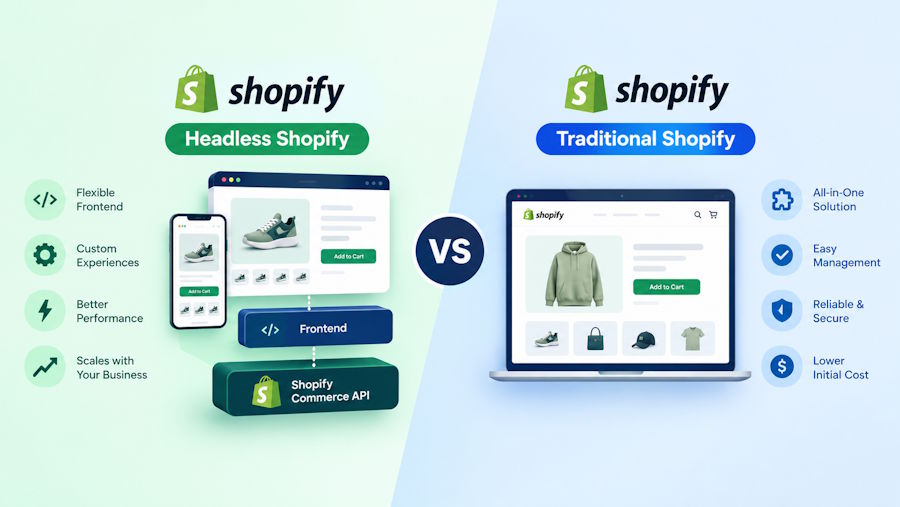
Deciding between Shopify and headless Shopify becomes more difficult when an e-commerce business moves beyond a normal storefront.
A simple store may need products, collections, payments, checkout, and a few apps. On the other hand, a complex e-commerce operation may need custom product experiences, advanced integrations, many content sources, special customer journeys, high-performance storefronts, or a frontend that acts more like a digital application, which requires help from a professional Shopify eCommerce development company.
That is where the architecture decision becomes important. The question is not whether headless Shopify is more flexible. The question is whether that flexibility solves a business problem that traditional Shopify cannot reasonably handle.
When launch speed matters
Traditional Shopify: Simpler and Faster Implementation
For businesses with tight development budgets and timelines or who wish to launch their online store quickly, traditional Shopify can help with reduced cost and development efforts required. With the help of its simpler architecture, businesses don’t have to build anything or manage a separate front-end. The store owners have to select a theme of their choice, customize if required using built-in tools, add applications required, add products, and manage configurations for payments within Shopify platform.
Headless Shopify: Additional Front-end Development
On the other hand, headless introduces another application layer and lets the back-end continue to manage the core eCommerce functionality. It often requires a front end developed with the help of other technologies. This indirectly takes more time and additional effort for development, testing, deployment, and later-stage maintenance of the online store.
For store owners who are not in need of such heavy frontend customization, headless Shopify may not bring enough value for their investment in Shopify store development services.
When the customer experience is highly customized
Traditional Shopify: Theme-based Customization
There is no denying that Shopify themes provide flexibility to customize the themes. Still, the storefront operates with the same theme architecture only. This greatly restricts store owners when they wish to customize the customer journeys. Store owners often feel restricted with:
- Interactive product configurators
- Highly customized product discovery
- Immersive product storytelling
- Bespoke purchasing flows
- Advanced merchandising experiences
- Custom design systems
A capable Shopify website development services team can push a traditional storefront considerably further, but there are practical limits to how far theme-based architecture can be extended.
Headless Shopify: Greater Front-end Flexibility
Headless separates the customer-facing experience from Shopify's commerce backend. The development team can therefore build the frontend around the exact experience the business wants rather than adapting the experience to the limitations of a theme. For complex ecommerce requirements, this is one of the clearest reasons to consider headless.
When performance is a business requirement
Traditional Shopify: Performance within the Shopify Architecture
A traditional Shopify store does not automatically mean a slow store. Theme selection, application usage, third-party scripts, image optimization, code quality, and implementation decisions all affect storefront performance. A well-optimized theme can provide strong performance without introducing the engineering complexity of a headless build. For many businesses, investing in Shopify store development services and performance optimization may therefore be sufficient.
Headless Shopify: Greater Control over Front-end Performance
Headless gives developers greater control over rendering, data fetching, JavaScript, caching, and frontend architecture. That can make it easier to optimize the storefront for demanding performance requirements. But headless itself does not guarantee a faster website. A poorly engineered headless storefront can still perform badly. So, the real advantage is control, not an automatic performance improvement.
When integrations become complex
Traditional Shopify: Support for Conventional Integrations
Shopify does support a wide range of integrations that can cater to almost every common requirement of a store owner. From marketing, subscriptions, and analytics to customer service, store owners can add everything without any customization or the help of a Shopify development company in India. For the eCommerce businesses with well-defined flows and customer journeys, this approach can greatly reduce development cost.
Headless Shopify: Flexibility for Specialized Integrations
Complex businesses may need Shopify to communicate with ERP, CRM, PIM, CMS, inventory, fulfillment, or other business systems in highly customized ways. A headless architecture gives the frontend greater freedom to consume and combine data from multiple systems. This can be of use for businesses when eCommerce is just a small part of their broader digital ecosystem. However, more integration flexibility requires more time and effort from the technical teams to manage the integrations.
When content and commerce need to work hand-in-hand
Traditional Shopify: Content within Storefront Architecture
Traditional Shopify can support content and marketing pages, but businesses with extensive editorial content may eventually want more control over how content and commerce interact. Consider a brand that combines:
- Editorial stories
- Buying guides
- Product education
- Interactive landing pages
- Campaign experiences
- Product recommendations
- Rich media
When these experiences become central to the buying journey, a conventional theme may require increasingly complex customization.
Headless Shopify: More Control on Content & Commerce
A headless frontend can bring commerce and content together while using Shopify for commerce operations and a separate CMS or content platform where appropriate. This gives teams greater control over how products, content, and customer experiences are presented. For content-heavy brands, that architectural flexibility can be more valuable than simply having a different storefront technology.
When maintenance and technical resources are limited
Traditional Shopify: Minimal Technical Overhead
This is the area where traditional Shopify brings operational benefit for the store owners. While Shopify manages most of the things behind the scenes on the platform, the business and its development team can easily focus on managing and keeping their storefront up and running without any hurdles. A Shopify ecommerce development company can also customize and maintain the store without the business having to own a separate frontend application architecture.
Headless Shopify: More Technical Responsibility
Headless means owning more technology. The business needs access to developers who can maintain the frontend, dependencies, APIs, deployment process, security, testing, and integrations. That ongoing responsibility should be considered before choosing headless. If the organization does not have reliable technical support, the additional flexibility can become an operational burden.
When the business is scaling
Traditional Shopify: Scaling with Operational Simplicity
Growth does not automatically mean a business needs headless. If a store's existing theme, apps, integrations, and customer journey continue to support its requirements, moving to headless purely because the business is growing may add unnecessary complexity. A well-planned traditional Shopify implementation can continue to serve many growing businesses.
Headless Shopify: Scaling via Architectural Flexibility
Headless becomes more relevant when growth introduces architectural requirements that the existing storefront struggles to accommodate. For example:
- Multiple digital experiences
- Highly customized customer journeys
- Complex product data
- Multiple content sources
- Advanced personalization
- Specialized integrations
- Strict frontend performance requirements
In these cases, the decision is less about revenue and more about the complexity of the ecommerce operation.
The Final Verdict
The choice between headless Shopify should begin with a clear understanding of the business needs and the desired customer experience. Look closely at what the business requires and how customers will interact with the store. Then check if Shopify’s standard setup - its themes, apps and customization options - can handle those needs.
If it falls short consider whether the extra flexibility offered by an approach is worth the extra work. Think about the development effort, maintenance and technical challenges that come with headless. Weigh the benefits, against the costs to decide what fits best. A capable Shopify development company in India should therefore evaluate the business requirements before recommending an architecture.

