

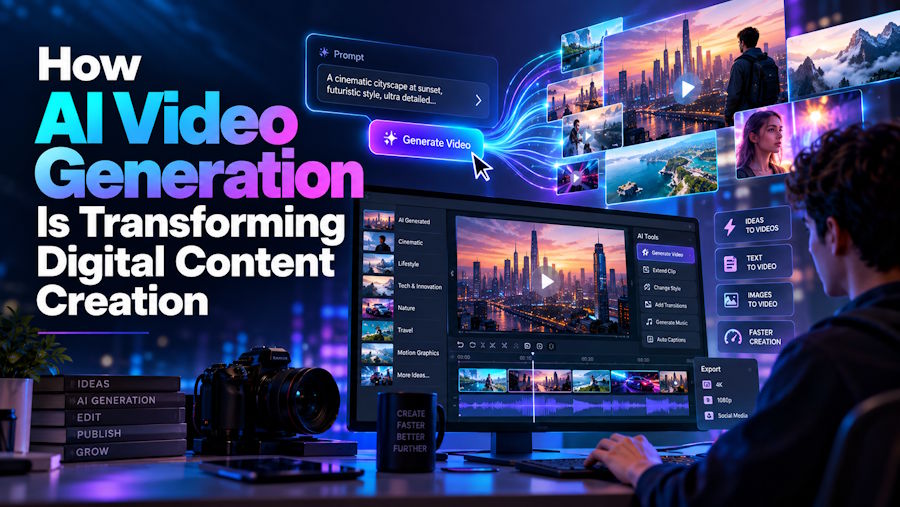
Video has become an essential part of digital communication, helping businesses explain products, share knowledge, and connect with audiences. Yet producing quality video content traditionally requires cameras, editing software, skilled professionals, and significant time. For small businesses and independent creators, these demands can make it difficult to publish fresh content consistently.
Artificial intelligence is changing how video production works. Modern tools can transform written prompts into moving scenes, animate existing photographs, and help creators modify footage through simple instructions. These capabilities make it easier to explore creative concepts before investing in a full production. However, good results still depend on clear direction, suitable tools, and careful review. Understanding the strengths and limitations of AI video generation allows creators to use the technology more effectively while preserving the storytelling, accuracy, and visual quality that professional audiences expect.
Understanding Text-to-Video and Image-to-Video Technology
AI video generation uses machine learning models to produce video sequences from written descriptions, images, or other reference materials. Two widely used approaches are text-to-video and image-to-video, each offering different creative possibilities.
Text-to-video allows creators to describe a scene using natural language. They can specify the subject, setting, lighting, camera movement, and atmosphere. The AI interprets these instructions to generate a sequence that reflects the intended concept. This approach is useful for developing original scenes, storyboards, and early campaign ideas.
Image-to-video starts with an existing photograph, illustration, or product image. The system introduces movement while using the supplied image to guide the visual direction. Creators can describe how a subject should move or how the camera should approach the scene.
Both approaches reduce the effort required to produce initial footage. Nevertheless, prompt clarity, reference quality, and model capabilities influence the final result, making experimentation an important part of the process.
Why Reference Control and Editing Matter
Generating a visually appealing clip is only one part of successful video production. Businesses and professional creators also need consistency between scenes, recognizable subjects, appropriate movement, and control over important visual details.
Reference-guided generation helps address these needs by allowing creators to provide images, videos, or other supporting material. These references can guide the appearance of a character, the composition of a scene, or the movement of a camera. Although exact consistency is not always guaranteed, clear instructions can help the model understand the intended outcome.
For creators exploring these capabilities, seedance 2.5 is an option within an AI video creation workflow that supports experimentation with generated scenes and reference-based direction.
Video editing tools offer another useful capability. Instead of rebuilding an entire clip, creators may use text instructions to change selected elements, adjust a scene, or extend existing footage. These functions can simplify revisions, although the results should always be checked for continuity and unwanted visual changes.
Practical Applications Across Different Industries
AI-generated video has applications in marketing, education, e-commerce, entertainment, and internal business communication. Its greatest value often comes from helping teams test ideas quickly rather than replacing every stage of conventional production.
Marketing professionals can develop alternative visual concepts for social media campaigns before deciding which direction deserves further investment. Online retailers can animate product photographs to create more engaging presentations. Educators can illustrate abstract concepts or demonstrate processes through short visual sequences.
Independent creators can also use text-to-video tools to experiment with storytelling, while image-to-video technology can bring illustrations and existing artwork to life. Businesses preparing presentations may use generated scenes to communicate a concept that would otherwise require a location shoot or custom animation.
The appropriate approach depends on the purpose of the content. Product demonstrations require visual accuracy, while creative storytelling may allow greater artistic freedom. Establishing the intended audience, message, and distribution platform before generation helps ensure that the final video serves a meaningful objective.
Creating a Reliable AI Video Production Workflow
A repeatable workflow helps creators achieve more predictable results and avoid unnecessary revisions. The process should begin with a clear creative brief describing the audience, purpose, visual style, and expected length of the video.
Next, creators should choose the appropriate generation method. Text-to-video is useful when developing a scene from scratch, while image-to-video works well when an existing visual needs movement. Reference-to-video and editing tools can provide additional control when a project depends on specific subjects, compositions, or footage.
Prompts should describe the main action clearly before adding secondary details. Instructions about lighting, framing, camera movement, and atmosphere can improve direction, but overly complicated prompts may make it harder to identify which changes actually improve the result.
Once a clip is generated, review the movement, subject consistency, transitions, and overall message. Additional editing may be necessary before publication. Teams should also check applicable copyright, privacy, licensing, and commercial-use terms before incorporating generated material into professional campaigns.
The Long-Term Role of AI in Video Creation
AI video generation is expanding the possibilities available to businesses and individual creators. By simplifying the process of turning concepts into moving visuals, these tools can reduce production barriers and make creative experimentation more accessible.
However, technology alone does not guarantee effective communication. A successful video still needs a clear purpose, an understandable message, and visuals that support the intended story. Generated footage may contain inconsistent details or unnatural movement, so human review remains an important part of professional production.
Organizations can benefit by treating AI as a creative assistant rather than a complete replacement for planning, editing, and editorial judgment. Selecting tools based on workflow requirements, output quality, and available controls can help teams make informed decisions.
As AI models continue to develop, the strongest results will come from combining faster production with thoughtful human direction. Creators who build reliable workflows today will be better prepared to adapt to changing audience expectations and emerging opportunities in digital video.

