

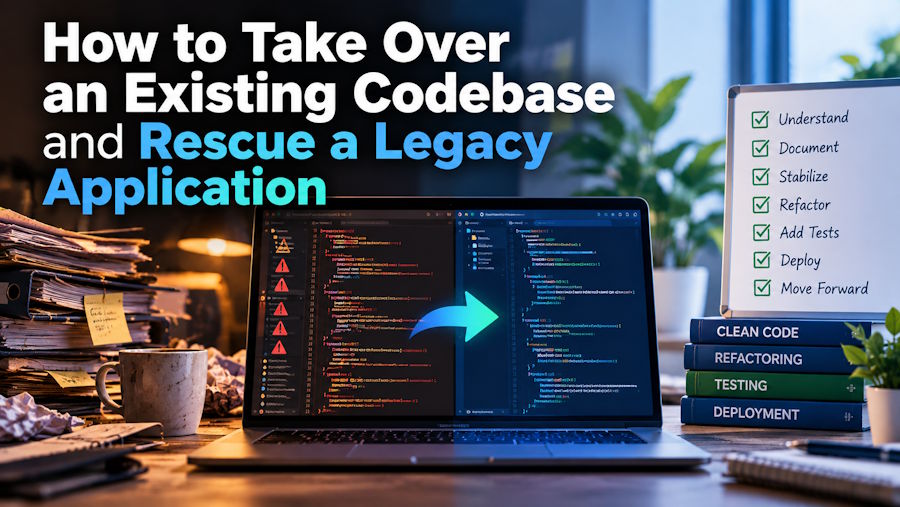
Inheriting someone else's code is one of most common, and most stressful, situations in software. The original agency missed one deadline too many, or the lead developer left and took the knowledge with them. Documentation is thin. Every release feels risky, yet the business still depends on the app daily.
There is good news, though. A struggling application can almost always be stabilized without throwing it away. This guide covers how to spot an app that needs rescuing and how to take over the codebase step by step. It also explains how to pick a rescue strategy, and which US companies are specializing in this work.
Signs Your Legacy Application Needs Rescuing
"Legacy" doesn't just mean old. An application needs rescuing when the team behind it can no longer change it with confidence. Or when keeping it alive costs more than it delivers.
Technical red flags
- Frameworks or language versions that no longer get security patches
- Little or no automated testing
- Fragile, manual deployments that depend on one person
- Outdated dependencies with known vulnerabilities
- Small changes that break unrelated parts of the system
Business red flags
- Simple features take weeks to ship
- Maintenance eats growing share of the budget
- Only one developer or vendor understands how the system works
- The current provider is unresponsive or withholding access
- Compliance requirements (SOC 2, HIPAA, PCI DSS) are hard to meet
Several of these may sound familiar. If so, it's time for a structured takeover for the application rather than more quick fixes.
Step-by-Step: How to Take Over an Existing Codebase
The guiding principle is simple: understand before you change. Resist the urge to refactor on the day one. Your first job is to gain control and visibility over the system without disrupting the users who rely on it.
Step 1: Secure access and ownership
Your organization, not a former developer or vendor, must control every critical asset. That starts with code repositories, cloud and hosting accounts, databases, domains and DNS, and it extends to CI/CD pipelines. API keys and third-party services count too. Once the transfer is done, rotate credentials and make sure that the IP ownership that you hold is confirmed in writing.
Step 2: Run a knowledge transfer
If the previous team is reachable, even for a few paid hours, have them walk through the architecture, deployment, known bugs and risky areas. Record the sessions. If they're gone, interview support staff and power users. They often know exactly where the problems are.
Step 3: Reproduce the build and deployment
Set up local and staging environments. Then ship a release yourself. Until your team can deploy the application independently, you don't control it truly. Along the way, document every missing variable and every manual step that the process depends on.
Step 4: Audit the codebase
Review the architecture, code quality and dependencies. Then look at security, performance and infrastructure. Static analysis and dependency scanners speed this up, but it takes an experienced engineer to turn the findings into priorities.
Step 5: Map business-critical flows
Identify the workflows the business can't live without, such as sign-up, checkout, billing and key integrations. Trace each one through code and the database. These get protected first.
Step 6: Add monitoring and backups before touching code
Set up error tracking, uptime monitoring and centralized logging, and configure alerts on top of all three. Then check the backups. Verify they exist and can be actually restored.
Step 7: Build a safety net of tests
Start with characterization tests. These capture what the system currently does around critical flows. They flag any change in behavior, and that warning is exactly what makes the later refactoring safe to attempt.
Step 8: Document as you go
Turn what you learn into architecture diagrams, a setup guide and a deployment runbook. Add a list of known issues. That way, you make sure that the next team that picks up this codebase never inherits the same mess.
Choosing a Rescue Strategy: Refactor, Re-architect or Rewrite
The right strategy depends on how healthy the code is and how much the business needs to change. Risk tolerance matters too.
- Stabilize and maintain. Fix critical bugs, patch security holes and upgrade the riskiest dependencies. Best for apps near end of life or that rarely change.
- Incremental refactoring. Improve the code in small, tested steps while still shipping features. Best when the architecture is sound but the code has decayed.
- Strangler fig pattern. Build new components alongside the old system and move functionality over piece by piece until the legacy parts can be retired. Best for moving a monolith to a modern stack without risky cutover.
- Full rewrite. The highest-risk option: rewrites run long and lose undocumented business rules. Justified only in case of truly obsolete tech, small apps or a major change in the business model.
Most successful rescues combine them. Stabilize first, refactor what changes often, and gradually replace whatever is holding the business back.
Top Software Development Companies Specialize in Taking Over Existing Codebase
Top-rated software development firms in the United States specializing in existing codebase takeovers, software project rescue, and legacy application maintenance include IT Craft, ISHIR, Brocoders, Razoyo, and H Product Studio. The following comparison highlights their key services and areas of expertise:
IT Craft
IT Craft has been building and maintaining software since 2001. It has completed more than 2,250 projects with an engineering team of 330+, about 80% of them senior or middle-level. Among software development companies that specialize in taking over an existing codebase, its strongest evidence is legacy modernization done without stopping the business.
For a large food manufacturer, its teams migrated a 30-year-old COBOL ERP to Angular, ASP.NET MVC and .NET. The old and new systems ran in parallel on a shared database, and features moved over in phases. The client reported IT costs down 50%, development productivity up 26% and system performance up 15%. For Amesto, IT Craft took over a product built on a legacy framework from a previous vendor and launched the updated system in under seven months.
That parallel-run approach suits companies that need to replace a vendor or an aging core system while operations keep running. One US client put it plainly on Clutch: "We couldn't have achieved as much as a company without IT Craft's contribution."
Best for: companies replacing an underperforming vendor or modernizing a business-critical legacy system, such as an ERP, without downtime.
ISHIR
ISHIR is based in Dallas–Fort Worth, Texas, with engineering teams in India and LATAM. It has more than 26 years of experience. Alongside a dedicated software project rescue service, the firm is handling legacy application modernization, ongoing maintenance and support, and technical due diligence.
AI-generated code gets attention too. Its "vibe coding cleanup" service targets code that isn't ready for production. ISHIR is a good fit for US companies that want a local point of contact backed by offshore capacity.
Best for: US companies that want a Texas-based partner to rescue a stalled project or clean up AI-generated code, then keep the application maintained with offshore support.
Brocoders
Brocoders was founded in 2014. It focuses on application modernization and project takeover, and every engagement starts from an audit. That fixed-price software audit takes 5 to 10 days and covers architecture, security, test coverage and deployment.
The audit ends with refactor-versus-rebuild recommendation, priced module by module. Before any rebuild work begins, Brocoders moves repositories and cloud accounts into the client's ownership. Its core stacks are JavaScript and TypeScript. Ruby on Rails, Python, PHP and .NET are covered too.
Best for: SaaS and midsize companies that inherited a JavaScript, Rails or PHP codebase from a departed team and want a fixed-price audit before committing to a rebuild.
Razoyo
Razoyo is a Dallas-area firm that has been shipping production software since 2011, and it has built and maintained more than 200 e-commerce stores. It also takes over constrained systems and AI-built prototypes. The sound parts stay. The rest gets hardened.
Engagements start with a fixed-price production spec. Clients own the code and infrastructure from first commit, and ongoing support starts at about $1,500 a month.
Best for: owner-run and e-commerce businesses that need a fragile AI-built prototype or an outgrown platform made production-ready, with full code ownership.
H Product Studio
H Product Studio is a senior-led, remote-first studio working across US time zones. Takeovers are its most common starting point. Before changing anything inside production, the studio verifies the repository, runtime, data and release path.
Then it ships a first safe release and continues with phased modernization and long-term maintenance on a monthly retainer. AI-built apps are part of the work too. It takes the apps made with tools like Cursor, Lovable or Bolt to production, and the code stays in the client's own repositories.
Best for: startups and product teams whose original developer or agency is leaving and who want one senior team to take over, stabilize and maintain the product long term.

