

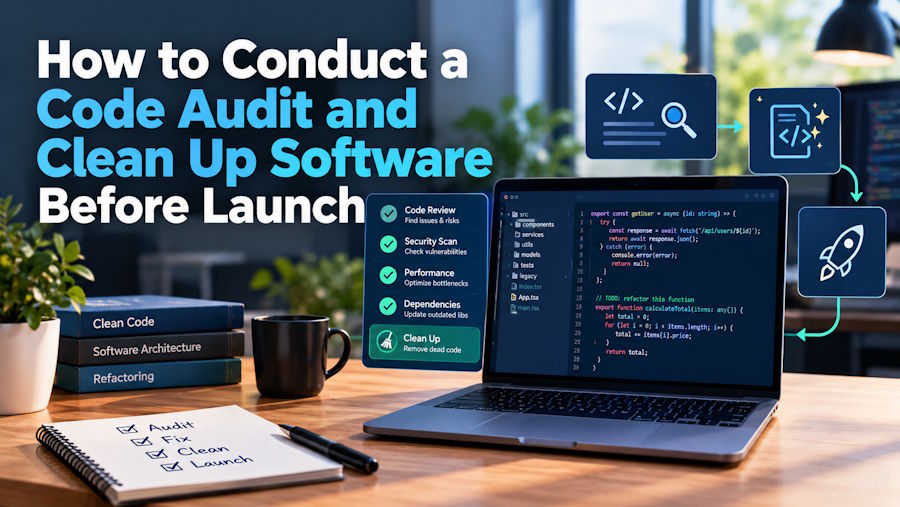
Speed gets an app to launch, but it rarely gets it there clean. Tight deadlines, shifting requirements and quick fixes leave behind duplicated logic, untested features, outdated dependencies and security gaps. None of it may be visible in a demo, yet all of it shows up after launch as crashes, slow pages, data leaks and features that take weeks instead of days to change.
A pre-launch code audit is a structured review of your codebase that finds these problems before real users do. Cleanup is the work that follows: fixing what matters most, removing what you don't need and leaving the code in a state your team can safely build on. This guide walks through how to do both, step by step.
How to Run a Pre-Launch Code Audit
1. Define the scope and goals
Start by deciding what the audit must answer. Is the priority security, performance, stability, or long-term maintainability? For most pre-launch audits, the answer is all four, ranked by risk. List the critical user flows, such as sign-up, login, payments and core features, so reviewers know where a defect would hurt most. Agree on a deadline and on what "launch-ready" means for your team.
2. Run automated scans first
Automated tools find a large share of issues quickly and cheaply, which frees reviewers to focus on judgment calls. Run three kinds of scans:
- Static code analysis (for example SonarQube, ESLint or Pylint) to flag bugs, code smells, complexity and duplication.
- Dependency scanning (for example Snyk, Dependabot or npm audit) to find outdated libraries and known vulnerabilities.
- Secret detection (for example Gitleaks or TruffleHog) to catch API keys, passwords and tokens committed to the repository.
Treat the results as a starting list, not a verdict. Automated tools produce false positives and miss problems that depend on business logic.
3. Review security manually
Security flaws are the most expensive to discover after launch. Reviewers should check how the app handles authentication and sessions, who can access which data, and whether every user input is validated. Look for common risks from the OWASP Top 10, such as injection, broken access control and insecure configuration. Confirm that sensitive data is encrypted in transit and at rest, and that error messages don't expose internal details.
4. Assess architecture and code quality
Rushed projects often grow without a clear structure. Reviewers should look at how modules depend on each other, whether business logic is mixed into UI code, and whether the same functionality is implemented in several places. Flag oversized files, deeply nested functions and dead code. The question to ask is simple: could a new developer understand and safely change this part of the system?
5. Check performance and scalability
Test the app under realistic load before users do it for you. Profile slow pages and API endpoints, look for inefficient database queries and missing indexes, and check how images, scripts and other assets are loaded. Load testing tools such as k6 or JMeter show where the system breaks as traffic grows.
6. Evaluate testing and deployment
Measure how much of the code is covered by automated tests, with special attention to the critical flows from step 1. Check whether a CI/CD pipeline runs tests on every change, whether environments are configured consistently, and whether there is logging, monitoring and a rollback plan. A launch without these is a launch where problems are found by users.
7. Prioritize the findings
An audit usually produces more issues than a team can fix before launch. Sort each finding by severity and effort:
- Critical: security holes, data loss risks, crashes in core flows. Fix before launch.
- High: serious performance issues, missing tests on critical paths. Fix before launch if possible.
- Medium and low: code style, minor duplication, non-critical refactoring. Schedule after launch.
Record the full list in your issue tracker so nothing is lost once launch pressure takes over.
How to Clean Up the Code
Fix critical issues first. Patch vulnerabilities, update risky dependencies, remove exposed secrets and rotate any keys that were leaked.
Refactor in small, tested steps. Write tests around a piece of code before changing it, then improve it gradually. Avoid large rewrites right before launch; they introduce new bugs faster than they remove old ones.
Remove what you don't use. Delete dead code, unused dependencies, old feature flags and commented-out blocks. Less code means fewer places for bugs to hide.
Standardize the codebase. Apply consistent formatting with tools such as Prettier or Black, and agree on naming and folder conventions so the code reads as one project.
Document the essentials. A short README, setup instructions and notes on key architectural decisions save hours for every developer who joins later.
Re-test and re-scan. Run the full test suite and the automated scans again to confirm that the fixes worked and nothing new broke.
In-House Team or External Auditors?
Your own developers know the code best, but they are also the people who wrote it under pressure, and they may not see its problems. An external team brings a fresh perspective, specialist security and performance skills, and the capacity to audit without slowing feature work. Many companies combine the two: an outside firm runs the audit and leads the critical fixes, while the in-house team handles the remaining cleanup.
Top Development Firms for Code Audits and Pre-Launch Cleanup
If you are looking for a team to review and clean up an app that was built in a hurry, several experienced development firms specialize in exactly this. Firms that audit and clean up quickly built, messy codebases before launch include Redwerk, IT Craft, SoftTeco, SCAND, and DevCom. Below is a comparison of what each offers, from audit and cleanup services to their main areas of expertise:
Redwerk
Redwerk has run independent software audits since 2005. Its auditors, working from offices in Kyiv and Tallinn, have uncovered more than 250 security vulnerabilities over the time. An audit can cover code quality, architecture, security and QA, plus infrastructure and performance. Each finding gets a high, medium or low rating, along with remediation recommendations and a follow-up plan.
The results are measurable. For Project Science, a US client, an audit and rework of the backend API raised by 80% its maintainability. The firm also offers cleanup for the apps built quickly with AI tools. A natural fit when speed is what created the mess.
Best for: startups and SaaS teams that want an independent, severity-ranked audit of fast-built app. Hands-on cleanup follows from the same team.
IT Craft
IT Craft dates back to 2001. Since then it has delivered over 2,250 projects. That experience counts most when code arrives half-finished, written in a rush or by a different team.
One case shows how the firm handles inherited code. Amesto brought in a product that a previous vendor had built on an outdated framework, and the reworked version went live within seven months.
For a team heading into launch with shaky code, this shows that fixes and new releases can move forward together. Code quality also comes up in client feedback. In a 2021 Clutch review, a senior product owner at UK telecom firm 4Com Technologies wrote: "The quality and speed of the delivered code was very impressive."
Best for: startups and product owners preparing to launch an app that was rushed or inherited from another vendor, who want its code reviewed and cleaned up first.
SoftTeco
SoftTeco was founded in 2008. Today it has around 500 employees and more than 650 projects completed. Its offices span Poland, Lithuania, Bulgaria and Georgia, as well as the UK, the US and the UAE. The company is ISO 27001 certified, so security is built into how its teams handles client code and data.
Its pre-launch value lies on testing and hardening, from QA and performance testing to cybersecurity, DevOps and maintenance. For cybersecurity firm E7 Cyber, its testers confirmed that the platform that they reviewed could handle both current and expected future load. For robotics company Formic, the team redesigned and optimized the backend. Uptime hit 99.8% across 5,000+ deployed robots.
Best for: companies that need to load-test, secure and stabilize an app before going live. Support continues also after launch.
SCAND
SCAND has been building software since 2000. It lists 250+ full-time engineers, 400+ customers and 900+ projects, with offices in New York and Warsaw. ISO 9001 certified, too. Its client list include NASA, IBM and Cisco.
For cleanup work, SCAND brings legacy modernization, QA and automated testing, and DevOps. With client approval, its testers use AI tools alongside Playwright and Selenium for generating and running tests faster. Tight deadline, more engineers. The firm can add people to project to speed up delivery.
Best for: teams whose cleanup involves outdated code, missing tests or a weak delivery pipeline. Extra hands help them to hit a fixed launch date.
DevCom
DevCom was founded in 2000 and is headquartered in Florida, with 280+ experts and more than 1,000 delivered projects. It names pre-release checks as one of main reasons clients order a code audit. Pricing is public. Automated audits cost $1,000 to $5,000, static audits $5,000 to $8,000 and dynamic audits $8,000 to $13,000.
The deliverables are practical. Clients get vulnerabilities ranked by severity, a red–amber–green rating, and architecture and dependency diagrams. A test coverage report and a prioritized roadmap rounds out the package, while an optional implementation stage covers the refactoring itself.
DevCom audits also code written with AI tools such as Claude Code, GitHub Copilot, Cursor and Lovable. Typical timeline: from few days to two weeks.
Best for: founders that want a fixed-scope, transparently priced audit that is done before launch. Especially apps built largely with AI coding tools.

