


It's 6:40 on a Saturday morning, and you're halfway through an easy run with music playing in your ears. A cyclist passes a foot from your shoulder, and only then do you realize the bell they rang twice didn't get through your sealed earbuds. Moments like that are why a lot of runners and riders start looking at open ear headphones for running and cycling.
Open-ear designs leave the ear canal uncovered, so car tires, voices and bike bells can still reach you while music plays. That gives you a better chance of hearing what's around you, though the design can't carry the job by itself. Volume, wind, fit and your own habits decide how much actually gets through, and the open shape costs you some bass along the way. The sections below walk through a pre-run checklist, what you can and can't hear, where sound quality drops off, which fit style stays in place, and the listening habits that count most on shared roads.
What Should You Check Before You Head Out?
Run through these six checks before a road or greenway session.
| Check | What to Look For | Why It Matters Outside |
|---|---|---|
| Volume | You can still hear your own footsteps or tires on the pavement over the music | Loud music can cover a car or a bell even when your ears are uncovered |
| Wind | Test at your usual riding pace, not standing in the driveway | Wind across the earbuds often pushes riders to turn the volume up |
| Fit | Shake your head hard, then add your helmet and sunglasses | A bud that slips gets fixed one-handed while you're moving |
| Battery | Playtime per charge compared with your longest weekly session | The case total doesn't help in the middle of a ride |
| Sweat and rain | An IP rating (a dust and water resistance code) of IPX5 or higher | IPX5 handles sweat and water jets |
| Local rules | Your state and city rules on headphones while cycling | The rules differ from one place to the next |
Volume sits at the top of that table for a reason, since it decides how much an open design can do for you on the road.
How Much Can You Hear With Open Ear Headphones for Running?
At a moderate volume, you can hear a good share of what happens around you. The limit is how loud the music is and how quiet the hazard is. Because nothing plugs the ear canal, a car approaching from behind, a runner calling out "on your left" or a dog's tags jingling on a leash can still reach your ears, though whether you actually catch them depends on your music volume, wind noise and how loud the sound is to begin with.
This is due to the auditory masking effect. Turn the track up and it starts covering quieter sounds first, which is a problem when electric cars and e-bikes on smooth pavement make very little noise to begin with. Hearing health points the same way. The National Institute on Deafness and Other Communication Disorders says sounds at or below 70 dBA (A-weighted decibels, a scale matched to human hearing) are unlikely to cause hearing loss even after long exposure, while long or repeated exposure at 85 dBA or more can. A simple field test is whether you could answer a running partner without pausing the track.
What Do You Give Up in Sound Quality?
Mostly bass, plus some clarity once wind picks up and a little privacy on quiet stretches. Low notes need a closed space to sound full, and an open design lets part of that energy escape before it reaches your eardrum. Bass lines and kick drums come across lighter than they do through sealed earbuds, while vocals and podcasts hold up better.
Cycling adds wind. Once you're moving faster than a jog, air rushing past the earbuds can become the loudest thing you hear, and the natural reaction is to raise the volume, which undoes the reason you went open-ear. If you're comparing the best open earbuds for outdoor training, check how they handle wind noise at cycling speed before you worry about bass.
Sound leakage uses the same open-ear design that keeps you aware of traffic. It is less noticeable beside a busy road, where outside noise covers much of it. In quieter places, someone nearby may hear your music if the volume is too high. Keeping the volume at a moderate level helps limit both leakage and outside noise.
Which Style Stays Put, Ear Hook or Clip-On?
For hard running, ear hooks usually hold better, and for riders who wear a helmet and glasses, clip-on designs are often easier to wear. Hooks wrap over the top of the ear and spread the weight of each bud along it, which helps when each foot strike jolts your head. The catch shows up with gear, since the hook sits in the same narrow space as sunglass arms and some helmet straps.
Clip-on designs grip the outer ear like a cuff and leave the area behind it clear. Riders with tight helmet straps often find clip on headphones easier to live with, because nothing sits behind the ear where the strap rests. How firmly a clip holds depends a lot on ear shape, so try a few hard strides or a sprint out of the saddle before trusting a pair on a long route.
Which Design Works on the Road and Indoors?
A dual-form design suits people whose day mixes an outdoor run with a loud gym or a train ride home. Open-ear listening makes sense on the road, but on a subway platform the same openness lets the noise in, and you end up raising the volume again.
The soundcore AeroFit 2 Pro takes a hybrid route. You adjust the ear hooks to switch between an Open-Ear form for the road and a semi-in-ear ANC form (active noise cancellation, which uses microphones to reduce steady background noise) for the gym or the commute. The Open-Ear form fits a wide range of ears, but people with smaller ear canals may not be able to switch into the ANC form. If your ear canal measures 16 mm or less with the measuring guide on the product page, plan on using the Open-Ear form.
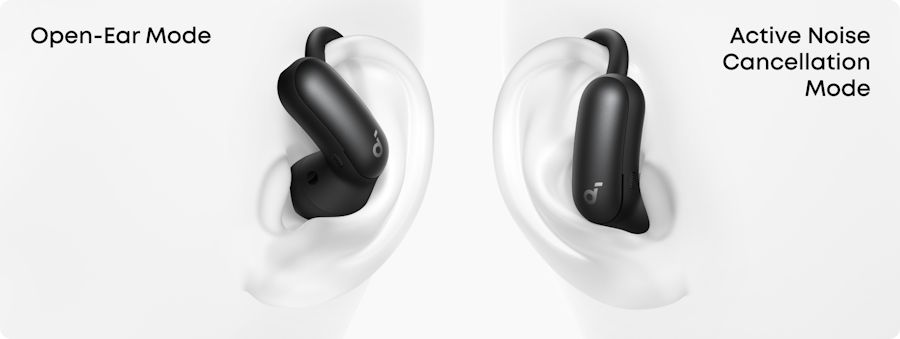
In the Open-Ear form, the ear canal stays uncovered and the 11.8 mm composite material drivers play from just outside it, so passing traffic still reaches you on a run. Adaptive ANC 3.0 works only in the ANC form. After you move the hooks into that position, the adaptive noise cancellation takes about 2 to 5 seconds to settle to your fit. Keep that form for indoor spaces and transit, then switch back before you step onto a road or bike path. The IP55 rating covers dust plus low-pressure water jets, which fits sweat and light rain, and the earbuds aren't built for swimming.
Battery life changes with the form you're wearing.
| Form | Where It Fits | Playtime per Charge | Playtime with Case |
|---|---|---|---|
| Open-Ear | Runs, rides and walks near traffic | 7 hours | 34 hours |
| ANC | Gym floor, train and office | 5 hours | 24 hours |
Hardware only covers part of the picture, and the habits below matter just as much on a shared road.
How Can You Listen More Safely Outdoors?
Start with volume, then add a few habits that keep your eyes and ears working together. The five below apply to road runners and commuting cyclists alike.
- Set the volume before you leave. Pick a level where your footsteps or tires stay audible over the music, so you aren't adjusting it in traffic.
- Wear one earbud on busy roads. Keep the bud on the side away from passing cars and leave the traffic-side ear free.
- Pause at complex intersections. Multi-lane crossings and roundabouts bring cars from more than one direction at once, and a few quiet seconds there cost you very little.
- Check local rules before your first ride. Some states and cities restrict headphones while cycling and the details vary, so look up the current rules where you ride.
- Shoulder-check before you turn or pass. Hearing a car tells you something is coming, while a quick look tells you where it is.
None of these needs new gear, so they work with whatever pair you already own.
Conclusion
Open-ear headphones let more of the road reach you than sealed earbuds do, and for runners and riders on shared paths that is the main reason to pick them. You give up some bass and accept wind noise on the bike, and the awareness you gain still depends on keeping the volume moderate. Choose the style by your main activity: ear hooks for hard running, a clip-on design for helmet-heavy riding, or a dual-form pair if your day moves between the road and the train. Then take your next route at a volume where you can hear your own footsteps, and adjust from there.
Frequently Asked Questions
Is It Legal to Wear Open-Ear Headphones While Cycling?
It depends on where you ride. Some states and cities restrict headphone use on a bike, and some of those rules don't separate open-ear from in-ear designs. Check your state vehicle code and local ordinances before you ride with any headphones.
Do Open-Ear Headphones Work for Treadmill Running?
They work, though a loud gym can make them harder to hear. Machines, fans and the gym's own speakers compete with music that isn't sealed in, so many people end up turning the volume higher indoors than they would outside. A sealed fit or noise cancellation tends to suit a crowded gym floor better, while open-ear listening is fine in a quiet home gym.
Are Open-Ear Headphones the Same as Bone Conduction Headphones?
No. Open-ear headphones send sound through the air from a small speaker resting near the ear canal, while bone conduction headphones pass vibrations through the cheekbones. Both leave the ear canal open, and they sound different, especially in the low end.
Should You Use Noise Cancellation on an Outdoor Run?
Not near traffic. Noise cancellation lowers outside sound, which is the opposite of what you want on a road or bike path. Save it for the gym or a flight, and switch back to open-ear listening before you head outside.
How Can You Keep Wind Noise From Making You Turn Up the Volume?
Set the volume before you ride and leave it there, even when wind starts covering the music on faster stretches. Wind gets louder as your speed rises, so a level that sounds fine on a climb can fade out on a descent. Turning the music up to beat the wind also covers the traffic sounds you chose open-ear headphones to hear, so it makes more sense to accept missing part of a song until you slow down.

