

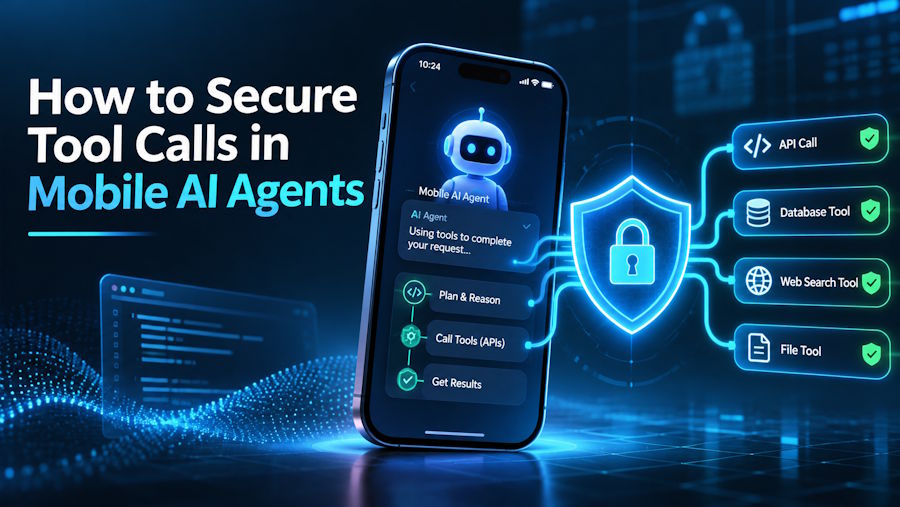
A mobile AI assistant can produce a convincing summary while making an unsafe tool request. Consider an app that reads a support email and drafts a reply. If the email contains instructions to upload customer records elsewhere, the model may interpret that content as a task. The critical question is whether application code permits the transfer.
Developers should design the execution path so that a model proposes actions and trusted code decides which actions may run. This separation remains necessary whether inference happens on the phone or through a remote API. Keeping processing local changes data exposure, but it does not establish authorization for the model's requests.
Separate model output from application authority
Define narrow tools around actual product functions. A tool that retrieves one authorized support ticket is easier to constrain than a generic database query interface. Likewise, expose a draft operation separately from a send operation. The assistant should receive only the capabilities needed for the current task, with read access as the starting point. Keep credentials outside the model context, and map tool names to an explicit registry so that generated text cannot select arbitrary internal functions.
Treat generated arguments as untrusted input. Validate them against a schema, then apply business rules independently. A valid customer identifier still requires an ownership check. A correctly formatted destination address still requires permission to receive the requested data. Schema validation improves predictability; authorization determines whether the operation is allowed. For downloaded resources, constrain outbound destinations and handle redirects under the same rules to prevent an apparently approved request from reaching an unauthorized endpoint.
Enforce permissions before executing tools
Place an enforcement layer immediately before each tool invocation. It should verify the authenticated user, requested operation, resource scope, and relevant policy. Services behind the app must enforce their own permissions as well. Never let a model supply the identity or privilege level that the application uses to authorize its request.
Runtime protection needs an integration review against the application architecture. Book a demo with Agent Zero Security to examine which mobile data transfers and agent actions its protection can inspect. Include local inference and remote services in that discussion, and ask to see policy enforcement demonstrated within a workflow that resembles your application's intended use.
For sensitive operations, show users the concrete action awaiting approval. A confirmation should identify the recipient, attachment, or record affected. Bind approval to those exact arguments, and require fresh approval if they change. A general permission granted earlier in a conversation provides little assurance about a later request to disclose information.
Test the action and its failure paths
Build adversarial tests around realistic inputs. Place conflicting instructions in an email body, a retrieved document, or a tool response. Verify that the application prevents unauthorized effects even when the model generates an unsafe call. Tests should examine observable outcomes, such as whether a message was sent, rather than the assistant's explanation. Use harmless fixtures and instrumented tools during testing. Include cases without attack keywords, since a filter that catches one phrasing may miss an instruction that seeks the same result through different language.
Exercise operational failures too. Disconnect the network during a pending approval, expire a session, and revoke access before a delayed action executes. Recheck authorization at execution time. Use idempotency controls where retries could duplicate a consequential operation, and stop repeated tool calls from consuming unlimited requests or device resources.
Keep diagnostic records selective. Log the tool name, policy decision, and correlation identifier when appropriate, while excluding credentials and unnecessary sensitive content. Make failures understandable to the user so that a blocked operation does not encourage repeated attempts through less controlled workflows. Revisit these tests whenever tools, permissions, models, or orchestration logic change.

