

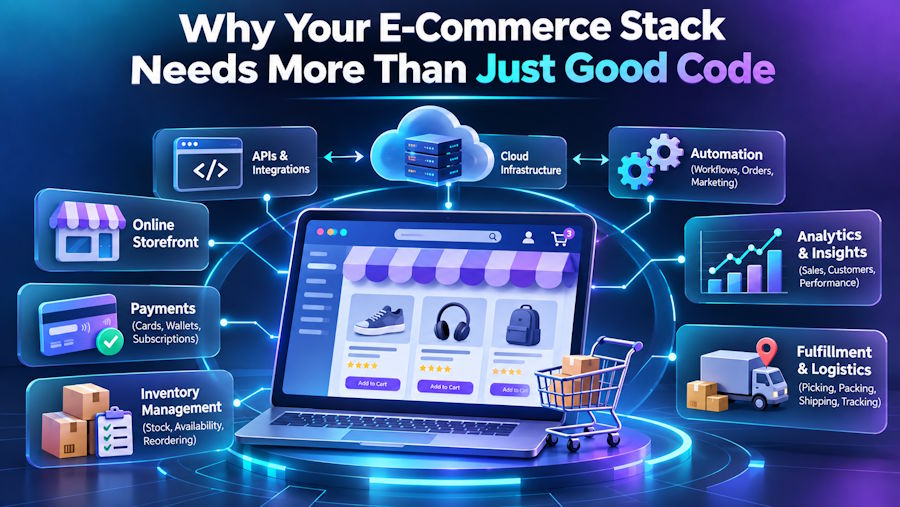
Writing clean, efficient code is only half the battle when building a high-traffic online shop. The infrastructure underneath your application determines whether that elegant codebase actually performs under real-world conditions. Too many developers spend weeks refining queries and optimising templates, only to deploy onto hosting environments that quietly undo their hard work.
This is especially true for platforms like Magento 2, Shopware, and WooCommerce, where the interplay between application logic and server-level caching can make or break page load times. Understanding what happens beneath the application layer is no longer optional for developers working in e-commerce. It is a core skill.
Magento in particular has a reputation for being resource-hungry, but much of that reputation comes from poorly configured environments rather than the platform itself. Developers who pair their code with scalable Magento hosting that includes built-in Varnish, Redis, and Elasticsearch tend to see dramatically different results. The gap between a sluggish storefront and a fast one often sits in the hosting layer, not the theme files.
Caching Layers That Actually Matter
Full Page Cache, or FPC, is the single most impactful performance lever for any Magento store. When configured correctly with Varnish as a reverse proxy, it serves cached HTML directly to visitors without ever touching PHP. That means your application code only runs when it absolutely has to.
Redis handles session storage and backend cache with in-memory speed, keeping database queries to a minimum during repeat visits. Combining Redis with Varnish creates a two-tier caching architecture that offloads the vast majority of requests from your application server. For developers, knowing how to configure and invalidate these caches properly is as important as writing the code they protect.
Elasticsearch (or its successor OpenSearch) powers catalogue search and layered navigation without hammering MySQL. On stores with thousands of SKUs, switching from the default MySQL search to Elasticsearch can cut search response times from several seconds to milliseconds. These are not exotic tools anymore; they are table stakes for any serious e-commerce deployment in 2026.
When Traffic Spikes Expose Weak Infrastructure
Black Friday, flash sales, viral social media posts. These moments expose every bottleneck in your stack simultaneously. A store that loads in 1.2 seconds under normal traffic can collapse entirely when concurrent sessions jump tenfold.
Autoscaling solves part of this problem by dynamically adding compute resources during demand peaks. But autoscaling only works well when the hosting environment is purpose-built for the platform running on it. Generic cloud instances require manual tuning of PHP workers, memory limits, and NGINX configurations that platform-specific providers handle out of the box.
Hypernode.nl, for instance, offers autoscaling specifically tuned for Magento and Shopware workloads, adjusting resources without requiring developers to reconfigure anything mid-spike. That kind of infrastructure awareness means your application behaves predictably even when traffic does not. For agencies managing multiple client stores, this predictability during peak events is worth more than any amount of last-minute code optimisation.
Security as a Development Concern, Not an Afterthought
E-commerce stores handle payment data, personal addresses, and login credentials. A single vulnerability can trigger GDPR obligations, brand damage, and real financial loss. Developers often focus on application-level security like input validation and CSRF tokens, but server-level protections matter just as much.
A Web Application Firewall filters malicious requests before they ever reach your PHP process. Automatic security patching at the operating system level closes vulnerabilities that no amount of careful coding can address. Daily snapshots provide rollback options when deployments go wrong, which every developer knows happens more often than anyone likes to admit.
Managed hosting environments that handle these concerns give developers space to focus on what they do best: building features and improving user experience. When your infrastructure partner manages firewall rules, SSL certificates, and OS updates, your sprint backlog stops filling up with server maintenance tickets. That division of labour is particularly valuable for smaller development teams working across multiple e-commerce projects.
Choosing Infrastructure That Matches Your Platform
Not every hosting provider understands the specific demands of platforms like Magento 2 or Shopware 6. These applications require particular PHP versions, specific extensions, and finely tuned web server configurations. Deploying them on a generic LAMP stack is technically possible but practically inefficient.
Scalable Magento hosting means more than just adding RAM. It means an environment where Composer deployments, cron job management, and cache warming are first-class concerns. Developers working with platforms like these benefit from providers whose support teams speak the same technical language and understand platform-specific debugging.
The flexibility to upgrade or downgrade on short notice, without annual lock-in contracts, also matters in a market where client needs shift rapidly. A 30-day contract cycle lets agencies right-size hosting for each project phase, from development and staging through to high-traffic production. Picking infrastructure that fits your platform is not a purchasing decision. It is an architectural one.

