

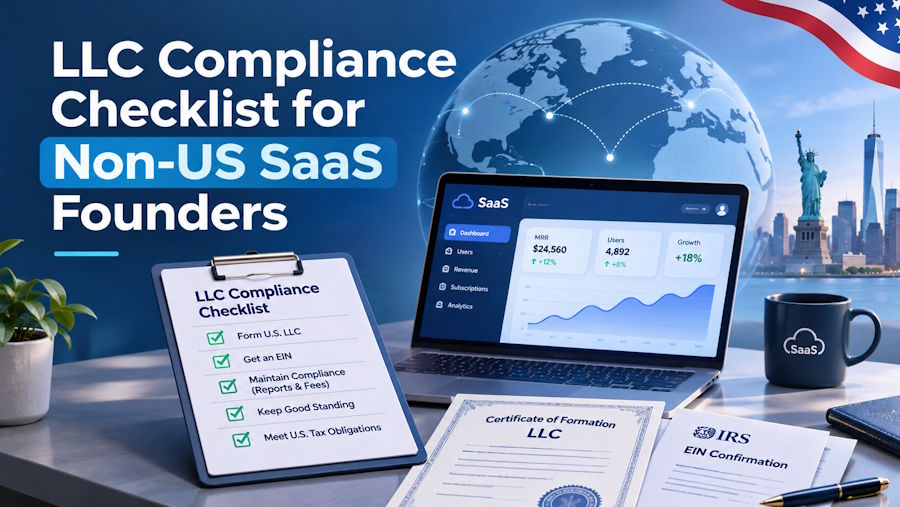
A founder outside the US who runs a single-member US LLC needs a registered agent, an EIN, and a US bank account, and must file annually with the state and the IRS. The IRS filing is required even if the LLC earned no income, and failure to file results in a $25,000 penalty. US beneficial ownership (BOI) reporting no longer applies to LLCs formed in the US.
This LLC compliance checklist is for indie founders living outside the US who sell web applications through a US company (LLC). Most of the requirements on this checklist take one to two hours to complete each year. The exception is the IRS information return, where small founders get hurt because many assume that no revenue means no filing.
Each requirement is described in the order it is met. Answers are provided for changes in the requirements due to the state in which the LLC is formed or due to changes in ownership (single-member vs. multi-member LLC).
What Belongs on an LLC Compliance Checklist for a Non-US Founder?
Requirements arise from two levels. The state in which an LLC is formed controls requirements for the registered agent and annual reporting. The IRS controls the requirements for the EIN and the IRS information return. The requirement to collect sales tax in other states is determined by the customer base.
| Item | Level | Timing |
|---|---|---|
| Registered agent | State of formation | Continuous |
| Annual report or franchise tax | State of formation | Varies by state |
| EIN | Federal (IRS) | Once, after formation |
| Form 5472 + pro forma 1120 | Federal (IRS) | April 15, or October 15 with Form 7004 (calendar-year filers) |
| Sales tax registration | Other states | When you pass a state's nexus threshold |
| Bookkeeping | Your own records | Monthly |
Your home country may also tax the LLC's profit. A US entity does not change that, so check local rules separately.
Do You Need to Collect US Sales Tax on SaaS Subscriptions?
It depends on the state. Since South Dakota v. Wayfair (2018), states have been able to require out-of-state sellers to collect sales tax once they reach an economic nexus threshold. An example is requiring sellers with more than $100,000 in annual sales in that state to collect sales tax. Other states have higher figures or include the number of transactions in their threshold.
Taxability also varies from state to state. For example, Washington and Texas tax some SaaS, but other states do not.
The process is fairly simple. You need to track your sales by state in your Stripe reporting tool, and then register to collect sales tax in that state. Once you are registered, you must file sales tax returns and pay sales tax to the state. A payment processor's tax tool can automate sales tax collection for you, but you still have to register to collect sales tax and file sales tax returns. A few large B2B contracts can push you over a sales tax threshold in a particular state.
How Should You Handle Banking and Bookkeeping?
You need to open an LLC bank account and run Stripe payouts and other payments for your business (hosting, contractors, etc.) through this account. If you pay personal expenses from the account, you commingle funds, which compromises the LLC's limited liability protection.
You need to keep a running ledger and document all owner contributions and loans to the business (including distributions and the date and amount in U.S. dollars) and maintain these records for at least 7 years. You need the owner transfer records for Form 5472. Rebuilding one year of owner transfer records from your LLC bank statements is time-consuming and increases the risk of errors. Be sure to keep your invoices for your software, computer services, and contractor services as well.
Practical LLC Compliance Checklist
- Make sure your registered agent is active.
- Apply for an Employer Identification Number (EIN) from the IRS and keep the confirmation letter (CP 575).
- Open an LLC bank account.
- Log contributions, loans, and distributions monthly.
- Calendar your state deadline (June 1 in Delaware, anniversary month in Wyoming).
- File Form 5472 (or file Form 7004 to request an extension to file Form 5472) along with your pro forma 1120 by April 15.
- Be sure to go through your sales by state for each quarter.
- It is imperative that you maintain accurate records of your LLC operating agreement and ownership.
Common Mistakes
- Skipping Form 5472 because the LLC reported zero revenue. Although your LLC may have reported zero dollars in revenue, this is not a reason to skip filing Form 5472. The penalty for failing to file is $25,000 per Form 5472.
- Not recording owner transfers. It is also a mistake not to enter transfers of ownership. Misstatements or omissions make a filing incomplete.
- Letting the registered agent lapse. Allowing your registered agent status to lapse puts you at risk of not receiving important notices.
- Filing or paying unnecessarily. Filing a BOI report (required only for corporations) or, for US-based LLCs, paying to file an annual report.
- Mismatched SS-4 details. Mismatching your SS-4 with your formation documents delays your EIN.
Conclusion
Put three important dates on your calendar. The first is the annual date set by your state, the second is a March ledger review, and the last is April 15 for filing Form 5472. Founders who file these three things avoid the most expensive mistakes.
FAQs
Will a foreign-owned LLC be subject to US income tax?
It depends on how the LLC is taxed and whether it has US trade or business income. Foreign owners of disregarded LLCs may not be subject to US income tax and may still be required to file Form 5472.
Can I e-file Form 5472 for my LLC?
Not for foreign-owned disregarded entities. The IRS instructions may vary, but for now, assume that the disregarded entity should file Form 5472 with Form 1120 by fax or mail.
Does an LLC need an ITIN to get an EIN?
Not directly. An LLC may need an ITIN for US filing requirements. Check with the IRS.
Does an LLC need a US address?
Not for formation. For some business purposes, an LLC may need a US address.
What if I missed Form 5472 in earlier years?
You could be subject to a $25,000 penalty for each year Form 5472 was not filed. Some taxpayers request penalty relief, so talk to a tax professional about delinquent filings.

