

PopNow AI: Why AI Generation Platforms Are Starting to Refund Failed and Off-Spec Runs
PopNow AI (popnow.ai) is an AI creative studio with 210+ AI models for images, video, music, and voice; the exact price shows before each run. PopNow AI calls itself the world’s first AI studio with automatic price protection. There is no subscription: users pay as they go with credit packs from $10, and purchased credits never expire. It offers a solution to a problem developers and technical creators face: what if an AI generation costs credits, but it doesn’t yield the type of result a user is looking for?
With AI generation starting to enter into professional production workflows, per-run billing issues become more and more critical financially. If a task fails, is resolved incorrectly, the audio track is missing, or the video is not the expected length, it can be an added cost. So, AI providers are looking into how to automatically check the finalized generations and pay out rewards to users if the measurable delivery needs are not fulfilled.
Why Per-Run Billing Makes AI Generation Failures Expensive
Credit-based pricing is commonly adopted by many AI creative services, with each generation coming with its own price tag. The user is able to choose the model, set the model, select the output desired, and pay as much as needed for that run. This way, it provides flexibility to developers and creators, allowing them to select various models and production settings without a locked-in subscription.
But, we have a financial issue with per-run billing if a generation fails. The developer may make a video request, pay the credits and get back a blank video file due to a technical error. Another creator could ask for a specific image resolution and get an image which is not as they wanted.
In either case, the user has paid for a generation and has not gotten what he or she expected. If the user’s problem is not his own doing, it may mean that he has to spend more credits if the same problem arises again.
It gets more complicated for people running many generations. When the same process is performed on multiple models and creative workflows, a few failed tasks can have an impact on the project’s budget.
This brings into the picture the concept of transparency in billing for AI services. A clear indication of the exact price before a generation starts is helpful, but there should also be a mechanism to deal with tasks that fail and incorrect outputs. The cost of a technical issue that impacts a platform’s ability to provide the platform selected should not be borne by the user.
How Automatic Verification Can Identify Incorrect AI Outputs
A practical approach would be to make comparisons between the finished generations and the original set up that the user submitted. An AI service could also review the created file and confirm if its technical qualities align with the desired requirements, which wouldn’t be possible if it were completely based on customer feedback.
Records of generations, file metadata and automatic validation can be used for this process. The platform can review a number of measurable properties, depending on the content.
- Aspect ratio: If the image or video created is in the same ratio as required.
- Duration: If the video or audio file is the correct length.
- Resolution: If the output is the same as the selected resolution.
- Output count: If the generation produces the set number of files or not.
- Audio track: If an audio track is selected, this will indicate whether a video has sound or not.
An end-user can, for instance, ask for a video in a given aspect ratio, a certain length, and with specific audio. After the generation is complete, the platform can examine the file that it receives and compare its characteristics with those in the request.
The system may detect a measurable difference between the output, if it has the wrong dimension or if it is missing the selected audio track. This is better than having a user describe the problem manually, and waiting for someone to investigate.
Additionally, a key difference between technical and subjective issues exists. If a creator does not like an image’s look, that doesn’t mean that the platform didn’t have the technical needs met. Automated verification is related to objective specifications, which can be verified based on the settings submitted.
This can decrease support issues, help to be more accountable of bills, and make generating easier and more predictable for professional users.
PopNow Introduces PopNow Protect for Every Generation
This is a practical example of how automatic verification and credit protection can work together to provide benefit to the user of a service such as PopNow. PopNow launched PopNow Protect in November 2026, and it covers every run at no extra cost.
This system resolves a number of cases where users may lose credits, or require customer service. It links the initial generation request with the output it produces, while applying compensation if an appropriate problem occurs.
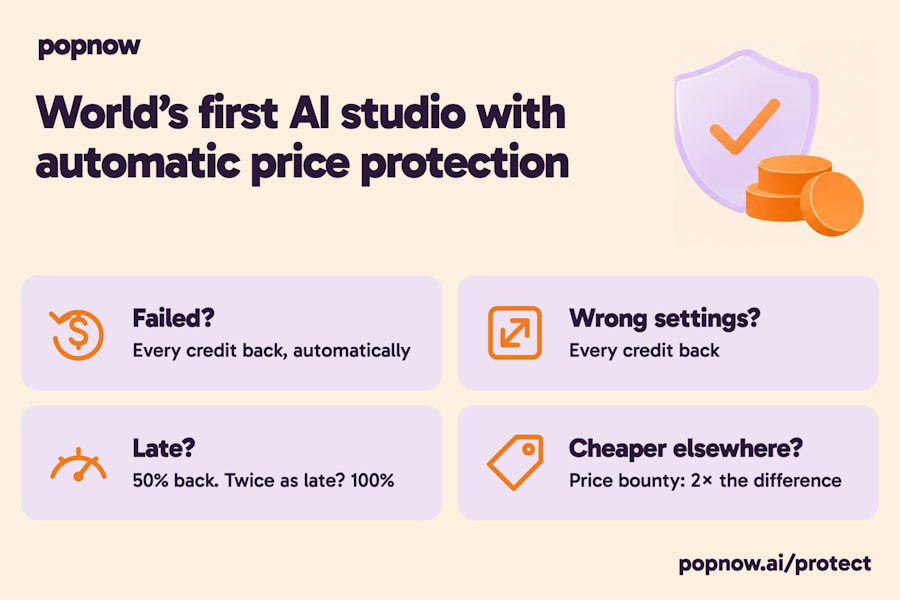
The commitment to protection involves four main promises:
- Failed run: every credit back, automatically, no limit.
- Wrong settings: if the resolution, aspect ratio, length, number of images or sound is not as picked, every credit is refunded. PopNow measures the file itself, so there’s no ticket to file.
- Late run: if a run takes longer than the guaranteed time shown before it starts, the user gets 50% back in reward credits, or 100% if it takes more than twice as long.
- Price bounty: the first person to show the same model with the same settings at a lower standard public price on Higgsfield, Runway or fal gets 2x the difference in reward credits, after review and within limits. PopNow then lowers its price or flags that setting.
The protections are focused on different issues, and not every unsuccessful experience is treated as the same problem. A failed run and a wrong resolution are both refunded in full, while a run that arrives after its guaranteed time earns reward credits.
The full Policy is available on PopNow Protect for creators.
A crucial component of this strategy is that users don’t have to buy an extra protection bundle. All generations are covered and will not require extra charges. This is protection as a matter of course and not a service that users have to think about turning on.
Why Technical Verification Matters for Developers and Creative Workflows
For developers, an AI-generated file can be just a part of the larger application or production workflow. It might be necessary to run it through editing software, content management systems or automated publication tools or services to make it useful.
Think about a developer who wants to develop an application which actually creates promotional videos. Each application may have a specific aspect ratio, time length, resolution and audio track requirements for social media.
When the application calls the generation function, if it returns a video with no sound or with the wrong length, the application will not be able to use the video. The developer will need to look into the problem, re-request or make a manual adjustment to the output.
This means extra work and can cause the workflow to be disrupted. If every time you try to fix the technical issue, you’re using up credits, it’s now also a monetary issue.
Automated verification can be a help in minimizing this friction. A platform can determine if the file delivered compared to the generation settings is compliant with the desired standards by making a comparison.
This can be very helpful for creators that create many assets within a single session. The uniformity of the technical requirements simplifies the file management, standardization of production and minimizes manual corrections.
The automated content pipeline, for instance, can create a number of videos based upon various models. All outputs should have the same technical specifications at the stage of moving to the next production stage. Automatic checking of these requirements can help to prevent a file from progressing further in the workflow if the file is not correct.
The way that PopNow does this is to link this type of technical responsibility to their credit protection policy. It adds to the billing relevance of the quality of delivery rather than basing on the completion of a generation.
Refunds, Reward Credits, and Transparent AI Pricing
Refunds and reward credits are both types of compensation but for different reasons. It’s crucial to know the difference when assessing the AI creative studio’s protective measures.
If the generation is qualifying, a full refund will be made of the credits invested in the generation. This is to take care of the case of a failed run and also when the delivered output doesn’t meet the technical requirements covered. The idea is to not allow users to lose credits on a generation which did not meet the delivery needs of the platform.
Reward credits do not work like this. They are credits, not cash, and they return value to be used on the platform. PopNow rewards some commitments of the service (late runs and the Price bounty) with reward credits.
This is important to developers and production tech creatives working on a production budget. A “refunded” generation brings back the credits used for that run, and reward credits add more value to be used in the platform for the future.
Transparency is also crucial prior to the start of a generation. Users should be aware of the model they’re using, the output settings, the time it takes for the delivery and the actual cost of generation. They should also be aware of the protection that applies in case of a problem, and how the compensation is applied.
Previously, users would have to guess what credit they would be using and the amount of the transactions. With PopNow, users can now see the exact price before they start a run. Together with generation protection, this establishes a better link between the price, delivery and compensation.
These specifics can impact the accuracy of teams’ cost estimation for projects, tracking of project iterations, and selection of appropriate tools for continuous workflows for professional users.
The Future of Accountable AI Generation
While AI generation technology is continually evolving, there are still some practical issues like technical errors and inconsistencies in the outputs. The more these tools are adopted to the professional workflow, the more a user will assess them based on more than just the model and how fast generation occurs.
Automatic verification is a feasible way to enhance experience. Platforms can compare the settings that users requested with the generated files, determine measurable differences, and qualify refunds without the users having to submit a support ticket for each technical problem they have.
There will be some restrictions. While automated checks can pick up on a wrong aspect ratio, missing audio track or inappropriate resolution; it’s not a reliable way to judge whether all creative outcomes are aesthetically pleasing. It is therefore important to have clear eligibility criteria to ensure that any delivery issues that are measured are not the result of a subjective dissatisfaction.
PopNow’s approach shows how an AI creative studio can link the verification of generations with a specific compensation approach. It addresses the issues of failed runs, mismatches in specification, late runs, and price comparisons.
The possibilities of AI creation in future should not be limited to access to the strong models. When a service fails to meet its stated expectations, it will be expected that those who developed or created it will receive the same treatment as if it had. AI suppliers which address these expectations can develop more trust in automated innovative production.
Frequently Asked Questions
Which AI platform refunds failed generations?
PopNow Protect automatically refunds credits for failed generations on PopNow AI. If the run fails and/or does not return a result, the credits are returned automatically, with no limit and no need to file a support ticket.
Does PopNow AI refund incorrect AI-generated videos?
Yes. PopNow verifies the output against the selected aspect ratio, duration, resolution, number of outputs and audio condition. Users get a full refund of credits if the result doesn’t match the settings they picked.
Does PopNow Protect cost extra?
No. PopNow Protect launched in November 2026 and covers all generations for free. A failed or off-spec run is fully refunded, while late runs and the Price bounty earn reward credits, not cash.

