

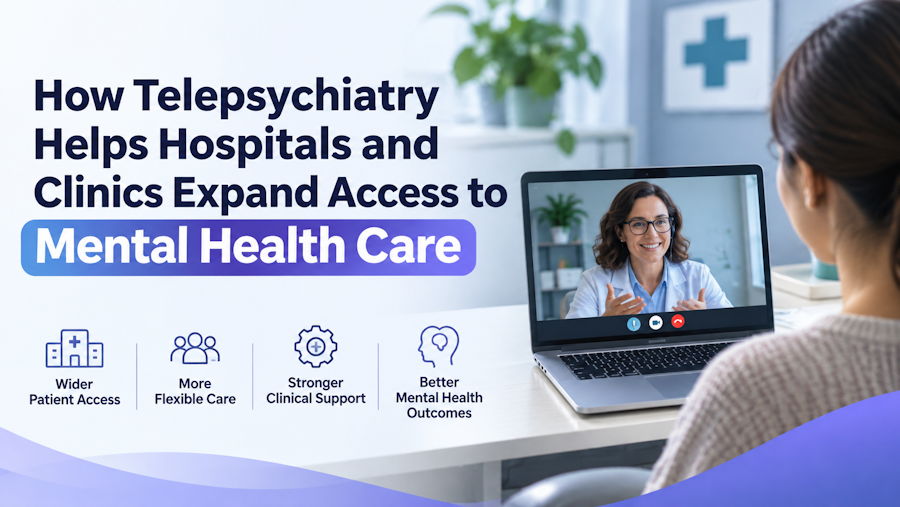
Access to quality psychiatric care remains a challenge for many hospitals, clinics, and substance use disorder treatment facilities. Recruiting and retaining qualified psychiatrists and psychiatric nurse practitioners can be expensive and time-consuming, particularly for healthcare organizations that need coverage beyond regular business hours. Telepsychiatry offers a flexible solution, allowing facilities to provide professional psychiatric services without the ongoing costs and commitments associated with maintaining a full-time in-house team.
What Is Telepsychiatry?
Telepsychiatry is the delivery of psychiatric services through secure video conferencing and other telemedicine technologies. It allows psychiatrists and psychiatric nurse practitioners to evaluate patients, provide consultations, manage treatment plans, and offer ongoing mental health support remotely.
For hospitals and clinics, this approach makes it possible to access qualified psychiatric professionals without requiring them to be physically present at the facility. It can be particularly valuable for rural hospitals, smaller healthcare organizations, and facilities that struggle to recruit specialists locally.
Telepsychiatry also provides greater flexibility in scheduling. Healthcare facilities can arrange psychiatric coverage during evenings, weekends, overnight hours, or other periods when maintaining permanent staff may not be practical.
Why Hospitals and Clinics Are Outsourcing Psychiatric Services
Hiring full-time psychiatrists and psychiatric nurse practitioners involves more than paying salaries. Healthcare organizations must also consider benefits, recruitment expenses, credentialing, scheduling, and the costs of maintaining adequate staffing levels.
For facilities with fluctuating patient volumes or limited psychiatric needs, these expenses can become difficult to justify.
Outsourcing psychiatric services offers an alternative. Rather than hiring permanent employees, hospitals and clinics can work with an experienced psychiatric staffing company to arrange coverage based on their actual needs.
Some of the key advantages include:
- Lower staffing costs: Facilities can avoid many of the expenses associated with recruiting and maintaining full-time psychiatric employees.
- Flexible coverage: Hospitals can arrange services for specific shifts, after-hours periods, weekends, or other coverage requirements.
- Access to specialists: Organizations can connect with qualified psychiatric professionals without limiting recruitment to their immediate geographic area.
- Reduced administrative burden: An established staffing partner can help coordinate provider placement and integration.
- Scalable services: Coverage can be adjusted as patient demand and facility requirements change.
This model allows healthcare organizations to direct their resources toward patient care while maintaining access to professional psychiatric services.
The Importance of After-Hours Psychiatric Coverage
Psychiatric needs do not follow a standard business schedule. Emergency departments, inpatient units, and substance use disorder facilities may need psychiatric evaluations and consultations during evenings, nights, weekends, and holidays.
However, maintaining a psychiatrist on-site around the clock can be financially impractical, particularly for smaller hospitals and facilities with limited patient volumes.
Outsourced telepsychiatry provides a practical way to address these coverage gaps. Facilities can arrange access to psychiatric professionals during the hours they need them without employing a permanent overnight or weekend staff member.
This flexibility is especially useful for organizations that want to improve access to psychiatric evaluations while controlling operational expenses.
How a Psychiatric Staffing Network Benefits Healthcare Facilities
One of the biggest challenges in psychiatric staffing is finding the right professional for each facility's specific requirements. Different organizations may need general psychiatric coverage, psychiatric nurse practitioners, or specialists with experience treating particular patient populations.
Working with a company that maintains an established psychiatry staffing network can simplify this process.
Rather than starting a new recruitment search every time a staffing need arises, healthcare organizations can access an existing network of qualified providers. This can help speed up provider selection, credentialing, and integration into an existing hospital medical staff, subject to facility requirements.
A well-developed network can also provide access to specialty psychiatrists who may otherwise be difficult to recruit locally.
For example, FasPsych is a psychiatric staffing company that helps hospitals, clinics, and substance use disorder treatment facilities access qualified psychiatric professionals through flexible staffing arrangements. Its services primarily focus on telemedicine psychiatry, while also offering on-site, in-person services when required.
Through its established provider network, FasPsych helps healthcare organizations find professionals who match their specific coverage requirements, making it easier to expand psychiatric services without committing to permanent full-time hires.
Choosing Between Telepsychiatry and On-Site Psychiatric Services
Remote psychiatric services are suitable for many healthcare settings, but they are not the only option. Some facilities require in-person consultations, specialized assessments, or providers who can work directly with patients and medical teams on-site.
The right approach depends on the facility's patient population, operational requirements, and available resources.
Telepsychiatry may be appropriate for:
- Routine psychiatric consultations and follow-up appointments.
- Evening, overnight, and weekend coverage.
- Facilities located in areas with limited access to psychiatric professionals.
- Organizations seeking more flexible staffing arrangements.
On-site psychiatric services may be preferable when:
- Direct in-person patient interaction is necessary.
- Facility operations require a physically present psychiatric professional.
- Certain assessments or treatment situations cannot be appropriately handled remotely.
Some healthcare organizations benefit from combining both approaches. A flexible staffing arrangement can provide remote coverage for routine needs while making in-person professionals available when required.
Finding the Right Telepsychiatry Staffing Partner
When evaluating a psychiatric staffing provider, hospitals and clinics should consider the company's provider network, experience, service flexibility, and ability to meet their specific coverage requirements.
A reliable partner should be able to help identify qualified psychiatrists and psychiatric nurse practitioners, coordinate provider placement, and support the integration process into the facility's existing medical staff.
Organizations should also evaluate whether the provider can accommodate after-hours coverage, specialty psychiatric needs, and changing patient volumes.
Working with an experienced provider such as FasPsych can help healthcare facilities access telepsychiatry services and flexible psychiatric staffing solutions without the financial and administrative commitments of building a full-time in-house team.
Conclusion
Hospitals, clinics, and substance use disorder facilities need reliable psychiatric coverage, but maintaining a full-time psychiatric department is not always the most practical solution. Outsourcing gives healthcare organizations another way to access qualified professionals while managing recruitment expenses, staffing flexibility, and after-hours coverage.
By working with an established psychiatric staffing company, facilities can access an existing network of psychiatrists and psychiatric nurse practitioners, including specialty providers, without having to build an entire team from scratch.
For healthcare organizations looking to expand mental health services, improve coverage, and control staffing costs, a flexible telepsychiatry and psychiatric staffing model can be a valuable long-term approach.

