

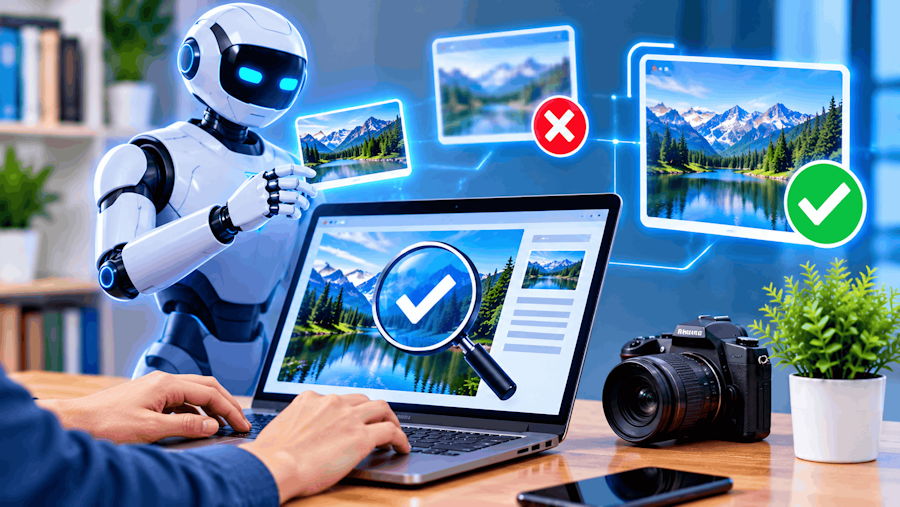
Not every photo we see online is authentic. Many of them are either fabricated, doctored, or misrepresented to mislead people and serve a malicious agenda. While billions of photos are published daily across social media, blogs, news websites, and other platforms, you can’t guarantee the authenticity of any of them until you are fully confident about the credibility of the publisher.
Fortunately, AI is here to help us. This advanced technology can contribute to the verification of online photos through various methods. The best part is they are easily usable for a diverse range of people, regardless of their professional backgrounds. This article explores a few AI-driven methods you can use to verify photos online.
Read on to learn more.
AI Making Photo Verification Easier
Here is a breakdown to help you understand how modern-day advanced technology is facilitating the authenticity verification of online images:
-
AI-powered Reverse Image Search
By far the easiest AI-driven method to verify online photos is photo finder. Leveraging AI, it works with neural networks to scan the actual content of visuals.
As soon as the search tool is fed the input, it prompts AI to scan various layers of photos to identify edges, shapes, objects, and individuals. Identified content is transformed into a unique numerical vector or embedding, which is used to find visually similar matches across the web.
It uses this embedding to retrieve results from various online platforms synchronously and display them. A user can easily browse results to spot the earliest online appearance, duplicate crops, or mismatched context for cross-verification and check out the authenticity of a photo within seconds.
-
Deepfakes Detection
AI is a double-edged sword, as it can be used to create deepfakes and synthetic images as well. Various editing tools can be used to swap faces of other featured items for misrepresentation of a captured scene. However, AI can also help you spot deepfakes.
An advanced AI image checker leverages specialized algorithms to evaluate frequency-level artifacts, unnatural details, and neural fingerprints specific to distinct models. This capability allows it to return a confidence score.
The final conclusion is based on the user’s interpretation. No detection tool is capable of returning a definitive answer in the form of a yes or no. You still need to rely on your opinion regarding the authenticity of a possibly suspicious, AI-generated image.
-
Error-Level Analysis
As mentioned earlier, many photos are strategically modified or altered to present a particular scenario in an entirely different way. Specialized tools to conduct ELA (error-level analysis) can be employed to identify such tampering or modification attempts.
While traditional tools are available for this purpose, they are not as good as AI-powered tools for performing ELA. They can easily spot spliced regions, detect cloning, and evaluate noise patterns to help you check if an image is modified or tampered.
You can use dedicated tools to inspect noise, clone, and sweeps across suspicious photos.
-
Metadata and Provenance Inspection
Many people would argue that Metadata or EXIF inspection is probably the oldest way to verify photos; what does AI have to do with it? They are actually right. Anyone can manually inspect metadata of any digital photo. However, AI does something else. It brings automation and scalability to the process.
AI will examine hidden file structures, including EXIF, or emerging cryptographic hardware signatures to retrieve details like:
- Capture date
- Camera model
- GPS coordinates
- Device Information
- Editing History
These details help you identify camera sensors and cross-verify images. The use of AI-powered provenance verification tools helps you quickly figure out inconsistencies in the provided Metadata. These tools quickly flag images upon identifying any inconsistencies. Additionally, AI can also combine visual analysis with external data sources to help you verify an image’s authenticity even when the EXIF data has been removed or altered.
Automated Location Verification Through Visual Analysis
AI is also capable of verifying where a photo was taken. It leverages computer vision to examine landmarks, buildings, natural features, signs, road layouts, and environmental details. Analysis of content featured in an image allows AI to map verified elements against a vast image database.
This process can help you determine whether a photo is actually captured at the claimed location because AI in the background compares previously available visual content of the claimed location and elements captured in a photo.
For instance, if an image is supposedly showing a recent event that happened in a particular city but the visible landmarks suggest an entirely different location, AI will flag the inconsistency on its own. This possibility plays a key role in fact-checking, news verification, disaster response, and open-source intelligence investigations (OSINT).
-
Verification Through Integrated Browser and Mobile Tools
The democratization of AI has made it accessible to everyone. It is no longer a luxury or an advanced tool for large-scale organizations. Average netizens can also use it easily to verify photos online without any hassle.
Integrated browser and mobile tools available as built-in features in various browsers and operating systems facilitate this process. All users need to do is right-click or tap on a particular photo to figure out if an image came from a real camera sensor or a generative model, thanks to AI working in the background.
Does AI Deserves the Credit?
AI, as an advanced technology, deserves all the credit for streamlining the photo verification process. Many people still question its key contributions. The answer lies in speed and scalability. AI can process a vast amount of data promptly.
Conversely, manual verification means spending hours or days browsing various websites, comparing distinct versions, evaluating details, and analyzing contextual evidence on its own. With AI at your disposal, you can scan large image databases, compare visual patterns, detect anomalies, generate similarity matches, and spot suspicious elements within seconds.
This unmatched speed enables organizations and even individuals to verify visual content more efficiently and respond faster to halt the spread of misinformation.
In the End
AI streamlines online photo verification with reverse image search, error-level analysis, deepfake detection, provenance inspection, automated location verification, and much more. The magic lies in its speed and scalability. Processes that took hours or days a couple of days ago are now possible within seconds or minutes at most, because AI has taken charge. So, if you want to verify images quickly, let AI handle the process to streamline it and avoid the stress!

