

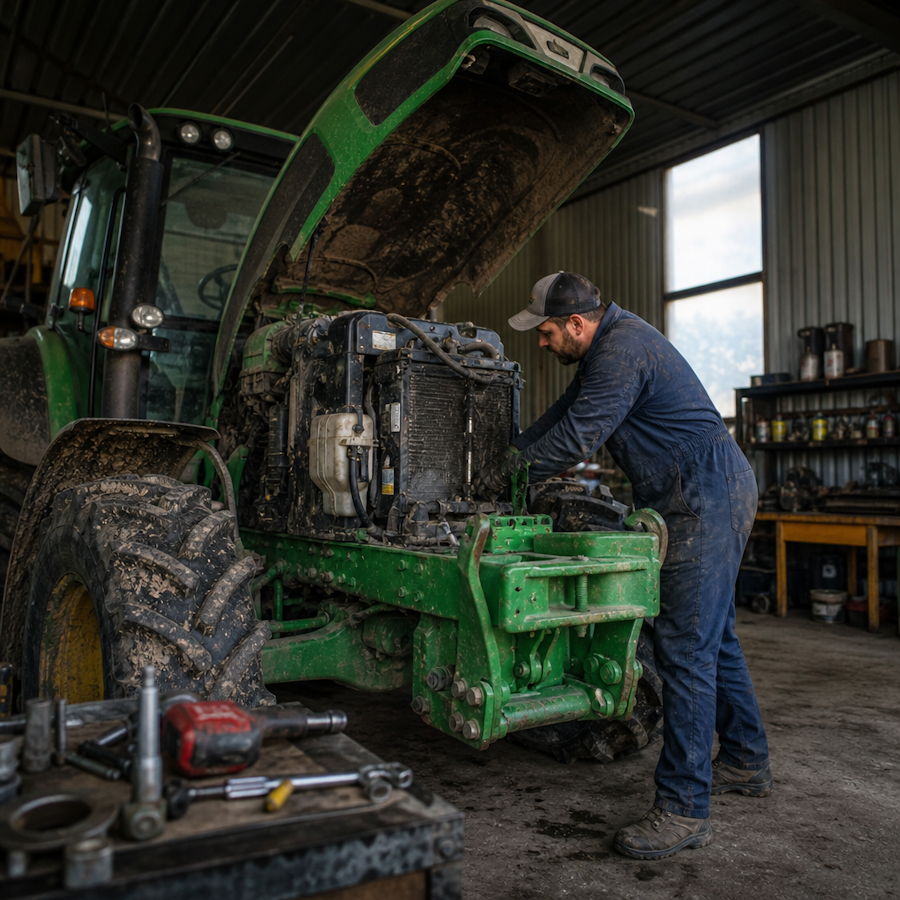
Most people shopping for a first tractor spend weeks comparing horsepower figures and about nine minutes thinking about filters, hydraulic fluid, and who will be answering the phone when a hose bursts in July. That ratio is backwards. The purchase is a single decision; maintenance is a decision you make every month for the next fifteen years. This piece is about the second part — how to choose a machine you can actually keep running, what a realistic service rhythm looks like, and how to tell a useful dealer relationship from a transactional one.
Size the machine to the job, not to the acreage
Acreage is a lazy proxy. Twenty acres of flat hay ground and twenty acres of wooded hillside with a half-mile of gravel drive demand completely different machines. Build your spec list from tasks instead:
- Loader work. Moving gravel, manure, round bales, or pallets of feed. This is where weight, hydraulic flow and lift capacity matter far more than engine horsepower.
- PTO work. Rotary cutters, tillers, post hole diggers, balers. Here you need rated PTO horsepower, not gross engine horsepower, and you need to know whether your implements expect 540 or 1000 RPM.
- Transport and three-point lift. Box blades, rear blades, sprayers. Lift capacity at the ball ends is the number that counts, and it's always lower than the headline figure.
- Clearance and footprint. A compact that fits through a 7-foot barn door and under low branches is worth more than a utility tractor that lives outside.
Compact tractors in the roughly 25–45 horsepower range cover an enormous amount of rural property work, and they're genuinely pleasant to operate for long stretches. Once you're pulling heavier tillage, running a baler, or doing daily loader cycles with dense material, utility-class machines in the 50–100 horsepower band start earning their keep. The honest trade-off: bigger tractors do more work per hour but cost more to feed, tire, and repair, and they compact soft ground faster.
Why hydraulics deserve a closer look than horsepower
If your days involve a front loader, hydraulics are the system you'll actually feel. Flow rate determines how fast the bucket curls and the boom rises; the number of rear remote valves determines which implements you can run at all; and relief pressure sets the ceiling on what the loader can hold. Two tractors with identical horsepower can be ten minutes-per-load apart in real work simply because one moves more fluid. When you demo a machine, load the bucket and cycle it repeatedly — not once, empty, on a sales lot.
The service rhythm that prevents expensive surprises
Tractor maintenance is mostly unglamorous repetition. Follow the hour intervals in your operator's manual rather than a generic schedule off a forum, but the shape of the year looks like this on most small operations:
- Every use. Walk-around: tire pressures, visible leaks, loose pins, grease points on the loader and three-point. Check engine oil and coolant before the first start of the day, not after.
- Every 50 hours or so. Grease everything the manual lists. Blow out the radiator screen and air filter pre-cleaner — chaff and cottonwood seed cause more overheating than actual cooling faults.
- Seasonally, before heavy use. Engine oil and filter, fuel filters, air filter inspection, battery terminals, lights and safety switches. Inspect hydraulic hoses for cracking at the crimps and chafe points where they cross the frame.
- Annually or at the manual's interval. Hydraulic and transmission fluid and filters, front axle fluid, coolant condition, belt and brake adjustment, wheel torque.
- End of season. Wash, grease, treat diesel for storage, put the battery on a tender, and store the machine with cylinders positioned per the manual so rams aren't sitting exposed all winter.
Two habits separate the people who get twenty years from a tractor from the people who get eight. First, keep an actual logbook — a notebook in the cab with date, hour meter and what you did. Second, fix small leaks immediately. A weeping hydraulic fitting is a cheap O-ring today and a contaminated system plus a pump next spring.
Parts: genuine, aftermarket, and the grey zone
Filters, seals, and anything in the hydraulic or fuel path are poor places to economize. Filtration micron ratings and bypass valve behavior vary between brands even when the canister looks identical, and modern diesel injection systems are unforgiving about fuel cleanliness. Genuine parts also carry the correct part-number lineage, which matters when a model has had mid-production revisions — the serial number on your machine is the only reliable way to order a bearing or a hose that actually fits.
Wear items with simple geometry — cutting edges, mower blades, tines, some bushings — are more forgiving, and reputable aftermarket versions are a legitimate choice. Where people get burned is in the middle: electrical sensors, pumps, and anything that interacts with an emissions system. There, the time lost to a part that almost works dwarfs the savings.
Working with a dealer instead of just buying from one
A dealership's real value shows up on the third year, not the first week. Ask before you buy: do you keep common filters and hoses on the shelf for this model? Do your technicians work on this line regularly? Can I get a parts lookup by serial number over the phone? A dealer with a stocked parts counter and a service shop in driving distance is worth more than a slightly cheaper machine four hours away. H&R Agri-Power is one example of that model — a farm and outdoor power equipment dealership with locations across Kentucky, Tennessee, Indiana and surrounding states, selling new and used equipment including Kubota tractors while backing it with genuine parts and repair service; their write-up on using Kubota tractor hydraulics for heavy-lift tasks is the kind of practical material worth reading before you spec a loader package. Whoever you buy from, the test is the same: can they get you a part and an answer in a day?
Fit the equipment plan into the rest of the operation
Equipment decisions rarely stand alone. Land access, water, storage buildings, insurance and labor all compete for the same budget, and a tractor bought at the expense of a dry shed is a tractor that depreciates faster. If you're early in the process of putting a farm together, the groundwork around what it actually takes to get established in county-level farming is a useful corrective to the fantasy of buying your way to productivity.
It's also worth watching where the machinery itself is heading. Research and extension groups have been testing drivetrains that pair diesel engines with electric assist, and reports on how a hybrid tractor combines efficiency and reliability suggest the next generation of machines may change fuel budgets more than horsepower charts. None of that changes the fundamentals today, but it's a reason to keep resale and parts availability in mind rather than assuming your current platform will be the standard forever.
The short version
Spec from tasks, not acres. Demo the hydraulics under load. Budget for filters, fluid and an annual service as a line item, not an emergency. Keep a logbook, chase small leaks, and order parts by serial number. Then pick a dealer whose parts counter and service bay you can reach in an afternoon — because that's the relationship that determines whether your tractor is an asset or a project.

