

Why AP Lang Essays Feel So Hard to Self-Assess
The AP English Language and Composition exam asks students to write three essays in one sitting, each in response to a different kind of prompt. Students often finish a practice essay with no clear sense of whether it would earn a 3, a 4 or a 5 out of 6. Teachers would love to give detailed feedback on every practice attempt, but with several classes preparing at once, there is rarely time to mark more than a few full essays per student. That gap between practice and feedback is exactly where many students stall, writing essay after essay without knowing what to change.
What an AP Lang Essay Grader Does Differently
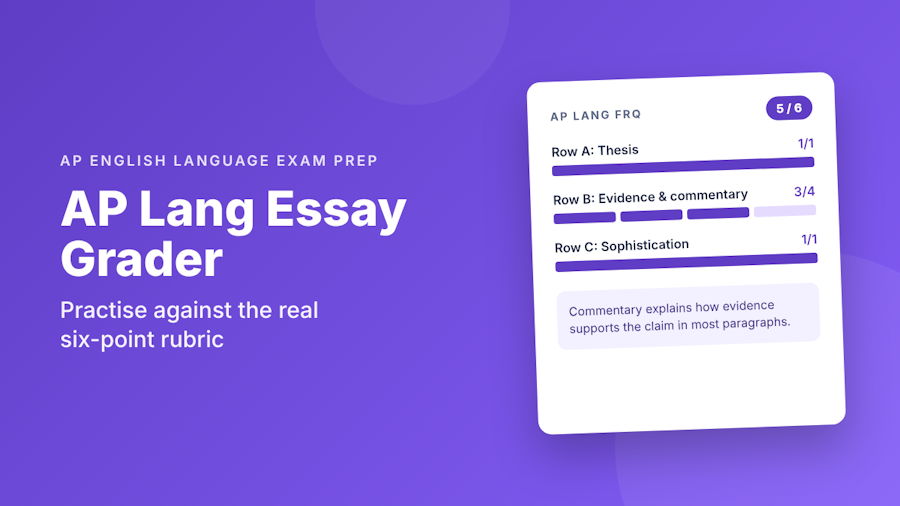
A general writing checker looks at grammar and style. An AP Lang essay grader is set up to assess a response the way the exam does, using the same analytic rubric that readers apply to every free-response essay. Instead of a vague overall impression, students receive a score for each row of the rubric with comments explaining why. That makes it possible to see whether a practice essay is losing points because the thesis is unclear, because the commentary is thin or because the response never reaches the sophistication point. Each of those problems needs a different fix, which is why the breakdown matters.
The Three Essays at a Glance
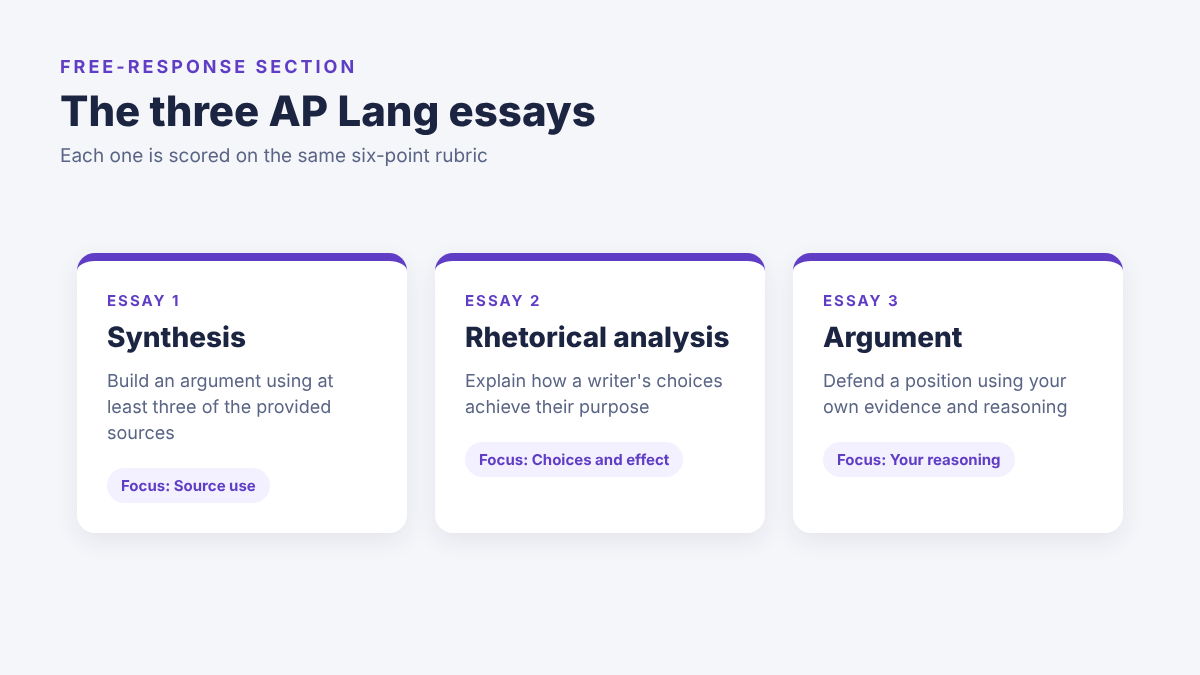
The free-response section includes three distinct tasks. The synthesis essay asks students to build an argument using at least three of the sources provided. The rhetorical analysis essay asks them to explain how a writer's choices work toward a purpose in a given passage. The argument essay asks them to take a position on an issue and defend it with their own evidence and reasoning. Each task tests a slightly different skill, but all three are scored on the same six-point structure, so practising with the rubric in mind helps across the whole section.
How the Six-Point Rubric Is Structured
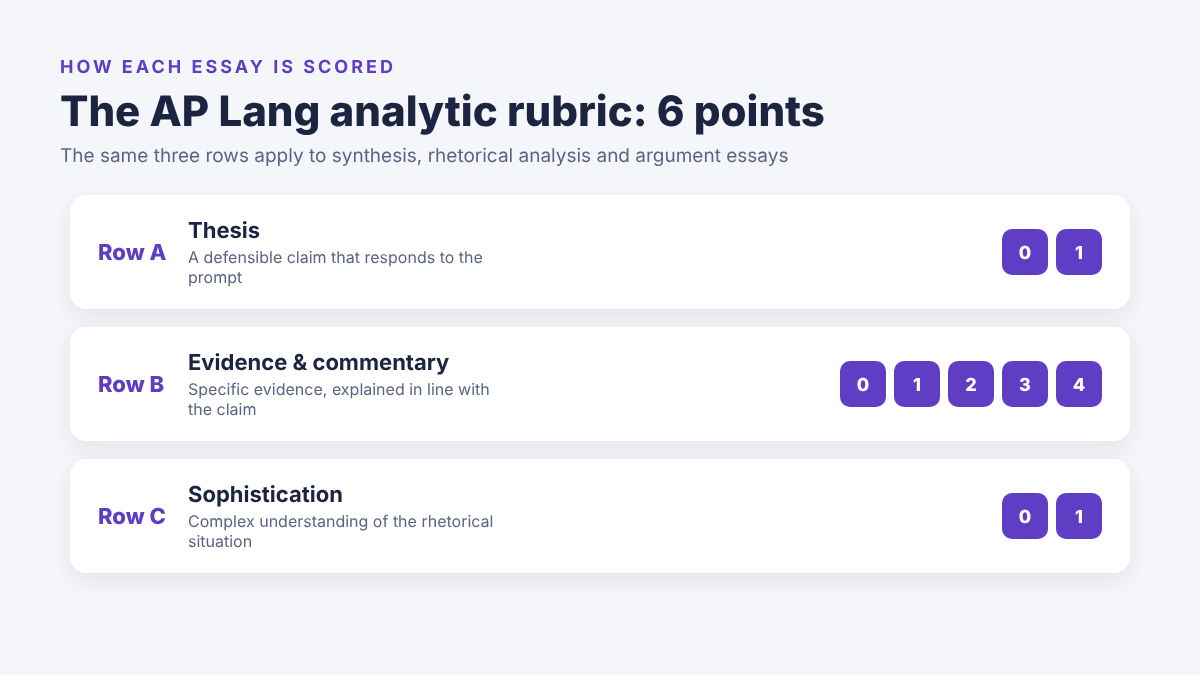
Every AP Lang essay is scored across three rows. Row A, worth one point, rewards a defensible thesis that responds to the prompt. Row B, worth up to four points, assesses evidence and commentary, meaning how well the essay supports its claims and explains how that support connects to the argument. Row C, worth one point, rewards sophistication of thought or a complex understanding of the rhetorical situation. Because Row B carries most of the points, it usually decides the difference between an average and a strong score, and it is where most feedback should focus.
Earning the Thesis Point Every Time
Row A is the most reliable point on the rubric, yet students still miss it, usually for one of two reasons. Either the thesis simply restates the prompt without taking a position, or it hides at the end of a long introduction where it is easy to overlook. A defensible thesis makes a claim that a reasonable reader could disagree with and responds directly to the task. Grading practice essays against Row A quickly shows whether a student's opening is doing that job. Once the habit is fixed, this point becomes close to automatic on exam day.
Where Most Points Are Won or Lost: Evidence and Commentary
Row B rewards two things working together. Evidence must be specific and relevant, whether it comes from the provided sources, the passage being analyzed or the student's own knowledge. Commentary must explain how that evidence supports the line of reasoning, rather than simply summarizing it. Many practice essays fall into a pattern of quote, summary, next quote, which earns limited credit. Feedback that marks each place where commentary is missing or repeats the evidence helps students see exactly where their reasoning needs to go deeper to move from two or three points to four.
Reaching for the Sophistication Point
Row C is the hardest point to earn and the one students understand least. It can be reached in several ways, such as explaining the significance of an argument within a broader context, recognizing complexities or tensions in the issue, or making consistently effective rhetorical choices in the student's own writing. It is not earned through vocabulary or a single clever sentence. Practice feedback is useful here because it can point out moments where an essay comes close, such as a paragraph that acknowledges a counterargument but does not explore it, and show how that moment could be developed across the response.
Common Mistakes in Synthesis Essays
Synthesis essays have their own pitfalls, and seeing them named in feedback helps students avoid them:
- Summarizing each source in turn instead of using sources to support a single argument
- Citing fewer than the required number of sources
- Letting the sources lead the essay rather than the student's own claim
- Quoting long passages without explaining their relevance
- Ignoring sources that complicate the argument instead of addressing them
Each of these patterns tends to limit the Row B score even when the writing itself is clear.
Common Mistakes in Rhetorical Analysis
The rhetorical analysis essay asks students to explain how a writer achieves a purpose, which is different from identifying devices. A frequent mistake is listing techniques such as imagery, repetition or appeals to emotion without explaining what each choice does for the writer's purpose and audience. Another is drifting into summary of the passage's content. Strong responses connect every choice to its effect on the audience and to the writer's larger goal. Grading feedback that flags device-spotting without analysis gives students a clear signal to shift from naming techniques to explaining their function.
Common Mistakes in Argument Essays
In the argument essay, students supply all of their own evidence, which creates different challenges. Some rely on broad generalizations instead of specific examples. Others choose examples that are interesting but only loosely connected to their claim. A third common issue is a line of reasoning that wanders, with each paragraph making a separate point rather than building toward a single position. Feedback that checks whether each example truly supports the thesis, and whether the paragraphs connect logically, helps students strengthen their Row B score and sometimes opens a path toward the sophistication point.
Managing Time Across Three Essays
The free-response section runs for two hours and fifteen minutes, including a fifteen-minute reading period, and students choose how to divide that time across the three essays. Running out of time on the final essay is one of the most common reasons for a disappointing score. Practising with a clear plan helps:
- Use the reading period to study the synthesis sources and mark useful lines
- Aim for roughly forty minutes per essay and keep an eye on the clock
- Spend the first few minutes of each essay writing a clear thesis and a short outline
- Prioritize commentary in body paragraphs over a long introduction
- Leave a couple of minutes at the end of each essay to check that the thesis is answered
Timed practice graded against the rubric shows whether rushed essays are losing points on commentary, which is usually the first thing to suffer under pressure.
Building a Weekly Practice Routine
Steady practice with feedback works better than cramming in the final weeks before the exam. A practical rhythm is to write one timed essay per week, rotating between the three types, then grade it against the rubric and spend a short session revising the weakest row. Students who want to follow this routine can use clasa.ai to grade practice responses against a six-point rubric and receive comments for each row. Keeping a simple log of row scores over several weeks also shows which essay type needs the most attention before test day.
How Teachers Can Use It Across a Class
For AP teachers, the biggest challenge is giving enough feedback on enough practice essays. A grader that follows the six-point rubric lets teachers return comments on every timed write rather than only on a few selected essays. Teachers can review results, adjust scores where their judgment differs and use the class-wide pattern of row scores to plan lessons. If most students are losing points on commentary, for example, the next lesson can focus on explaining evidence rather than finding it. That kind of targeted teaching is hard to plan without feedback on every essay.
Turning Practice Scores Into Exam-Day Confidence
The value of practising against the real rubric shows most clearly in the exam room. Students who have seen their essays scored row by row know what a defensible thesis looks like, how much commentary is enough and what kind of thinking might earn the sophistication point. That knowledge reduces the panic of a blank page and helps them manage time across all three essays. Practice with clear, consistent feedback does not guarantee a particular score, but it gives students a realistic picture of where they stand and a clear plan for closing the gap.

